Literature: Between “here” and “there”
Cinema: two mirrors for the nation
Theatre: Forced course to the East
Music: Foreign stars at the festival in Minsk and ours in the USA
Art: preservation and interpretation of Belarusian cultural heritage
Literature: Between “here” and “there”
This summer, we suffered a great loss for Belarus and Belarusian literature: (known under the pen name Eva Viežnaviec), the author of one of the strongest books of the last decade – the story “What Now, Mr. Wolf?” [Belarusian: “Pa Shto Idzesh, Voŭcha?”] – passed away. Sviatłana’s interviews and her meetings with readers, during which she spoke about things that were necessary and important for our society, are worth noting. On August 9, a book market dedicated to her memory was held in Warsaw. Also, in honour of Sviatłana, the Belarusian book community established the Eva Viežnaviec Prize for Belarusian women writers.
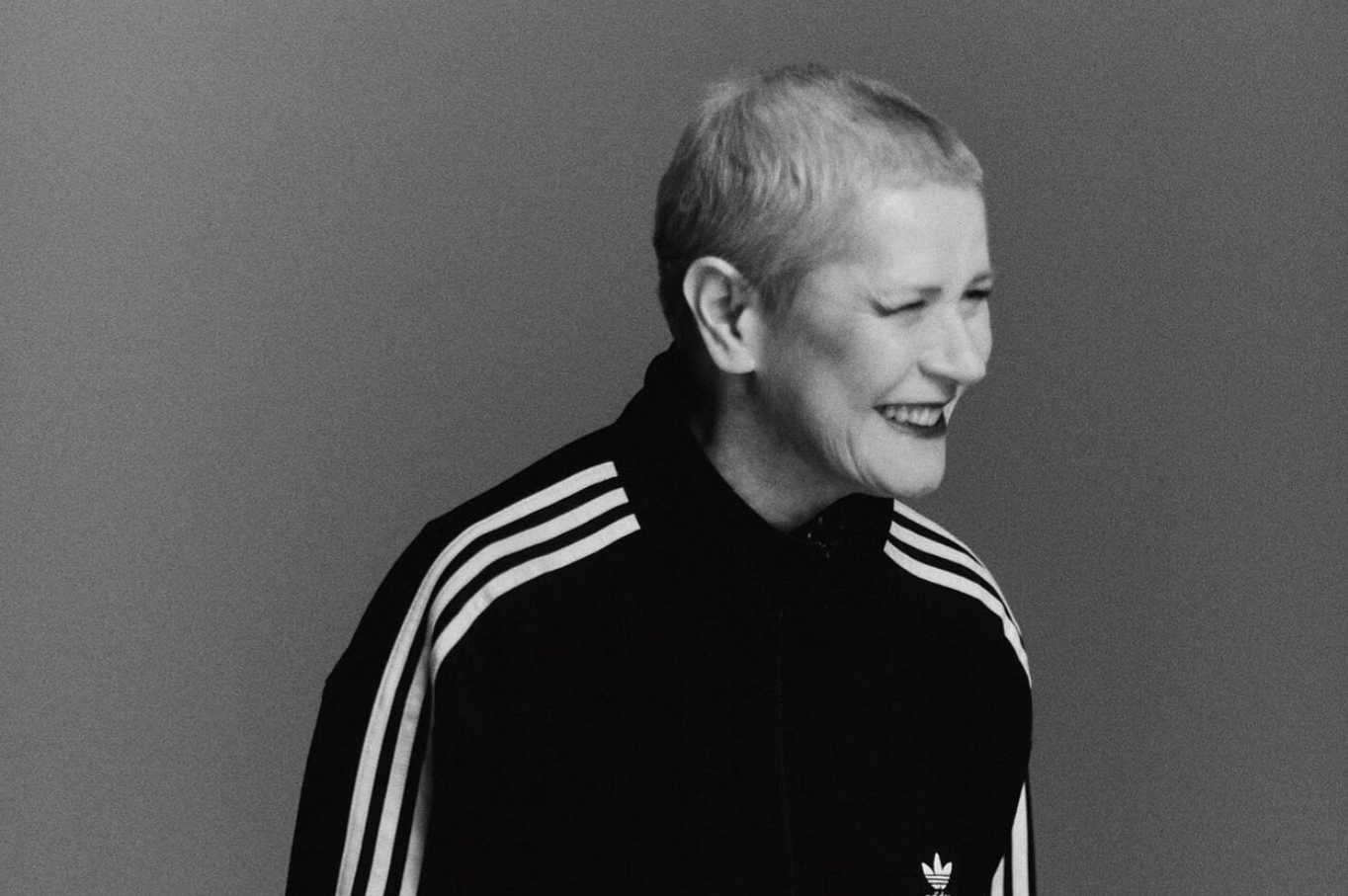
Sviatłana Kurs. Photo: Yauhen Kanapliou & Yuliya Leydzik.
Depth of underground passages
Belarusian publishing houses abroad published mainly essays and translations this summer. In September, an interview with literary critic Cichan Čarniakievič was published in “Nasha Niva”, which resonates quite strongly with our previous review. The expert notes that there are still not enough thorough fiction books about 2020-2022 and afterwards – for a true understanding of these events, a certain time distance and “completeness” of history are needed. So far, we have mainly autofiction and postfiction about the “times of trouble”, and the publishing houses “Mianie niama” and RozUM Media are actively working in these formats. Meanwhile, in September and at the end of August, two novels by the most famous Belarusian authors were published: “The Depth” [Belarusian: “Глыбіня”] by Viktar Marcinovič, who lives in Belarus and has the opportunity to observe what is happening inside the country, and “Underground Passages” [Belarusian: “Падземныя пераходы”] by Alhierd Bacharevič, written in exile and to a large extent about exile For both books, the important and painful theme is the division of Belarusian life into “here” and “there”.
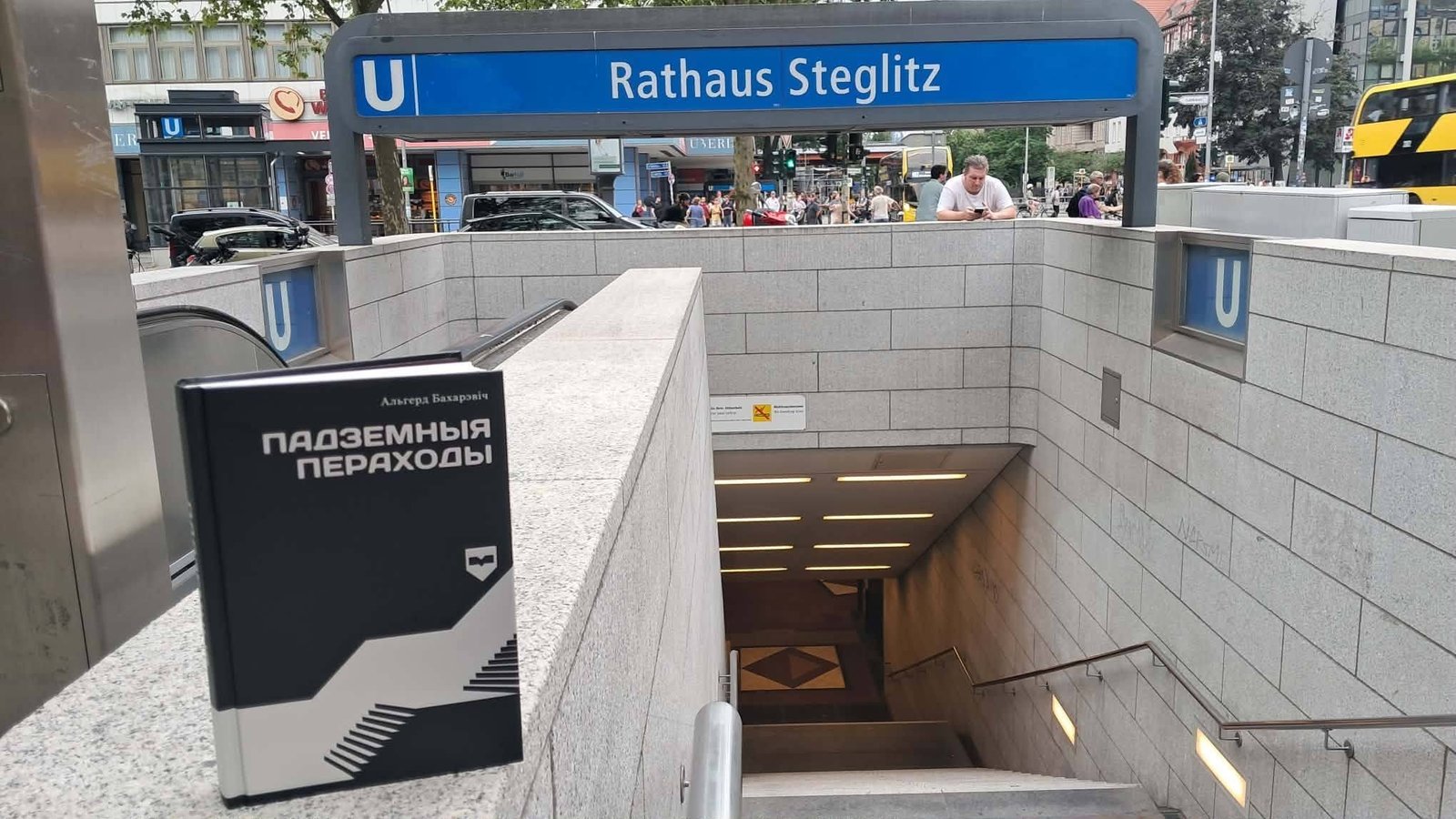
The new book by Alhierd Bacharevič, Underground Passages. Source: https://www.facebook.com/alhierd.bacharevic
Essays, translations and autofiction
More than ten independent publishing houses are now operating outside Belarus, and the Association of Belarusian Publishers was also created this year. Moreover, this archipelago is being joined by even smaller islands and reefs – publishing initiatives, as well as books published by authors completely independently, such as Nasta Rahatko’s “Carry It With You”, which has become a sensation in Facebook discussions. Recently, a collection of Rahatko’s short stories was translated into Belarusian (an announcement about this appeared on the website of the “Łohvinaŭ” publishing house). It is worth noting that social capital and the necessary PR skills of the author herself play a large role in the distribution of this book and in the strategy of “publishing without a publisher”.
“Mianie niama” can be congratulated on their first translation – the novel “Our luminous bodies” [French: “Nos corps lumineux”] by Belarusian-French writer Elena Glukhova. Siarhiej Šupa also translated the memoirs of Marc Chagall from Yiddish. Pre-orders are now available on the “Mianie niama” website, with the print run expected at the end of October. A striking autofiction work from the same publishing house was Jula Arciomava’s book “While I Was Choosing Words” [Russian: “Пока я искала слова”], and the “Pflaŭmbaŭm” publishing house sold a license for this author’s first book “I Am the Revolution” [Russian: “Я и есть революция”]. In July, it was published in German under the title “Ich bin die Revolution” by the Weimar publishing house “Mauke Verlag”, and the book was translated by Jacob Wunderwald.
That same summer, a translation of “The Dogs of Europe” into Polish by Joanna Bernatowicz was published. This edition was available in the main shop windows of Polish bookstores in September. The “Pflaŭmbaŭm” Publishing House also released Tania Arcimovič’s essay “The Gardener’s Manifesto” [Belarusian: “Маніфест гародніцы”]: a book about reinventing oneself and growing a garden “on the edge of the world and history”. London’s publishing house Skaryna Press released Simone de Beauvoir’s “A Very Easy Death” [French: “Une mort très douce”] in Belarusian, as well as the collection “Simone de Beauvoir and Belarus” – decolonialist and feminist essays by Uładzisłaŭ Harbacki about the complexities of the dialogue between Belarus and France. This year, the Warsaw-based Bukinist:ka Press publishing house released a collection of modern funny prose “Giggles and laughs” [Belarusian: “Хіханькі-хаханькі”], which was created within the framework of a writing laboratory organized by the “Расцяжэнне” [literally in English: “Stretching”] project. The Krakow-based Gutenberg Publisher released the bilingual poetry collection “Street of Charlatans” [Polish: “Ulica szarlatanów”] by Konstanty Ildefons Gałczyński (translated into Belarusian by Andrej Chadanovič) and the children’s book “Fox & Son Tailers” [Belarusian: “Ліс&Сын Хвастары”] by Paddy Donnelly, translated by Kasia Tyškievič. “Andrei Yanushkevich Publishing” pleased the audience with the long-awaited summer translation of “Dandelion Wine” by Ray Bradbury. No less long-awaited Lavon Barščeŭski’s translation of “The Odyssey” was published by the “Polackija labirynty” publishing house. This is a unique edition in which Lavon Barščeŭski prepared two translations – in prose and in hexameter – of one of the most important texts in world literature. The first translation of “The Odyssey” into Belarusian, made by Juljan Drejzin and Michaił Hramyka in the 1920s, is considered lost. A Belarusian translation of Adam Kirkor’s “Lithuanian Pictures” [Polish: “Obrazki Litewskie. Ze wspomnień tułacza Sobarri”] was also released: this was facilitated by the Belarusian Institute of Public History.
The most active this summer was the publishing house “Kamunikat”: “And it’s all in you. A collection of prison essays” by Mikoła Statkievič; the novel “Elza’s Return” by Alaksiej Dzikavicki; a collection of poems “#So that the pigeons don’t sh@t” [“#Каб не ср@лі галубы”] by Zmicier Dziadzienka; a reprint of “The Long Road Home” by Vasil Bykaŭ; “The Book of Obituaries”, prepared by researchers of the history of Belarusian emigration Natalla Hardzijenka and Lavon Jurevič; a translation of the book “The Stones Had to Be Thrown. The Obliterated Past of Podlasie” [Polish: “Kamienie musiały polecieć”] by Aneta Prymaka-Oniszk. In addition, the Kamunikat.shop bookstore opened in Białystok in September. This is the publishing house’s second offline bookstore, the first of which appeared in April in Warsaw.
In July, “Andrei Yanushkevich Publishing” and the bookstore “Knihauka” proposed creating a franchise of book clubs. The occasion was the release of the novel “Underground Passages”, which book club members could read even before the official presentation. However, unfortunately, this initiative was not fully implemented, and some book clubs received the novel just a few days before the presentation – perhaps the reason for this was the summer holidays of the printing houses. In any case, this is a useful idea that corresponds to the international trend for book clubs, which cannot but please. We wish “Knihauka” success in implementing this idea.
Autumn promises to be eventful. Ahead is the “Pradmova”, which this year covers venues in Wrocław, Vilnius, Prague and Warsaw, and the presentation of literary awards. We also wrote about the Angelus Literary Award in our previous review: it is worth noting that Uładzimir Arłoŭ’s book “Dances over the City” [Belarusian: “Танцы над горадам”] (translated by Bogdan Zadura) is in the finals, and you can vote for the publication on the award website
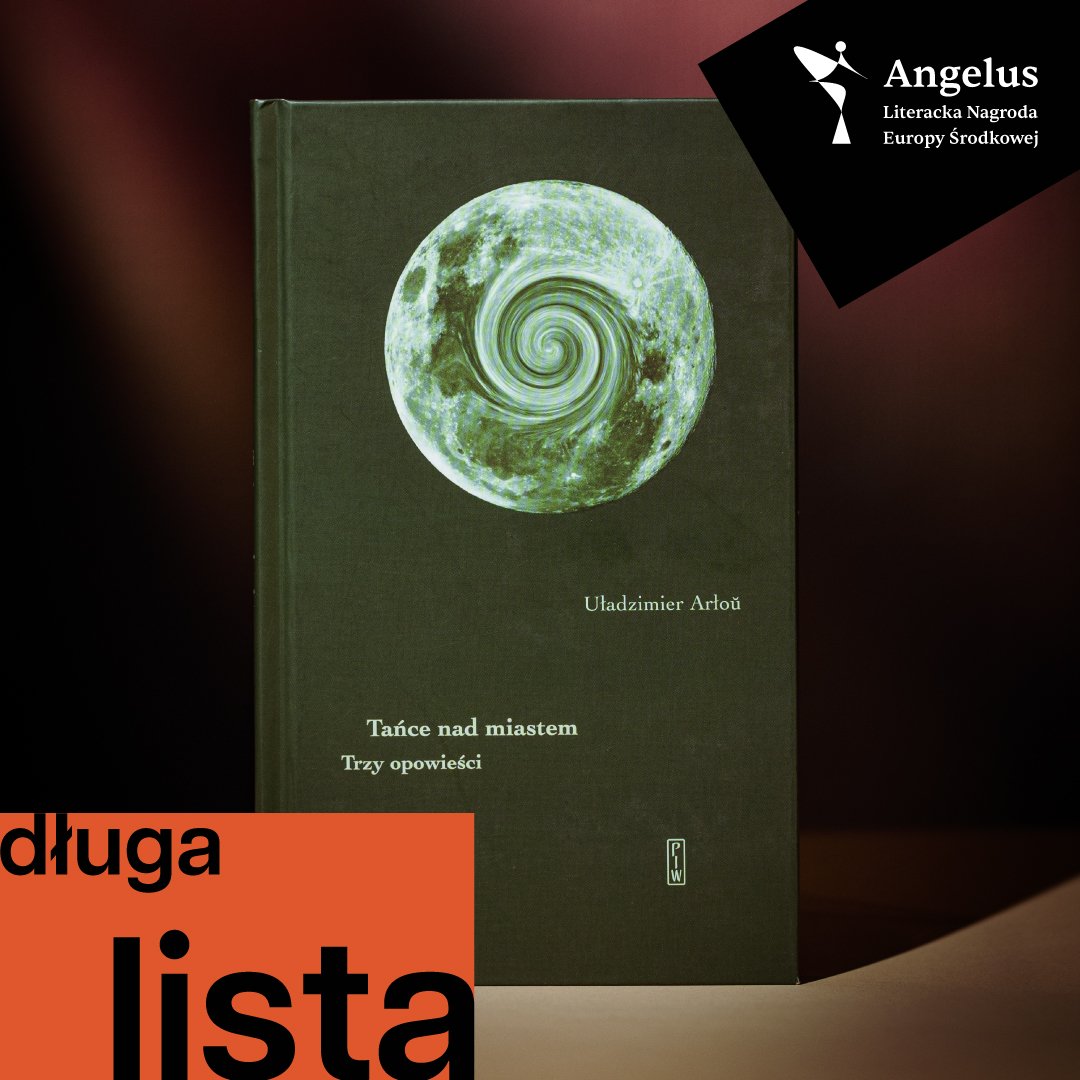
The book Dances Above the City by Uladzimir Arlou, translated into Polish, has been longlisted for the Angelus Central European Literature Award. Source: angelus.com.pl
Book festivals and new publications in Belarus
The publishing initiative “Polackaje Liada” released a collection of poetry by Viktar Slinka “Correspondence” [Belarusian: “Ліставанне”]. To mark the 90th anniversary of Hienadź Buraŭkin, the poet’s last book during his lifetime, “To talk your heart out to the stars” [Belarusian: “Нагаварыцца з зоркамі”], edited by Siarhiej Šapran, was republished. Siarhiej Šapran also published the book “Bykaŭ. [About] Art”, which contains more than 500 illustrations made by Vasil Bykaŭ. Meanwhile, the publishing house “Suvig” released an expanded reprint of Uładzimir Duboŭka’s novel-biography “The Circle” [“Круг”] written by Aleś Paškievič. We should also pay attention to the community of Belarusian science fiction writers “Shuflyadka”, which published a collection of young authors “Dirty Minsk” [Belarusian: “Нячысты Мінск”] a year ago, and this year presented the book “Doom and gloom in the surroundings” [Belarusian: “Хтонь за ваколіцай”].
One of the most interesting book events in Belarus is the “Revue” festival, which took place at the end of September in Minsk. The festival included lectures, master classes, a book market and Harry Potter film screenings. From September 4 to 25, the Jakub Kołas Library hosted the Day of Belarusian Writing exhibition, dedicated to the history of the handwritten and printed word. The main exhibition included materials that introduced modern research into the heritage of Belarusian religious and educational figures: Francysk Skaryna, Jeŭfrasińnia Połackaja, Simiaon Połacki, and Symon Budny.
On August 22, the traditional Kušliany Festival was held in Kušliany. In addition to a tour of the Francišak Bahuševič Museum, meetings with writers, and master classes, the festival announcement states that “the central music venue will feature traditional Belarusian instruments: the duda/bagpipe and the wheel lyre… And festival guests will also have the opportunity to master Belarusian traditional dances and hear folk songs”.
Inside Belarus, public independent reflection on the present is impossible, so those cultural events and books published in the country try to reflect upon history and the destinies of historical figures. It is also important to note that this is not the first time in the historical perspective that Belarusian culture has delved into ethnography in times of crisis: the fact that this is happening now is evidenced by the popularity of folk festivals, traditional dance groups, rituals, and folk crafts courses in modern Belarus. The duda/bagpipe and the wheel lyre are becoming partially “permitted” and at the same time hidden manifestations of identity.
And there is good news. Book publisher and translator Zmicier Kołas has been released from prison. He was among the 25 political prisoners who were taken to Vilnius on September 16 after their release.
Cinema: two mirrors for the nation
Belarusian cinema as a cultural phenomenon after the events of 2020 has actually been divided into two autonomous worlds that are developing in completely different dimensions: state cinema within the country, subject to censorship and ideological control, and independent cinema in exile, which is fighting for funding, the attention of the European audience, and the right to preserve its own identity.
The period from July to September 2026 once again testified: the gap between these two worlds is only widening.
Export of trauma and international triumph: The “Listy”/”Letters…” phenomenon
The main geopolitical and cultural event for Belarusian independent cinema in 2026 was the release of Andrej Kuciła’s full-length documentary “Listy”/”Letters…” (international title – “Letters from the Silenced Country”). The premiere of the film at the 83rd Venice Film Festival in the non-competitive Venice Open programme was a historic breakthrough. This is the first large-scale appearance of a new post-Soviet Belarusian author at one of the most influential festivals in the world. The importance of the event is also added by the fact that the Venice Film Festival is primarily intended for feature films. And a documentary by a Belarusian director here is a distinctive phenomenon in itself.
The success of Kuciła’s film, which received the prestigious Impact Golden Globes out-of-competition jury award for strong social impact in Venice, demonstrates the demand for Belarusian topics in the world through the prism of socio-political trauma. “Letters…” is a hybrid documentary-animation film built on the stories of political prisoners and their families (in particular, Vitold Ašurak, who died in prison, student Kasia Budźko, and former investigator Andrej Astapovič).
Andrej Kuciła, who has been living and working in Łódź, Poland since 2021, was creating this film together with an international team for the past five years in co-production with producers and companies from Poland, Lithuania and Germany. “Letters…” has, in fact, opened a new trend – Belarusian national cinema about Belarusians and Belarus after 2020. The use of animation and reading letters off-screen allowed the author to overcome the visual deficit (the impossibility of filming inside modern Belarusian prisons) and create a metaphor for the lack of freedom. Foreign critics saw not just a regional chronicle, but a universal warning in the film: the democratic world easily forgets those who suffered in the fight against tyranny.
Nevertheless, the film’s wide European distribution (thanks to the distributor Filmotor and the partnership with ZDF, Arte and Deutsche Welle) raises a difficult question for Belarusian creators: is our independent cinema capable of offering the world something other than reflection on its own pain and repression?
Another important case was that Andrej Kuciła’s film was selected for the programme of the influential documentary film festival IDFA in Amsterdam, which will be held from November 12 to 22 this year. For Andrej Kuciła, participation in IDFA will be the third in a row. In 2018, he received the festival’s award for best director for the film “SUMMA” in the medium-length film competition programme.
Projects and premieres
Another Belarusian premiere at the Venice Film Festival this year can be considered the out-of-competition screening of the new film Imperium by Baranavičy native and ethnic Belarusian Siarhiej Łaźnica. The director has been living in Germany since the beginning of the 2000s, but his work has been repeatedly connected with Belarus. “Imperium” is also a documentary, fully edited work of several European countries’ joint production. It is created o the basis of materials filmed in the USSR by foreign journalists in the 1970s.
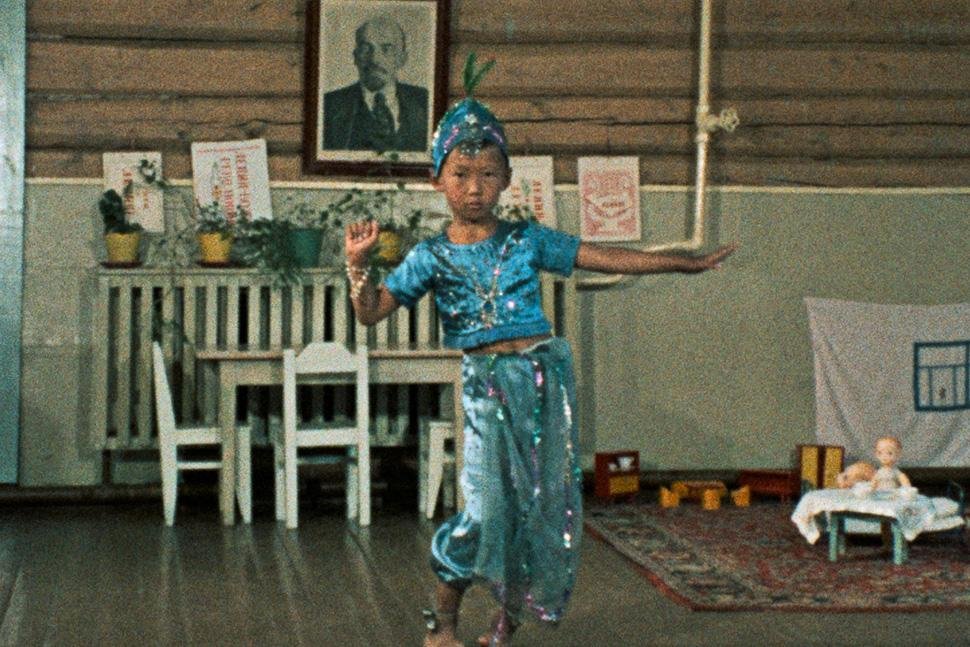
Belarusian Alexandra “Sasha” Kutsen won a special prize in the short film competition of the prestigious 51st Polish Film Festival in Gdynia (September 21-26) for her fourteen-minute film “Wszystkie miały na imię Anżelika” (“They Were All Named Anzhelika”). This is Alexandra Kutsen’s second film as a director and screenwriter.
Another significant event was the digital release of the documentary “Not Made for Politics” by Vola Čajkoŭskaja on the streaming platform HBO MAX. The platform also co-sponsored the project, and the film was released under the HBO Original label for the European region. The film tells several stories of female activists who became participants in the events of 2020. The world premiere of this film took place in the fall of 2025 at the Black Nights festival in Tallinn.
Apologist of hyper-authorial cinema and staff writer for AFISHA.RU, Mikita Łaŭrecki, has posted his new series “FILMTELEKT”/”Filmtelligence” online.
In the longer term, a number of works by feature film authors are in the pipeline.
Director Mara Tamkovič is working on the psychological drama “Northern Lights” about a Belarusian emigrant based on a script by Julija Pahrabniak. The project was included in the international MIDPOINT Feature Launch 2026, which took place on July 1–8 as part of the industrial programme of the Karlovy Vary Film Festival. The film is being co-produced by Finland, Poland and Croatia. The planned budget is two million three hundred thousand euros.
In parallel, the director is working on the film “Jestem jego matką” (“I am his mother”), where she acts as a director and screenwriter. The project was co-financed within the framework of the second session of the Polish Film Institute’s feature project development for 2026 and received assistance in the amount of PLN 200,000 (approximately EUR 46,000). The total budget of the project is PLN 334,000.
The creator of the drama “Crystal Swan” [Belarusian: “Крышталь”] Darja Žuk is working on a film adaptation of Taćciana Zamiroŭskaja’s prose “Exactly What It Seems” and the documentary “Our Breasts Are Our Weapons: The History of the Femen Movement”. Alaksiej Pałujan, supported by German and Polish film institutions, is developing two ambitious full-length projects “Heritage” and “Incubator”, dedicated to current events in Belarus and Ukraine. Andrej Kašpierski and Michaś Zuj received the Polish Film Institute funding for the full-length project “The Judgment of the Dead”. Documentary filmmaker Maksim Švied is raising funds for his new film “The Johnny Cosmic Effect” using crowdfunding.
Director Juryj Siamaška is looking for actors for his new film “Senseless People”, and his “The Swan Song of Fedor Ozerov” has finally received a full theatrical release in Lithuania.
Identity preservation technologies
Alongside the Belarusian festival’s stellar achievements, a process of systematic emergence of alternative venues is taking place abroad. An example of this is the second silent film festival “Silent Fever” (curated by film critic Irena Kaciałovič), which took place in September 2026 in Warsaw at the Free Belarus Museum
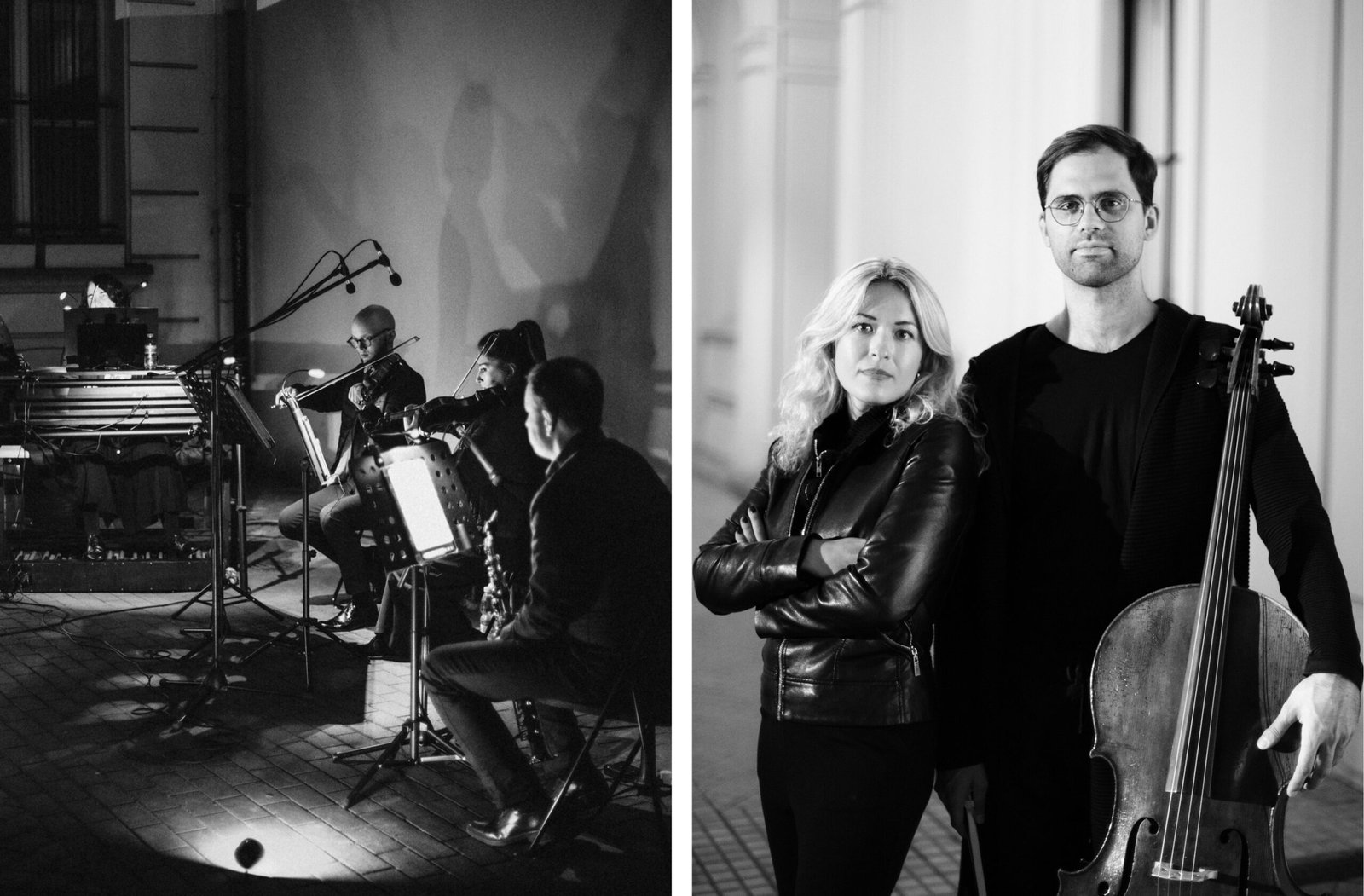
Source: www.instagram.com/niema_goraczka
This initiative is important from the point of view of cultural integration and historical continuity. Screenings of classic world masterpieces of silent cinema (“The Cameraman” by Buster Keaton, “The Passion of Joan of Arc” by Carl Theodor Dreyer, “The Cabinet of Dr. Caligari” by Robert Wiene) accompanied by live music by Belarusian and Polish composers (Kanstancin Haračy, Kanstancin Jaśkoŭ, Volha Padhajskaja and Alaksandra Chmialeŭskaja) perform the function of “building bridges”.
A major symbolic step was the inclusion of the Soviet Belarusian film “The Trial Must Continue” by Jafim Dzihan and Barys Šrejbier (1930, “Belgoskino”) in the programme. This is an independent critics and curators’ attempt to rethink and return the Belarusian heritage to a modern context, because that heritage today is often presented either distortedly or ignored within Belarus itself. Even the technical challenges of the festival – the need to install a real organ in the courtyard on Foksal Street and the struggle with the September rains – emphasize the “feverish” but lively nature of the existence of culture in exile.
Another important direction are projects such as the programme “Our Cinema”[Belarusian: “Наша кіно”] from the Belarus Tomorrow streaming platform. The analysis of such iconic films as “Crystal Swan” [Belarusian: “Крышталь”] by Darja Žuk and “Kastus Kalinovskiy” [a.k.a. “Konstanty Kalinowski”] by Vladimir Gardin testifies to the formation of an expert discourse that attempts to understand the history of Belarus through the language of cinema.
The international scientific community is also trying to analyze our cinema with the help of Belarusian researchers. The German academic journal “Apparatus”, dedicated to cinema, media and digital cultures of Eastern, Central and South-Eastern Europe, has published an issue focusing on Belarusian cinema and the protests of 2020 – Belarusian Cinema and the Protests of 2020: Cinema in Exile. The issue includes articles, interviews, reviews and studies on Belarusian cinema in conditions of exile, censorship and political change.
Degradation of institutions and ideological deadlock
Against this background, the processes within the official cinema of Belarus are showing signs of a deep systemic crisis and creative impotence. The passing of an era of outstanding masters is emphasized by physical losses.
On July 23, documentary filmmaker Juryj Chaščavacki died – he is the author of the cult film-pamphlet “Ordinary President”, among many other works. On September 20, the legendary camerawoman of “Belarusfilm” Taćciana Łohinava, who shot such famous films as “King Stakh’s Wild Hunt”, “Wreath of Sonnets”, “The Black Castle Alshanski” and “Sign of Trouble”, passed away. The modern state film production system is not capable of replacing deceased creators of such a scale.
The final transformation of the Belarusfilm film studio into an instrument of direct television propaganda is taking place. The launch of a documentary about Belarusian teachers under the direction of Natalla Ždanovič, a director of the ONT TV channel known for her ideological shows (“Markov. Nothing Personal”, “Propaganda”), is a vivid confirmation of this. State cinema no longer tries to be art – it performs the function of a state order to form loyalty.
Another striking example is the start of filming for the series “The Officer’s Word” about the Belarusian police, conceptually similar to the Soviet ideological series of the 1970s “Born by the Revolution”. The director of the project, Ahata Macko, is filming based on a script by Valancin Załužny. The film is being created “in cooperation with the Ministry of Culture and the Ministry of Internal Affairs”. Paradoxically, even within such a rigid framework, state structures demonstrate inefficiency. Even among loyal authors, there is a shortage of high-quality ideas that can satisfy the requests of ministerial officials. The jury meeting of the Ministry of Culture for the script competition for the 110th anniversary of the Armed Forces of the Republic of Belarus ended with the fact that, despite the presence of 19 applications, the winner was not determined at all. Three scripts were sent for revision until October 2026.
Another competition organized by the National Film Studio ended with the victory of Alaksandra Šyšova and her script “In the Footsteps of the White Lightning”. The latter and three other scripts, it is stated, “received recommendations for further development” and have a chance of being accepted for production in 2027-2028.
The only alternative within the country remains grassroots amateur cinema, which exists in defiance of the system. A striking example is the appearance on the Internet of Andrej Jahoraŭ’ micro-budget horror film “Echo”. In early 2026, the film even had a limited release in Minsk, which shows that the desire to create cinema in Belarus is still alive.
Meanwhile, any public, non-state initiatives in the field of cinema and their participants are subject to repression and persecution. On July 22, in Minsk, the apartment of the director and founder of the private film initiative “Kinocollider” and the project “Chronotop” Andrej Kudzinienka was raided by KGB and OMON riot police officers. Andrej Kudzinienka was subjected to continuous interrogation for many hours, and his apartment and the office of “Kinocollider” were searched. The director was accused of “extremism” and several criminal offenses. As a result, Andrej Kudzinienka managed to leave Belarus, and his initiative “Kinocollider”, within which there was a film school, lectures and film screenings, ceased its work.
In an atmosphere of total terror, the public activities of organizers of film screenings and festivals of independent cinema in Belarus became virtually impossible.
Old addiction
Belarus’ industrial dependence on the Russian Federation is not decreasing. In addition to the high employment of Belarusians in Russian film production and filming in the country, it also extends to film distribution. It was precisely because of the postponement of pirated release dates in Russia that the release of the world blockbusters “The Odyssey” by Christopher Nolan and the film “Spider-Man: Into the Spider-Verse”, which Belarusian distributors were counting on for box office success this year, was delayed on Belarusian cinema screens. In order to comply with censorship in the Russian Federation, Russian distributors also made rough cuts in the copy of the latter film.
Meanwhile, not all Russian-made films appeal to Belarusian cinemagoers. Unlike viewers in the Russian Federation, Belarusians prefer Hollywood repertoire first and foremost. And not all Russian box office hits are released in Belarus at all.
Even the authorities are concerned about the predominance of Russian-made films in the repertoire. In mid-September, a session entitled “Mechanisms for Creating a Unified Cinema Space of the CIS Countries” was held within the framework of the “XII St. Petersburg International Forum of United Cultures”. The representative of Belarus, Deputy Minister of Culture of the Republic of Belarus Siarhiej Sarakač, in his speech at the forum, proposed “to move from separate co-productions to a system of mutual distribution”. As one of the mechanisms for expanding cooperation, Siarhiej Sarakač proposed “the parity principle: a certain number of screenings for films from the partner country in exchange for a comparable volume of screenings of its own cinema”.
Conclusions and perspectives
- The loss of the state’s monopoly on the “Belarus” brand. The success of independent authors at venues such as the Venice Film Festival finally solidifies the status of foreign creative communities as the main presenters of Belarusian film culture in the world. Official Minsk is losing the opportunity to influence the international agenda through cinema.
- The problem of “short breath” of reflection. Independent cinema is still holding on to the resource of trauma (the events of 2020 and their consequences). Director Andrej Kuciła rightly notes that making predictions or constantly participating in discussions about the future is a futile task – one must “accumulate experience and get educated”. The main challenge for emigration is to move from documenting pain to creating new meanings and broad artistic forms.
- Ideological burnout within the country. Bureaucratization and censorship have led to the state apparatus facing a personnel and creative famine. Belarusfilm and a few private studios are turning into producers of short-term content that will not remain in the history of art.
Belarusian cinema in 2026 proves: art can exist in conditions of censorship and financial restrictions, but the price of this existence is the complete rupture of a single cultural space. The nation has received two different mirrors: one is trying to record the tragedy of the human spirit in captivity, the other is constructing an artificial ideological picture.
Theatre: Forced course to the East
It is becoming increasingly difficult to find Belarusian in Belarus. Domestic playwrights are rarely allowed on stage. Even in Belarusian-speaking theatre groups, they try to push productions in Russian. And globally, the entire theatre, under the conditions of the semi-Iron Curtain, is forced to look exclusively to the East. What this results in practice is in our next review.
Russian – repertoire and language
In early autumn 2026, the RTBD hosted a week of modern Belarusian drama “Concentration”, organized by the Centre for Belarusian Drama. In addition to several repertoire performances, stage readings of three plays took place within its framework: “Ma-Sin-Sin” by Ułada Alchoŭskaja (a story about and for teenagers), “Why it is important” by Julija Mleva (a story in which women try to overcome loneliness) and “Samson behind the door” by Alaksandr Savucha (an absurdist text about a moose who started talking). The two latter plays were written last year during the XIV International Drama Laboratory of the CBD. This, by the way, is a rare example of how modern domestic plays are eventually embodied on stage. Let alone in the format of stage reading. Also in the format of the Week before the performance of the play “Boor” [Belarusian: “Хам“], a lecture “Belarusian Dramaturgy of the 20th Century and Eliza Ažeška” was held, which was read by theatre scholars Anastasija Vasilevič and Jaŭhienija Bačyła – another rare example of what should be the norm.
The promotion of domestic creators is especially significant against the background of processes in other theatres. For example, the New Drama Theatre announced the production of “Demons” by Fyodor Dostoevsky, which is positioned as an “immersive” performance. Other premieres include a fairy tale by Valentin Kataev, a play by Nadezhda Ptushkina, and an interpretation of Lermontov’s “A Hero of Our Time”. As you might have guessed, all the authors are from Russia.
Most other collectives have a similar or close repertoire policy. For example, the Hrodna Drama Theatre has announced the premiere of the play “Denis Davydov. A Story about Hrodna”. Although this Russian poet has a very indirect connection to the city: Davydov’s detachment captured it at the end of 1812 during the war with Napoleon. Thus, the tradition of glorifying foreign heroes and introducing them to the domestic “iconostasis” continues. Of the other premieres, “Zemfira’s Night” based on Alexander Pushkin’s “The Gypsies” is again related to Russian material (however, the title is quite clickbait, as it evokes associations with a popular Russian singer). Interestingly, the staging was created by an unnamed domestic playwright. Thus, the theatre knows about his existence, but is in no hurry to stage his own play. It is symbolic that the only director on staff is Alina Sorokina from Russia.
However, there is no need to have any illusions: our compatriots also neglect their own – both Belarusian material and language. For example, the RTBD, along with the production of one of Ivan Šamiakin’s works (in the version of the Russian Yuri Pakhomov), announced a performance in Russian – “Little Tragedies” based on the work of the same name by the ubiquitous Pushkin. The theatre’s director Sviatłana Navumienka will stage it in December 2026. Last year, she named “Boys’ Stories” by the Russian writer and propagandist Zakhar Prilepin as the intended premiere. Fortunately, that attempt did not come to fruition. But the persistent director still achieved her goal. On the sidelines, it was mentioned that she had tried to stage a Russian-language performance in this collective even when she was not in a managerial position. Therefore, it is quite possible that the idea was not imposed from above. We assume that it was Navumienka who promoted it: either to curry favour, or to earn more from tickets, or hoping for a tour in Russia, or maybe all of that together. Although the successful tour of the play “Evening” in China shows that a language that is incomprehensible to foreign audiences is not a problem.
Now, out of 28 professional domestic theatres, the Janka Kupała National Academic Theatre, the Jakub Kołas National Academic Drama Theatre and the RTBD work exclusively in their native language. In addition, the Viciebsk “Lalka” has most of its performances in Belarusian. After the implementation of Navumienka’s idea, only two exclusively Belarusian-speaking theatre groups will remain. And then – here it is, a terrible irony – the Janka Kupała National Academic Theatre with its Russian actors will be one of the guardians of the Belarusian language.
The Janka Kupała Theatre new course?
Meanwhile, the oldest domestic collective also (as in the RTBD) turned to Šamiakin’s work: the premiere of the play “Heart in the Palm” based on t e author’s novel of the same name (directed by Dźmitryj Akimaŭ) was scheduled for early October. This writer had not been mentioned in the theatre for a long time, so the simultaneous appeal to him on two stages at once is hardly accidental. Naturally, in conditions when modern drama is systematically ignored, the choice of material is not too large. However, Šamiakin’s plays did not become an artistic success, while his prose is a classic example of socialist realism.
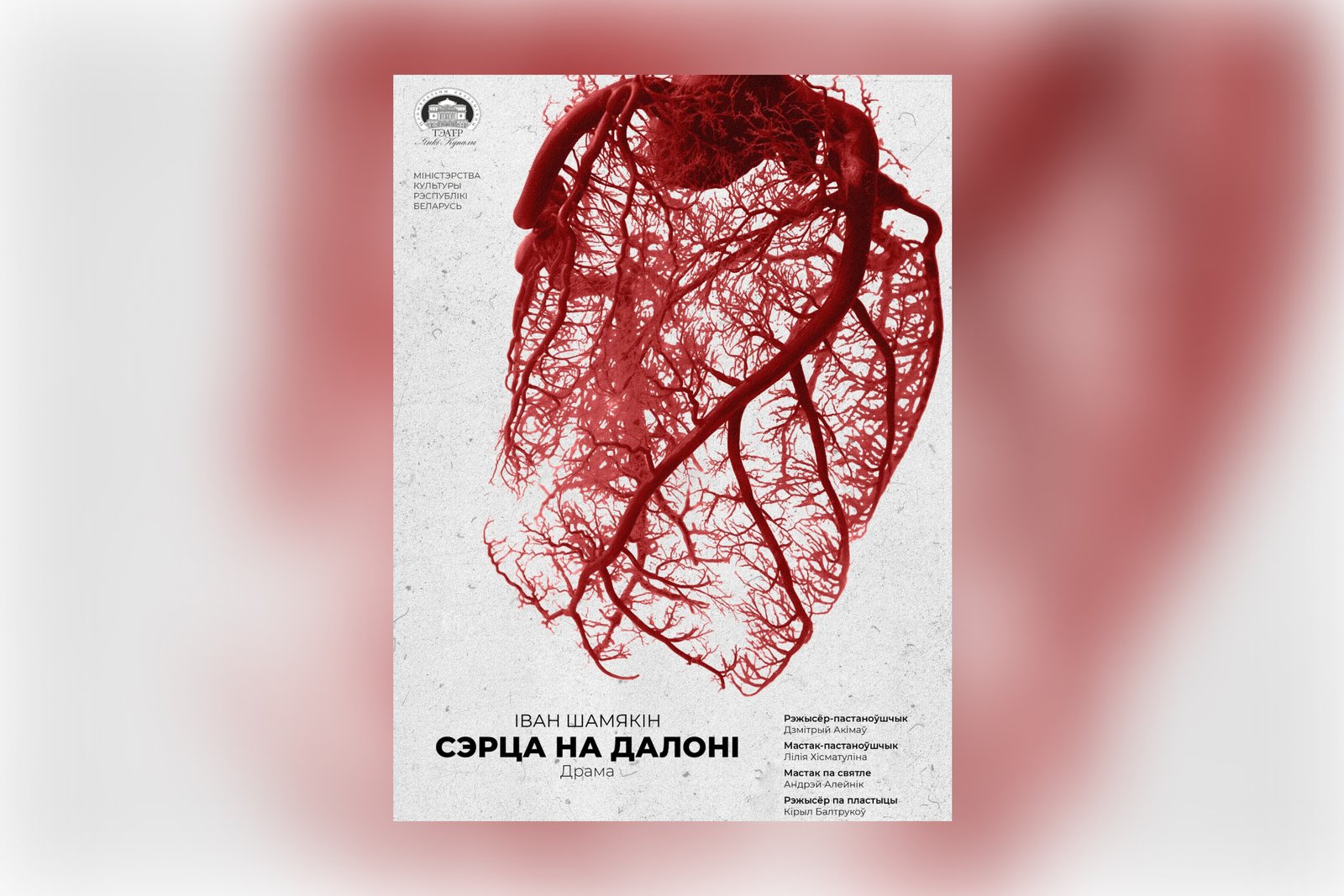
Poster for the Kupalauski Theatre’s production Heart in the Palm. Source: kupalauski.by
In general, with the arrival of Akimaŭ in the Janka Kupała Theatre (he became artistic director in March 2026), the team has become much more active and noticeable. One of the proofs of the latter is the project “Kupała. Laboratory”, within the framework of which three Russian directors prepared performances based on the works of Belarusian classics (this is far from the only example of funding from the Russian Federation: domestic theatres travel to Russia under the “Big Tour” programme). However, it also, apparently, faced censorship. It was originally planned that on August 30 the theatre would show three sketches: based on “Mudramer” [Belarusian: “Мудрамер”] by Mikałaj Matukoŭski, “The Ruined Nest” [Belarusian: “Раскіданае гняздо”] by Janka Kupała and “The Devil and the Woman” [Belarusian: “Чорт і баба”] by Francišak Alachnovič. However, on that day, the Janka Kupała Theatre announced the cancellation of the latter show with the wording “our sketch requires additional dramaturgical refinement”. However, it was about a play that had been written a long time ago. Obviously, if there were any problems, they would have been noticed before that. Let’s not forget that the name of Alachnovič – a victim of Stalinist repressions – was banned for a long time. As a result, the mention of the sketch based on Alachnovič’s work was removed from the “Zvyazda” website. The text of “SB. Belarus segodnya” with the mention of the three sketches was removed altogether, now it is only available in the web-archive. Therefore, we assume that there was intervention from above at the last moment.
There is money to invite new actors from abroad. Among others, the Janka Kupała Theatre was joined by Kristina Andreeva, who until now worked at the Russian Kazan Theatre. Apparently, she does not speak the Belarusian language in which the performances are shown. At least, she has not lived in our country before, she has not spoken about her roots or any connections with it. Nevertheless, she is 30 years old, and this is the age category that the troupe really needs. There are plenty of young, inexperienced actors from the Academy of Arts, there are mature creators (those who remained in 2020), but there is an extreme shortage of middle-aged performers – none of the actors with the name have joined the Janka Kupała Theatre in recent years. Therefore, they turn a blind eye to their not knowing the Belarusian language.
Meanwhile, real Janka Kupała Theatre actors who have a refined command of the Belarusian language continue to pass away. In August, actor Mikałaj Kučyc died at the age of 73, and in June, Ivan Kušniaruk, who was only 34. Taking into account the previously deceased Hieorhij Malaŭski, three actors will never return to their native stage. Andreeva’s invitation looks even more cynical against the background of the personnel shortage that regional theatre groups are facing. For example, the Homieĺ Drama Theatre announced a search for actors. “Relevant education is welcome, but the most important thing is your abilities and desire”, the announcement says. This caused an emotional reaction in the press, but in fact, such a problem has been faced since at least the 2010s. Poor funding does not attract newcomers to the stage, and the level of education is not inspiring. For example, at the Faculty of Cinema, Theatre and Television of the Academy of Arts, there is now no practice of studying with masters in special courses. We are talking about a basic element of Soviet and post-Soviet education. Naturally, this is not the best practice and not the ultimate truth, but no one offers an alternative to it.
Puppets over the Nioman, Minsk and beyond
The puppet theatre has traditionally been in the spotlight lately. The fifth festival “Puppets over the Nioman” w s held in Hrodna. This year, performances from Belarus, Russia (including Tatarstan and Dagestan), Uzbekistan and China took part in it. The latter brought a marionette theatre. In conditions when the capital’s forum of puppet theatres is actually paused, the Hrodna puppet theatre remains the only one of its kind in Belarus. In many ways, it relies on the personality of the theatre’s artistic director Aleh Žuhdža – one of the few creators who has remained in his post since the last decade. Among the invited performances is “A Midsummer Night’s Dream”, which he staged in Ryazan, Russia.
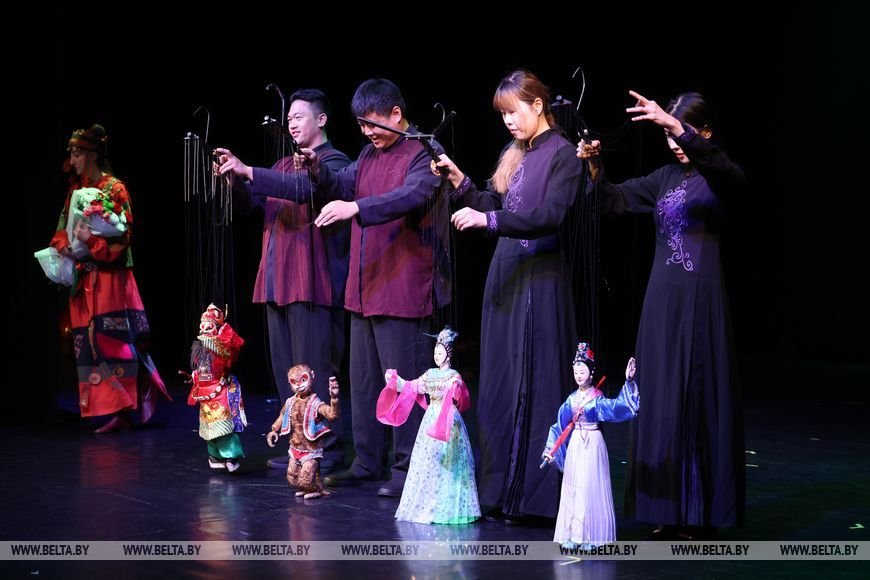
It is trite to rejoice at such a thing, but it is good that at least we are talking about fresh performances. After all, this year the XXX International Theatre Festival “White Tower” [Belarusian: Белая Вежа] in Brest hosted “The Black Maid of Niasviž” – not the best production by the great Valeryj Rajeŭski, and the play was also staged in the distant 2000. If we are guided by such logic, then we can safely take the legendary “Paŭlinka” to all forums.
However, let’s get back to the puppets. The Minsk collective continues to be the most popular in Belarus. Tickets fly away instantly, queues form at the box office, and those spectators who were left without tickets share their grievances on social networks. The main director Jaŭhien Karniah is living his best theatrical life here and now. He was named Minsk resident of the year in the “Culture” nomination. In the current realities, this can be a kind of security document for the theatre. But for Karniah himself, it’s difficult to say for sure. Any creator needs recognition, but the challenges of handling success remain as relevant as ever.
Meanwhile, Karniah’s popularity goes beyond Belarus. The director’s first production took place in Moscow – at the Shalom Theatre, he presented the play “Magda”, which is about the last days of the Third Reich. At t e Mayakovsky Theatre in the same city, at the end of the season, his production of Homer’s “Odyssey” was announced. It is interesting that even before the war, Karniah staged the play “Odysseus, Return Home”, at the Kyiv Theatre of Drama and Comedy on the Left Bank. But only in the future will it be clear whether we will see a new play or a (partial) transfer of the old one. Karniah was also recognized as the best director (for the St. Petersburg play “Sandbox”) at the Yekaterinburg festival “Petrushka the Great” (it is interesting that the Grand Prix was awarded to Ihar Kazakoŭ’s long-standing production “Very Blue” [Belarusian: “Сіняя-сіняя”] at the Mahilioŭ Puppet Theatre, and the jury included Belarusian critic Anastasija Vasilevič). That victory is extremely prestigious. Unlike her grand prix for the play “Zhenya + Tanya = Love” by the capital’s Belarusian State Academic Theatre for Young Spectators at the Cairo International Festival for Experimental Theatre, it is perceived differently: rather as an opportunity for actors who almost never went on tour in the 1990s to see the world. After all, Taćciana Sambuk’s production itself cannot be called innovative.
Staff shortage and Music Theatre news
The chief choreographer of the capital’s Opera and Ballet Theatre, Ihar Kołb, admitted that the troupe had changed by 95% in four years. In fact, we are talking about a completely different team. Meanwhile, Kołb’s productions are subject to criticism, and the choreographer himself even complained about hate. However, during a tour in Moscow, his production of “La Bayadere” was crushed. “The Minsk “La Bayadère” – with its wrinkled painted sets, meager stage props, and a dim tulle curtain that obscured the entire dance of the “shadow” corps de ballet – looks poorly executed.
Designer Luboŭ Sidelnikava, striving to compensate for the poverty of the design with glittering costumes, strewn them with “jewels”, which only led to confusion: the ascetic temple dancers, led by Nikiya, looked like wealthy call girls”, Tatyana Kuznetsova wrote in her review. In Minsk, it is a priori impossible to have such feedback, which, unfortunately, testifies to our provinciality. Criticism is practically destroyed and driven under the pressure of censorship and self-censorship. But who cares if the management reports on the fulfillment of tasks set from above. The director of the Opera and Ballet Theatre, Kaciaryna Dułava, proudly stated that the task of equal funding has been accomplished: last year the institution was able to earn 51% of its budget.
Meanwhile, the ballet company of the Belarusian State Music Theatre presented another premiere of Siarhiej Mikiel – the ballet-fairy tale “The Nightingale” following the eponymous opera by Igor Stravinsky. In the current conditions, it is extremely important that Kołb and his troupe in Minsk have an alternative.
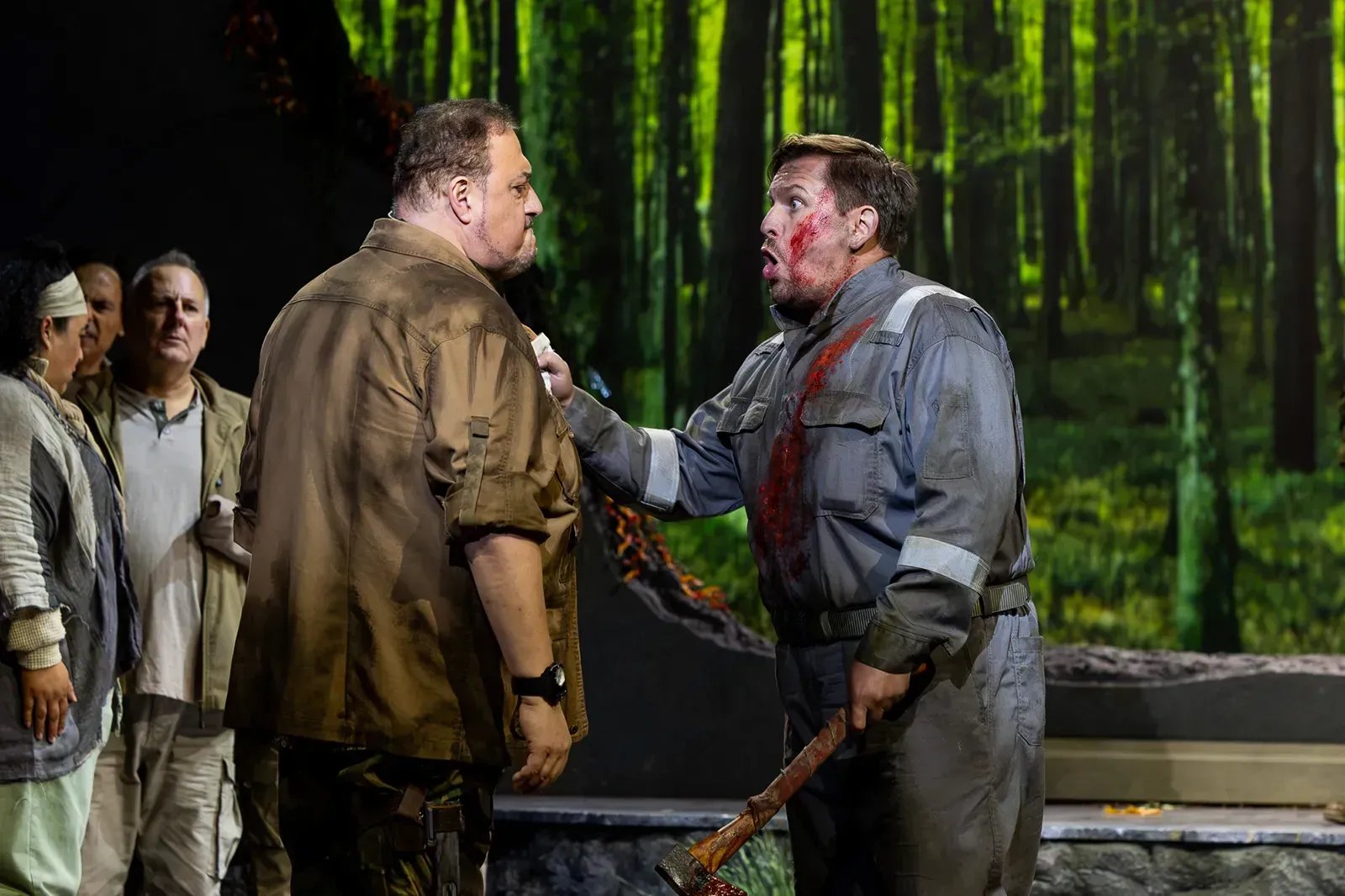
Belarusian artists continue to build their careers in the West. Baritone Illa Silčukoŭ made his debut at the Boston Lyric Opera in the production “William Tell”. The orchestra at the opening ceremony of the prestigious Salzburg Festival was conducted by Vital Aleksiajonak. And playwright, writer, director and translator Dźmitryj Płaks, who, by the way, has been living in Sweden for a long time, was awarded the Honorary Prize within the framework of the prestigious theatre award Bennypriset 2026.
Premieres of plays and readings abroad
Belarusian plays are premiering abroad. In Białystok, the “Pryjechali” theatre (directed by Alaksandr Jendžajeŭski) first showed the production of “The Red Cross” based on the novel of the same name by Saša Filipienka. His colleague Ženia Davidzienka staged the play “LITHOPEDION II” in Sopot. It is about the phenomenon of the “stone child” – a dead embryo that remains in the body for years.
The premiere of the play “The Bee in the Throat” by Natalla Lavanava took place in Poznań at another “Second Attempt” festival (organized by a team led by Valancina Maroz). It was held in Polish. In the same language, a reading of the play “The Red Squirrel” (author – Chasia Kornijeva, director – Viktoryja Jahorava) was also held in the forum format. In fact, out of a dozen stage performances in Belarusian, only the reading “How to Get Rid of Shame” (author – Ženia Davidzienka, director – Julija Šaŭčuk) was held. And even then there was one Russian-speaking character. “The situation is quite logical: the forum is being held in Poland, the directors want their work to have a long stage life, and therefore it is necessary to leave the emigrant bubble and appeal to the local audience”, notes critic Nastaśsia Pankratava. She rightly observes that only time will tell which direction will be more fruitful for Belarusian theatre in exile: to maintain a Belarusian-speaking audience or to switch to the local language. However, there is no correct answer to this question.
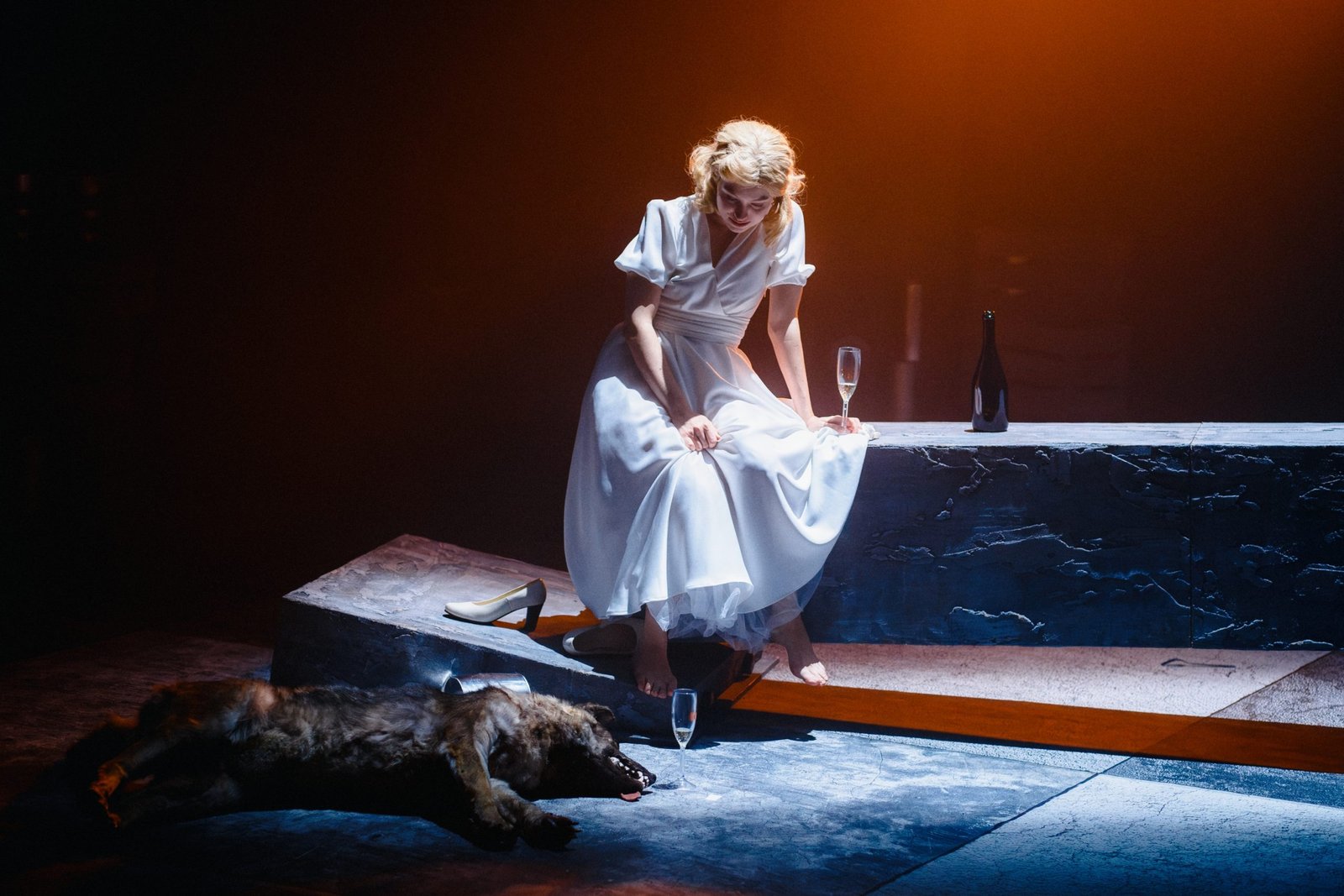
Among other news, we would like to mention the release of a special issue of the Polish theatre magazine “Raptularz” dedicated to Belarusian theatre. Also we should note the tour of Polish cities of the performances “Radziva Prudok”, “Whisper” and “What Now, Mr. Wolf?”, produced by the INEXKULT initiative, as well as the opening of a new theatre space in Vilnius, which will host Belarusian émigré actors who have united in Baltas Teatras.
Music: Foreign stars at the festival in Minsk and ours in the USA
Summer in Belarus was traditionally a festival-filled one. Large Belarusian festivals such as Graj and Tutaka took place abroad, and Belarus saw some foreign stars in addition to traditional Russian ones. From July to September, we met musicians from Tor Band on the outside after political imprisonment, rejoiced at the success of Dymna Lotva, and continued to sadly observe the restrictions faced by Belarusian artists.
Festival summer in Belarus and abroad
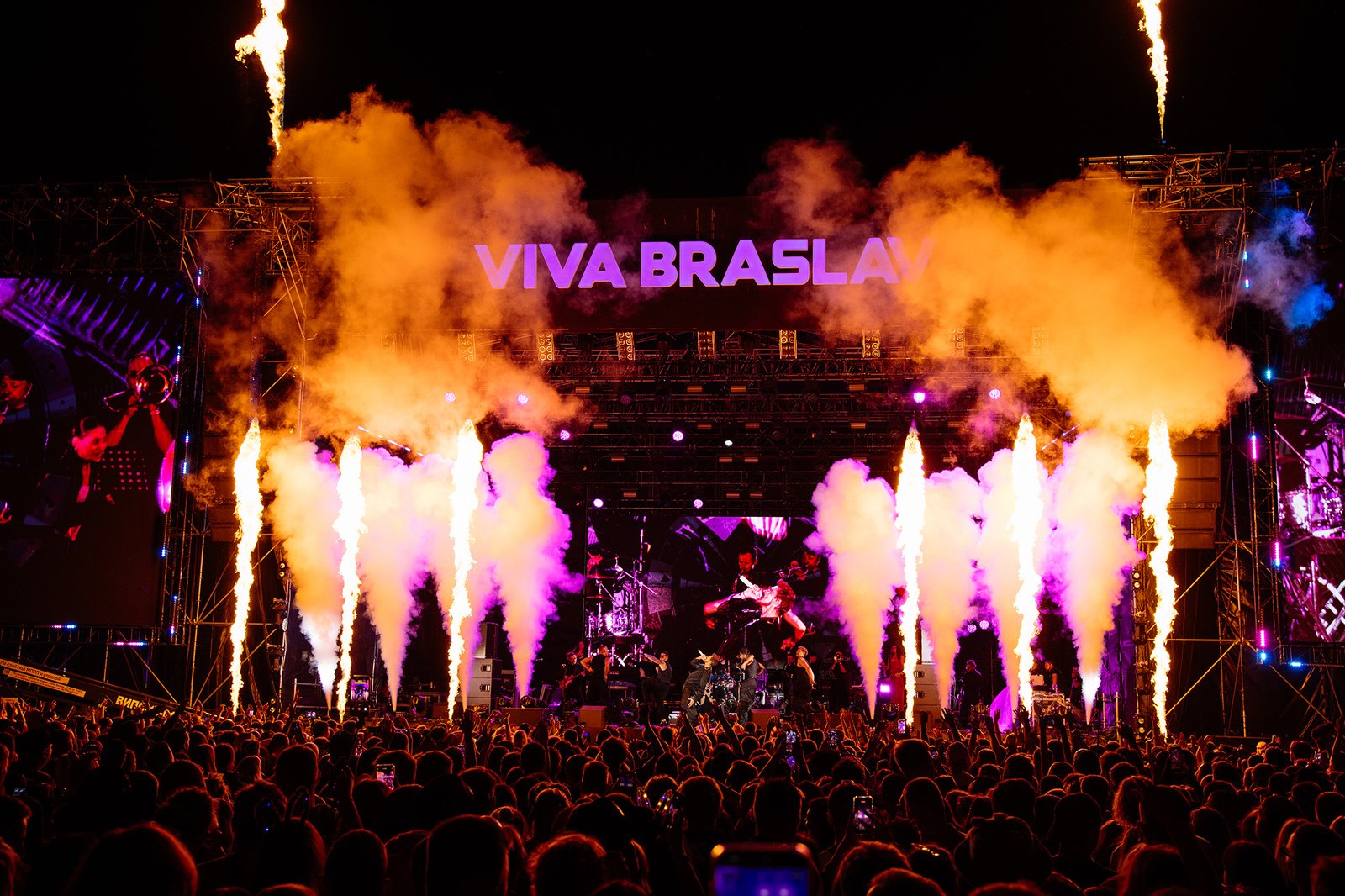
The third quarter was remembered primarily for festivals both within the country and abroad. In addition to established players such as Lidbeer and Viva Braslav, new ones appeared. For example, at the end of August, a free musical picnic Utka Day was held in Minsk. It featured performances by Belarusian artists Loukii, “minimarket”, Postoyanno, Saint Wenz, Alexey Krivdin and Wasssup.
The traditional Viva Braslav took place from July 24 to 26. Among the guests were Dima Bilan and MOT, and Belarusians were represented by the bands “Davay na ty”, LYRIQ, ROOMEE and others.
Lidbeer, the organizer of which was initially denied the right to hold the festival, also took place this year. This year, the festival featured active supporters of the war in Ukraine. For example, Sergei Bobunets and “Komnata Kultury”. By the way, there was a scandal with the latter. The band was late and could not get on stage on time, the organizers did not know until the last minute whether the set would take place at all. As a result, the musicians performed at night, many listeners left, and some were simply not allowed back to the venue by the security guards. As a result, the organizers were forced to take anti-crisis measures and offered the public a free visit to the Lida Brewery Museum.
At the end of August, another Poima Fest was held in Viciebsk, where Laitovy, Nevika, Reallowly Pluto and other Belarusian artists performed. Another festival where you could see Belarusian artists was Vulitsa Ezha, where Laitovy and Pazniaks performed on the same stage.
The series with the postponed techno rave in Biełavieža Forest continued and reached its logical finale. The festival was cancelled, and instead of it, the “Zubr-fest” was held, which took place on the last weekend of Septem The festival was moved outside the reserve, a special platform was built for the event, on which asphalt was laid. The headliners were again Russian stars: Lyusya Chebotina, Antokha MC, etc.
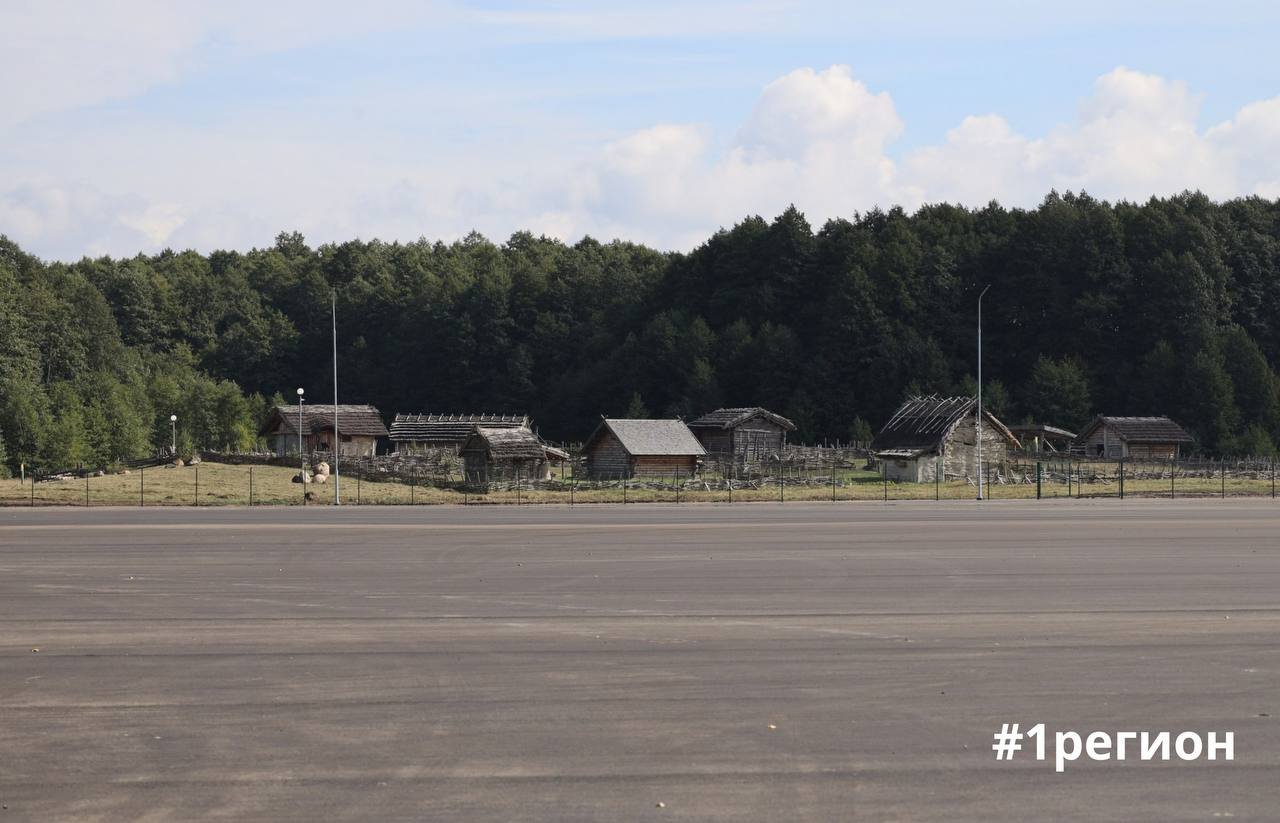
Photo: New venue for the Zubr Fest in Biełavieža Forest. Source: #1регион.
The only festival in the country that was able to attract foreign stars, albeit from the past, was “Prime Era” at the “Dynamo” stadium. Morandi, Mr. President, Cappella, etc. performed here. Again, on August 16, the “Dynamo” hosted the Lay’s Mushroom Festival, where Belarusians Police in Paris, Parade of Planets, Wassup, “Borisov Trakt” and others performed.
Non-trivial venues were also used for events. In July, a party was held on the roof of the National Library with a view of Minsk. In Brest, concerts were held in a Catholic church and on the roof of a puppet theatre.
The Belarusian foreign scene was marked by the holding of the sixth Tutaka festival. For the first time in its history, the festival became a paid ticketed event. It featured rapper Vinsent, “Raźbitaje serca pacana”, Dzieciuki, Anastasia Rydlevskaya and Chornabrova.
In September, the traditional Graj festival was held, which gathered a sold-out crowd of 700 people. On September 12, MARA FEST was held in Sopot with the participation of Intelligency.
Speaking of international festival successes, mnogolun performed at Burning Man for the first time. There she performed her Belarusian-language songs.
Repression, restrictions and release of musicians
Belarusian musical life has not been without repressions and restrictions over the past three months. In August, the Minsk City Court sentenced the leader of “Lyapis Trubetskoy” and Brutto in absentia to four years in a penal colony for insulting the president and inciting hostility.
On August 24, the court in Navapolack recognized the song “Numbers” [Russian: “Номера”] by the LSP as “extremist materials”.
There is also good news. Drummer Alaksiej Sančuk has been released. He was detained in November 2020 along with other musicians, and in July 2026 he was released after six years in prison.
On September 16, 25 political prisoners were released, including musicians from Tor Band (Jaŭhien Burło, Dźmitryj Hałavač, Andrej Jaremčyk) and Aleś Čumakoŭ from “Stary Olsa”. All of them were evacuated to Lithuania. Čumakoŭ was convicted under Article 361-1 for participating in an “extremist formation”, and the charges, according to him, stated that he played Belarusian folk music and thus gathered a protest core.
Belarus’ international isolation also affected the musicians. Metal band Extermination Dismemberment did not manage to obtain Schengen visas in time, which led to the loss of the European part of the tour. The band is currently on a major tour in the USA with the cult metal band All Shall Perish.
Belarusian musicians abroad continue to face bureaucratic restrictions. For example, NaviBand cannot tour the world while they are waiting for residence permits. The deadlines for processing documents are lengthening, and musicians are left without the main part of their income.
The band “Drazdy” has changed its mind and continues to give concerts in Belarus. At the end of July, the band performed at the City Day in Brest.
Meanwhile, concert life in Belarus continues to be unstable. Literally on the day of the concert, a joint performance by the bands Vihilia and Dreamless was cancelled.
There were losses. On July 6, one of the founders of “Pesniary” Uładzisłaŭ Misievič died. He was 81 years old.
Big releases and new projects
Despite the fact that summer is not the most productive season for releases, Belarusian musicians continued to release high-quality material, which was noted not only by Belarusians.
On August 7, Dymna Lotva released the album VYRAJ on the German label Prophecy Productions, which was included in the list of the best releases of 2026 according to Metal Hammer. This release includes a joint track with Aaron Steintorp, the ex-vocalist of My Dying Bride, who even sang in Belarusian.
On July 17, Anton Aniščanka presented the ambient release “Hłybokaje / Čarbamysła”. This is an album of immersive field recordings created in the wild forests of the very north of Belarus. The project was recorded in mid-June 2023 on the territory of the “Hlybokaje – Vialikaje Astravita (Polack district) hydrological reserve and near lake Čarbamysla. The album consists of 8 tracks, featuring the voices of more than 30 species of birds (from common cuckoos to rare black-throated loons), as well as frogs and insects.
Artist Domsun has started to release his music on Warner Music Poland. It is a rare case when a Belarusian-language track is released on a major label. Belarusians have also appeared in films. The guys from the Belarusian male choir Kasary starred in the second episode of the third season of “1670” – a satirical Polish series about the nobility of the 17th century.
On August 14, a joint album by .K (Jaŭhien Kučmiejna) and Sviatłana Bień “White Cow” [Belarusian: “Карова белая”] was released. The idea for the compilation appeared after a small joint European tour of the musicians in the spring of 2025. The album itself was created in Ozierany Małe, Poland in Podlasie, not far from the Belarusian border.
Anastasia Rydlevskaya and Bakei delighted listeners with new albums. Akute vocalist Stas Mytnik emerged from the shadows with a project of the same name. The musician sings in Russian and has already managed to perform in the Lidbeer yard. Apsent also returned to the stage. In the summer, he performed at the LTCŃ picnic in Krakow, and also organized an online concert.
Intelligency continue to excite the audience before the release of their Belarusian-language album. On September 19, the musicians presented a cover of the Pesniary hit “Good evening, girl!” [Belarusian: “Добры вечар, дзяўчыначка!”].
Two iconic metal bands have made big releases. Rise in Rage returned after six years with the single “Dead Cargo” [Russian: “Мертвый груз”], and Exist-M recorded a Belarusian-language track “The Path” [Belarusian: “Шлях”].
Young metal musicians Set To Hate also burst into the scene with their single “The Pit”. In 10 days, their video has gained 28 thousand views, and their Facebook profile has grown from almost nothing to 16 thousand subscribers.
New media projects have also appeared in the music field. For example, K6 teamed up with the documentary project “Tvary” [literally in English: “Faces”]. Their first work was a documentary about musician Mikita Arłoŭ (Applepicker, Soyuz).
Rapper Nkeei collaborated with Mark Formelle. Together they presented a limited collection of clothes in the style of the 2000s glamour.
Startup Graj, founded by Belarusians, acquired the social listening platform Hangout, which was created by the authors of the Turntable.fm service.
Unfortunately, there were burnouts in the media field. The creator of the Telegram channel about metal Mayhem F&Q Sofja Sitnik announced that she was closing the project.
Art: preservation and interpretation of Belarusian cultural heritage
The third quarter of 2026 deepened the trends that defined the Belarusian cultural space in the first half of the year. The liquidation of the National Centre for Contemporary Arts (NCCA), the redistribution of its funds and buildings, as well as new restrictions on independent cultural activities indicate a further narrowing of the space for autonomous initiatives within the country. At the same time, abroad, the Belarusian cultural community is strengthening its position through the artists’ participation in international exhibitions and festivals, the development of independent museum and research projects, and work with national heritage and collective memory.
Narrowing of cultural space
If in the previous review the main institutional shift was the actual cessation of the activities of the National Centre for Contemporary Arts, then in the third quarter this process was formalized and completed. In early August, the Council of Ministers adopted Resolution No. 391 on the liquidation of the National Centre for Contemporary Arts. Budget funds allocated for financing the centre are distributed between the National Art Museum and the Belarusian State Academy of Music, and its buildings and funds are transferred to other state institutions.
At the same time, the liquidation took place not only at the level of administrative decisions.The last exhibition of the National Centre for Contemporary Arts “NCCA: Selected works” [Belarusian: “НЦСМ: выбранае”] was closed ahead of schedule, and the building on Independence Avenue was transferred to the National Art Museum. Thus, the previous tendency to close autonomous cultural spaces has moved to the stage of redistributing their resources and functions. The physical exhibition space is preserved, but its institutional affiliation is changing. This does not mean the automatic disappearance of all works or practices associated with the NCCA, but it does raise questions about the future of curatorial autonomy, programmatic diversity, and the place of contemporary art in the state cultural system.
In parallel, pressure on independent cultural activities continues. In Belarus, they banned public creative meetings and lectures by artist, writer and urban culture researcher Siarhiej Filipaŭ, who developed an educational project at six venues and organized about two dozen events over the course of a year. This case continues the trend noted in the previous review: restrictions affect not only individual artists, but also spaces that provide public knowledge exchange, cultural education and discussion.
A separate episode for this quarter was the recognition of the Instagram account of Chrysalis Mag, an independent online magazine about contemporary Belarusian art, as “extremist materials”. Founded in 2018, the project tells about artists from Belarus, analyzes current visual trends, and also collects information about authors and their works. This case expands the scope of pressure. Now, not only is the opportunity for independent expression narrowing, but also the space (including virtual) in which knowledge about Belarusian culture is formed and connections between authors, researchers, and the audience are built.
Cultural heritage: again between state control and public initiatives
In July, three ancient icons confiscated from the Catholic priest Hienrych Akałatovič, who was released in November 2025 and left for Rome, were sold at auction. Among them was the 18th-century icon “The Resurrection of Christ from the Tomb”, as well as two icons from the late 19th and early 20th centuries. According to published information, each auction was restricted to a single bidder, who was given the right to purchase the property at a price 5% higher than the starting price. Now confiscated art objects are becoming objects of repression and sale, and their future fate is determined without public discussion of their historical, artistic and religious value.
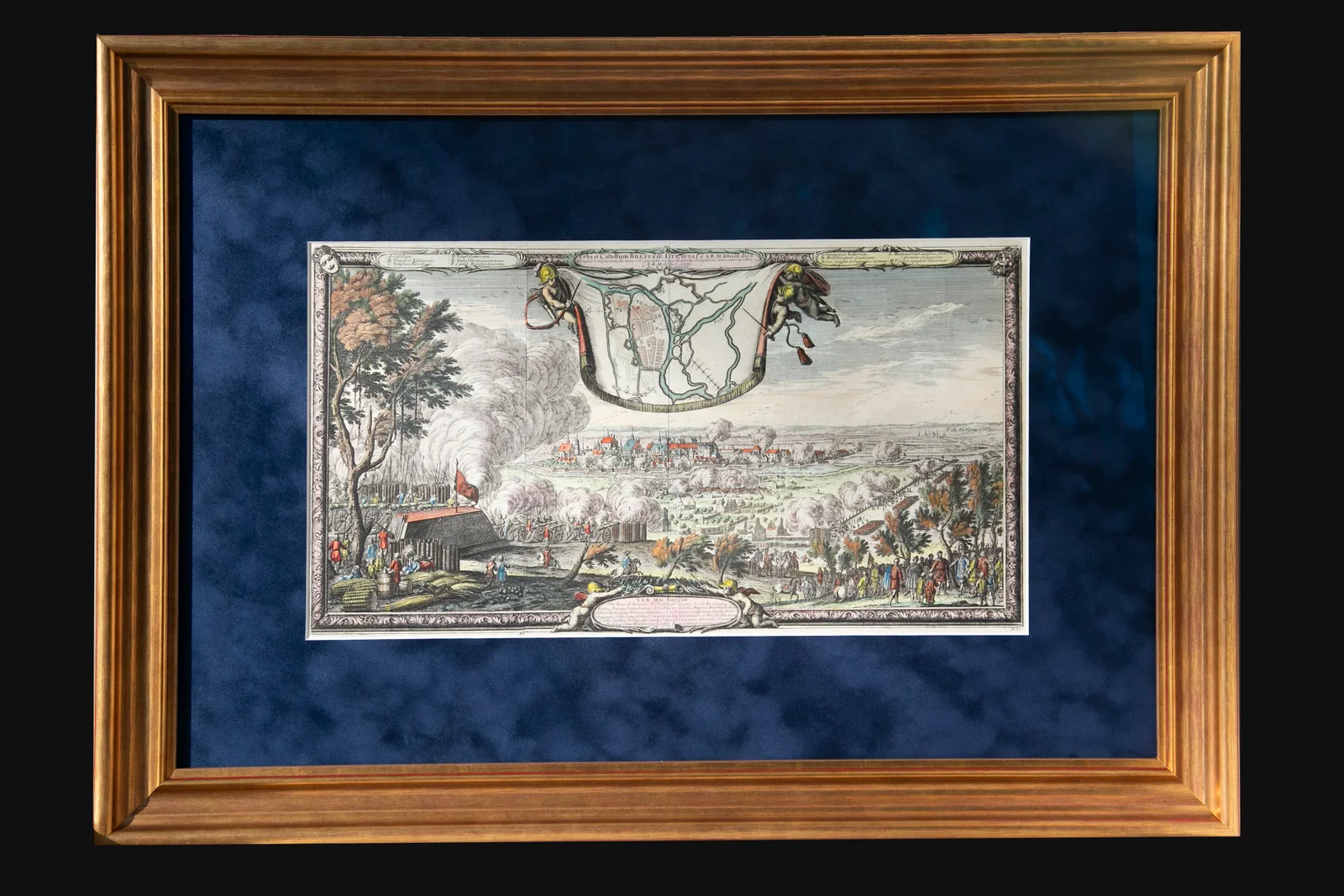
Against this background, the activity of initiatives working with cultural heritage as a common public resource is again noticeable. In the period covered by this review, the MALDZIS initiative can be singled out again. In August, its representatives acquired a rare engraving “The City and Castle of Bierascie Litoŭskaje”, published in Nuremberg in 1696. This work is considered the only detailed image of old Brest – a city that was destroyed in the 19th century during the construction of the Brest Fortress. In the future, the engraving is planned to be transferred to the Museum of the History of the City of Brest as a public gift.
Another example of the return of heritage has already been recorded within the country. Three graphic works by Vosip Cadkin, a native of Viciebsk and a representative of the Paris School, have been added to the collection of the Marc Chagall Museum in Viciebsk. As the museum director Iryna Voranava said, the collection was donated by a museum trustee who wished to remain anonymous. These are the artist’s first works in the institution’s holdings.
Belarusian art abroad
In the third quarter, Belarusians abroad continue to strengthen their positions in cultural circles. One example was the victory of multidisciplinary artist Anastasija Rydleŭskaja at the SURVIVAL art fair in Wrocław. Her installation “Disintegration” won the audience award according to the results of a vote of 1,565 visitors. The award includes a financial prize and the opportunity to hold a personal exhibition at the Mieszkanie Geppertów gallery. The project was presented in the space of the former city hospital, which gave it a new conceptual dimension.
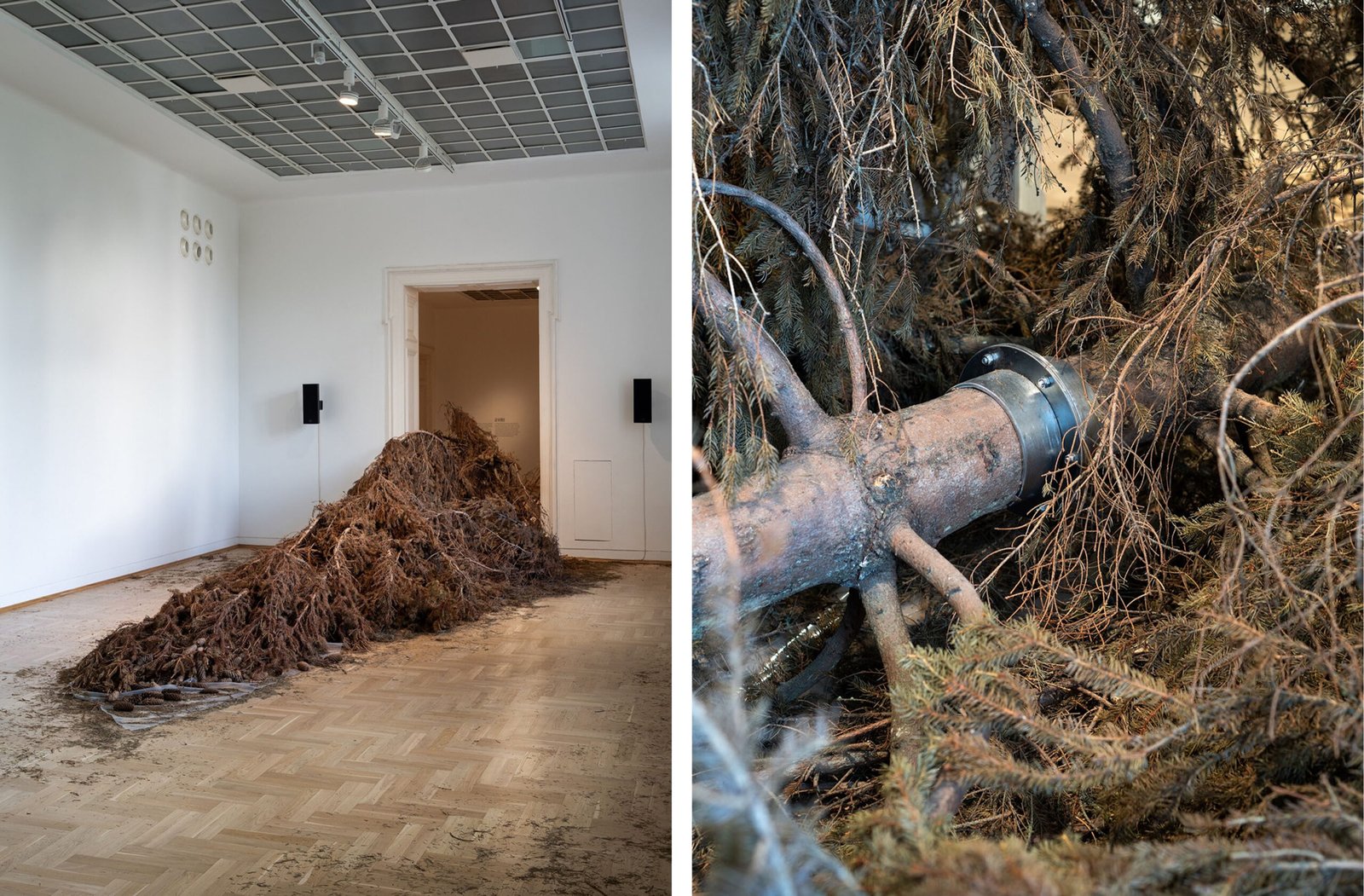
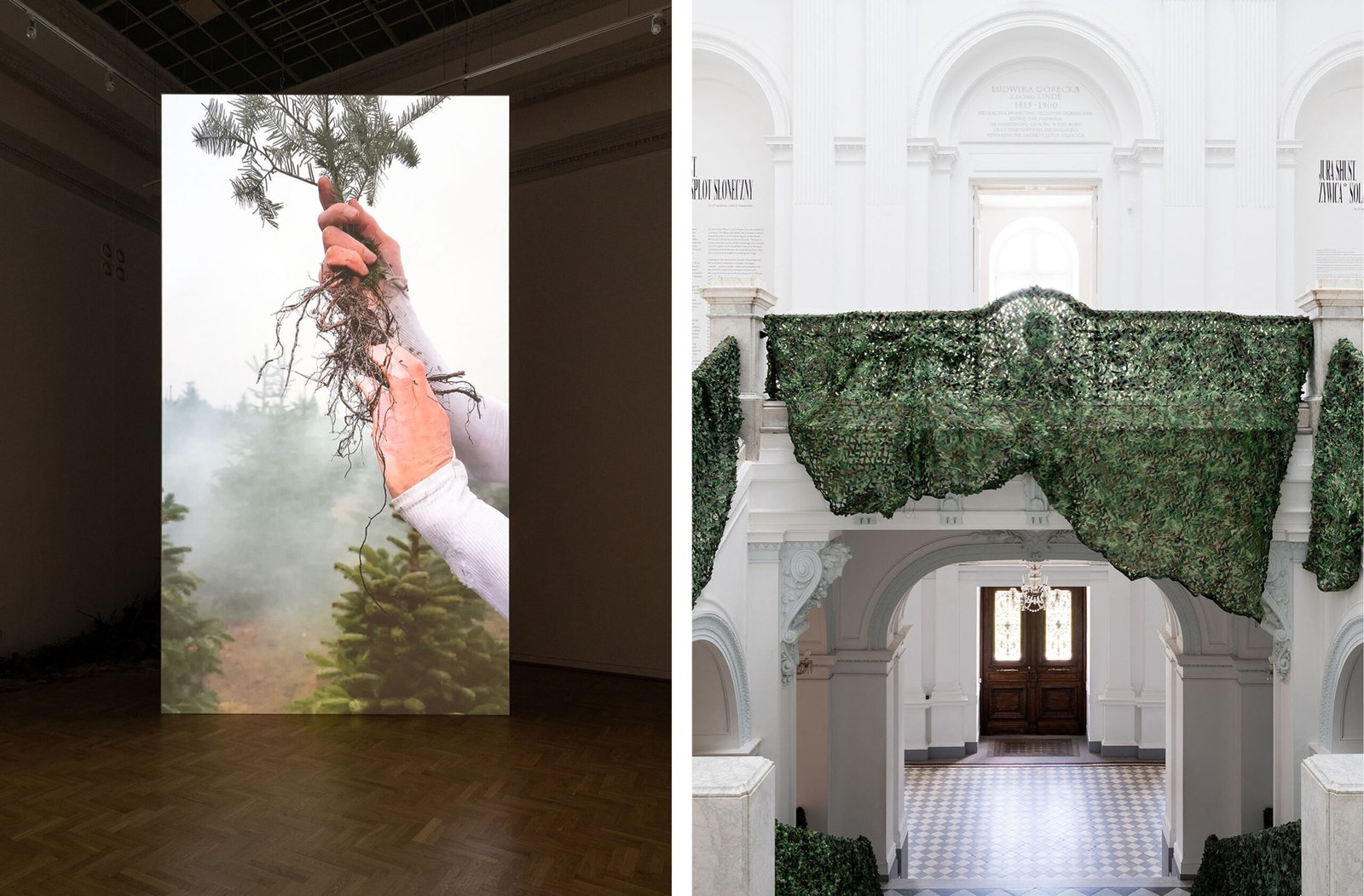
Another example is the personal exhibition of Belarusian artist Jura Šust “Żywica* Solar Plexus” [Polish: “Żyvica* Splot słoneczny”] at the Zachęta National Gallery of Art in Warsaw. The project, which ran from July to the end of September, explored the connections between spirituality, nature and modern technologies. The central image was the Biełavieža Forest – at the same time a sacred space, a place of historical intersection of cultures, and a territory associated with military technology, surveillance and control. The project also involved a performance with the participation of Belarusian migrants.
Belarusian authors continue to appear in the programmes of international events dedicated to the study of collective memory. Photographer and researcher Volha Bubič joined the curatorial group of the international art programme in Buenos Aires, organized within the framework of the Memory Studies Association conference. This is an important example of the expansion of the geography of Belarusian cultural presence: from European venues to international research and art communities in other parts of the world.
Memory, migration and solidarity: art as a way to maintain connections
Another clear trend of the period under review is projects in which art becomes a tool for working with the experience of repression, forced emigration and separation from home. The previous review already noted exhibitions and performances dedicated to Chernobyl, political persecution and bureaucratic difficulties of legalization. Now this thematic spectrum is expanding towards private memory, mourning and collective solidarity.
In September, the exhibition “POGRZEB.MP4. Utrata i żałoba na emigracji politycznej” opened in Poznań, dedicated to the experience of loss in the circles of political emigration. For many Belarusians who cannot safely return home, a video recording or online broadcast of the funeral is the only way to say goodbye to their loved ones. The exhibition, based on interviews and private archives of Belarusians, turns this personal and often invisible experience into a subject of public conversation.
It is about the physical distance between people, as well as the inability to participate in rituals through which communities preserve the memory of the deceased. In this sense, the exhibition continues a broader line of contemporary Belarusian art that works with the consequences of political events through individual stories and private archives.
A different scale – but a similar logic – is in the performance A Percussion Piece, which took place on September 19 in Amsterdam. About 1,200 participants wearing cardboard masks depicting Belarusian political prisoners created a collective sound composition using ordinary everyday objects. The project, initiated by an international team of Belarusian and Ukrainian cultural figures, united people of different nationalities in solidarity with those who remain behind bars in Belarus for political reasons.
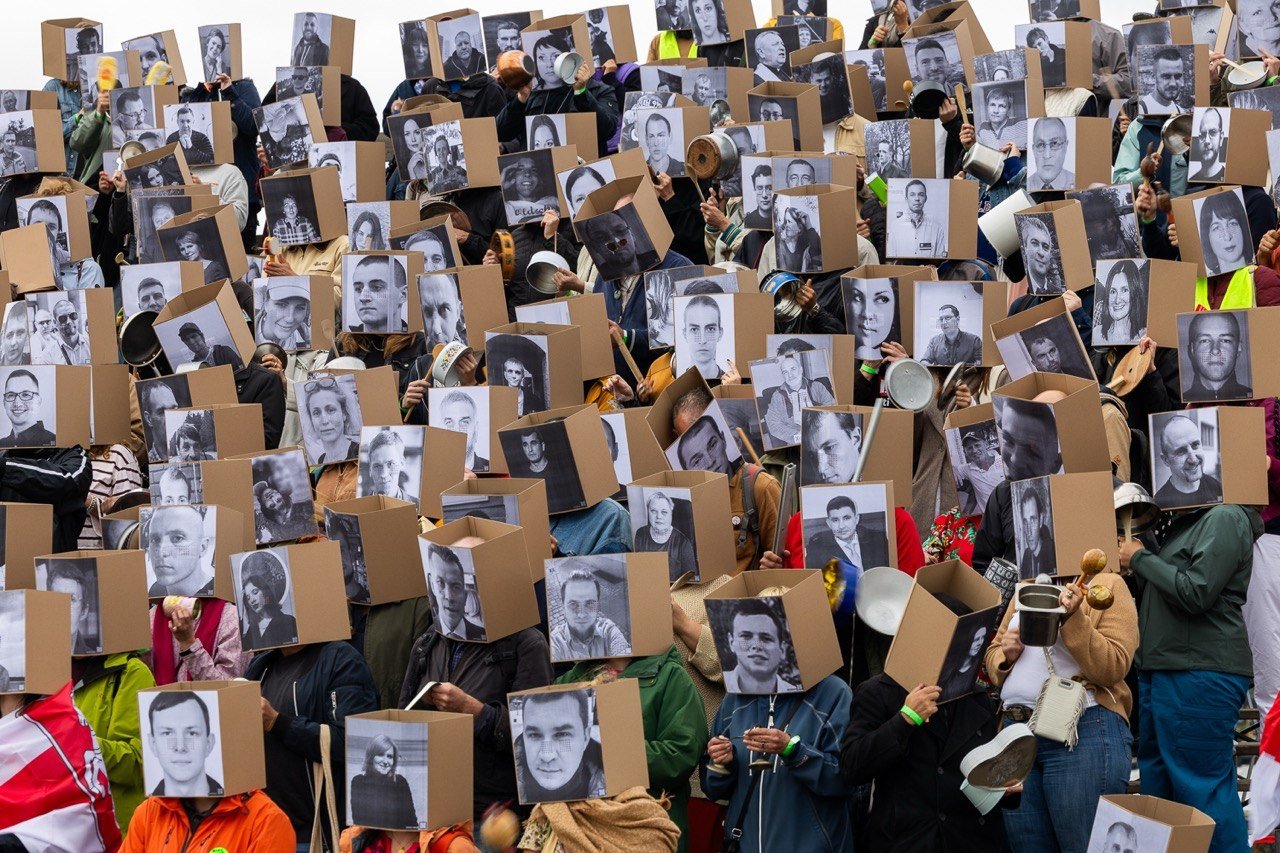
While the exhibition in Poznań addresses the intimate experience of loss, the Amsterdam performance transforms individual voices into a collective expression. Both projects, however, work with the same problem: how to give a voice and visibility to those whose stories under normal circumstances remain outside the public space or are deliberately silenced.
Conclusions: two models of development
The first half of 2026 saw a structural demarcation between official and independent cultural spaces, and the third quarter showed how these two models are developing further. Domestically, the state is redistributing institutional resources and narrowing opportunities for independent activity. Abroad, the Belarusian cultural community is creating its own platforms, maintaining ties with international institutions, and continuing to work with national heritage, despite obstacles.
The reviews are prepared with the support of the ArtPower Belarus programme and the European Union.