
Literature: The Hunger Games in the Curiosity Shop
Cinema: Both Sides of the Border
Theatre: Remodelling Toward a Russian DNA
Music: The Dissolution of the band Petlia Pristrastiya [Noose of Passion], Alexei Khlestov’s return, and a popular festival gets cancelled
Traditional Culture: Exhibitions, New Books, and Anniversaries of Belarusian Universities
Art: PRA _BEL. Beyond Foreignness
Literature: The Hunger Games in the Curiosity Shop
The political conditions of late 2025 brought relief to nearly two hundred Belarusian political prisoners whom the Belarusian authorities released from prison, while simultaneously expelling them from the country. Among those freed-on December 13 were the writers Ales Bialiatski, Alaksandr Fiaduta, Maxim Znak, and Pavel Seviarynets.
Overall, however, the situation for people working in culture remains bleak. Physical and symbolic purges of the cultural space continue. At the same time, cultural scene is now experiencing increasing pressure, since the statute of limitations expired for potential cases related to participation in the protests of 2020 and maintaining the current level of repression and intimidation inside the country is now possible primarily through accusations of extremist activity (views, statements), that is precisely the territory of for which writers, among others, are forced to bear responsibility.
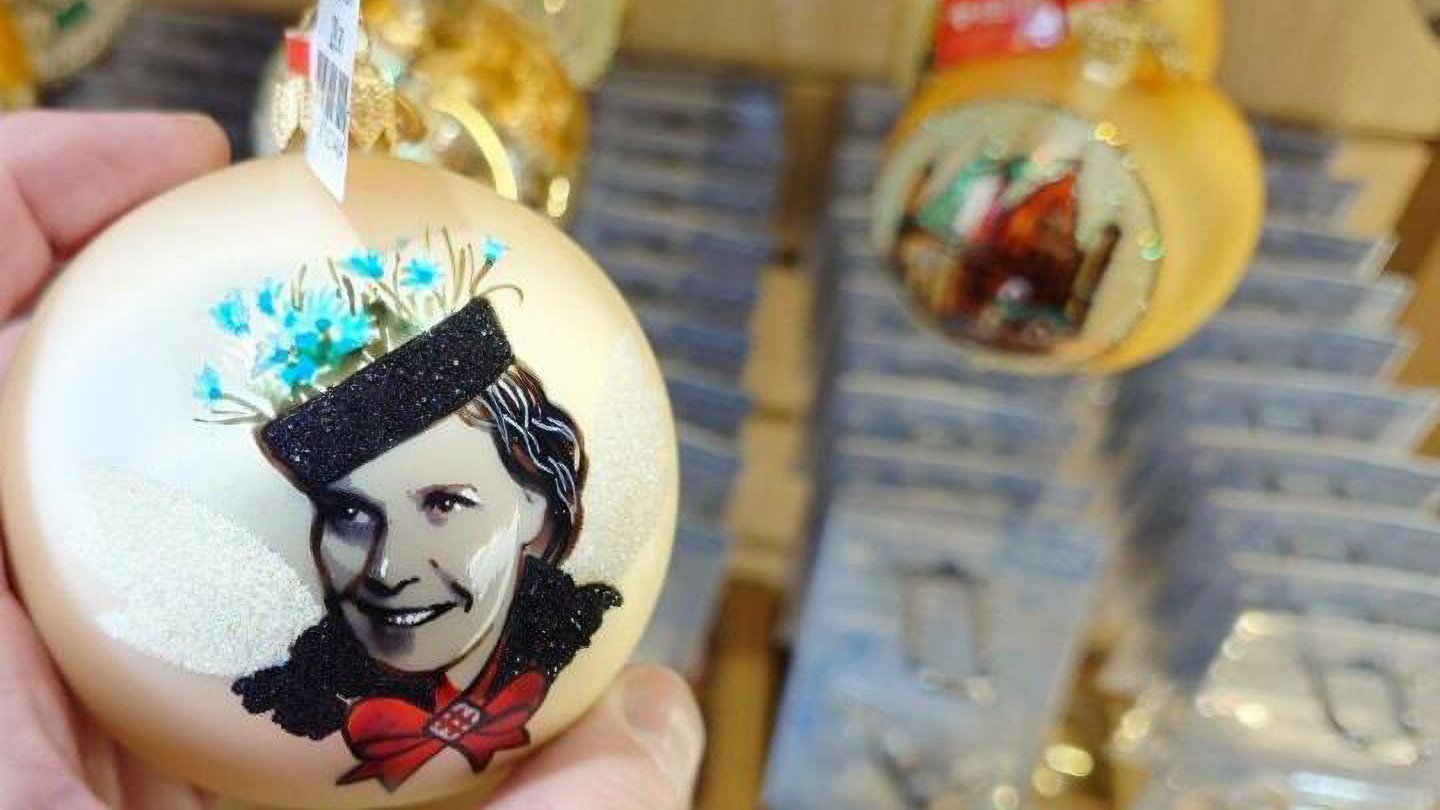
One example will suffice. At the beginning of December in Minsk the “Christmas Shop,” a popular retail point for holiday goods, was closed. The reason was one of the items sold there: a Christmas-tree ornament featuring a portrait of Larysa Hienijuš, any public mention of whom propagandists interpret as a “rehabilitation of Nazism.”
It is impossible not to mention a major loss for Belarusian culture: on the night of December 20–21 the interviewer Mikita Mielkaziorau passed away. He was the author of the talk show Life is Raspberry (“Жыццё – маліна”), which provided the venue for the Belarusian language and for thoughts about Belarus, and achieved high ratings on YouTube. Between 2021 and 2025 Mielkaziorau recorded conversations with a lot of cultural (not limited to that of course) workers, among them writers Uladzimir Nyaklyayew, Victor Martinovich, Andrey Kureychik, and Liavon Volski. At the beginning of December Life is Raspberry released a conversation with Andrei Khadanovich about the phenomenon of Uladzimir Karatkievich, marking the ninety-fifth anniversary since the birth of the writer.
Literary Autumn Abroad: Awards and Festivals
By the end of 2025, essentially all prizes for the literary achievements of 2024 had been awarded.
At the 30th Festival of Belarusian Bard and Author’s Song Bardaŭskaja Vosień (“Бардаўская восень”), held on October 24–25 in Bielsk Podlaski, Poland, organised by the Tutaka Foundation, which has recently added a literary stage, the Michał Aniempadystaŭ Prize for Best Book Cover was awarded to Ihar Yukhnevich and Masha Maroz for the book by the Polesian author Golya from Opolya, My Grandma Is the Funeral Director (“Мое баба – діректор морга” (an independent publication).
The Viartanne Foundation also revived its awards: the Ciotka Award for the Best Children’s Book and the Carlos Sherman Award for the Best Literary Translation.
It is notable that three of the four books recognised by the Ciotka jury over the past two years in the “writer” category belong to teenage reading (the young adult genre). This may signal a growing demand within the community for books in precisely this category.
The culmination of the season was the awarding of the Jerzy Giedroyc Literary Award in Gdańsk on November 15. The winner was Siarhiej Dubaviec with the book Zanzibar. The Coming of Age of a Young Soul (“Занзібар. Сталенне маладой душы”). Overall, the shortlist of six books reflected the current literary situation.
Three authors from the list (Yuras Kaliada, Zmicier Dzadzenka, Klok Shtuchny) represent a kind of play with the so-called “genre literature” (what Tsikhan Charnyakevich calls “invented works.”) The other three authors (Anka Upala, Alyaksandr Lukashuk, Siarhiej Dubaviec) represent different shades of autofiction. This trend ultimately prevailed in this year’s awards.
Award of Frantsishak Alyakhnovich, given for notable books written in prison, was granted to three authors whose names were not disclosed. The award ceremony took place simultaneously with the Giedroyć Award (November 15 is the Day of the Imprisoned Writer). In doing so, the organizers emphasized the importance of public attention to writing behind bars.
Unfortunately, in the coming years we may see even more nominees for the Alyakhnovich Awards. Between October and December Belarusian media published testimonies about prison experiences from intellectuals who had recently regained their freedom. One can expect that even more such “prison” narratives are going to appear in 2026.
In October and November the Pradmova Festival took place in Vilnius, Prague, Poznań, and Warsaw. It was noticeable that the programs in the various cities had lost some of their scope when compared with previous years. There were no high-profile invitations of “stars”, that is probably influenced by the resonance of 2022 due to the conflict surrounding the planned participation of the Russians Anton Dolin and Linor Goralik in the 2022 edition.
Instead, there was cooperation with Polish, Lithuanian, and Czech authors. More attention was given to the internal context and to pressing issues within Belarusian literature itself. Discussions at different venues addressed the Soviet legacy of Belarusian literature, the interpretation of Stalinist repressions, Europe today, autofiction and post-fiction, the TikTok format for Belarusian books, and more.
According to participants, the attention of listeners and readers was not particularly ambitious. Nevertheless, there remains a sense of hope that what was spoken at Pradmova would somehow be remembered and preserved.
The festival also served as the platform for launching the new publishing house RozUm (Poznań), whose mission is to make new Belarusian voices heard. In Prague, meanwhile, a new prize, Sinitsa, was announced for the best inclusive children’s book.
Ukraine – Belarus: Restoring Bilateral Relations
From November 11 to 15 the Ostrogski Forum took place in Lviv and Kyiv. The forum is essentially in itself a meeting of Ukrainian and Belarusian experts devoted to establishing cooperation between contemporary Ukraine and the democratic community of Belarus.
This event, and the fact that for the first time in the forum’s history there was a separate panel devoted to culture, demonstrated an improvement of Belarusian-Ukrainian relations. These relations had been undermined in 2022, when the Lukashenka regime assisted the Russian military invasion of Ukraine.
Against this backdrop, literary connections have also improved. For the first time since 2021 Ukrainian publishers released books by Belarusian authors: the photo album Sozh with poems by Ales Plotka (published by Kolo) and the novel Alindarka’s Children (“Дзеці Аліндаркі”) by Alhierd Bacharevič (translated by Daryna Hladun and Lesyk Panasiuk published by Stylos and Dukh i Litera).
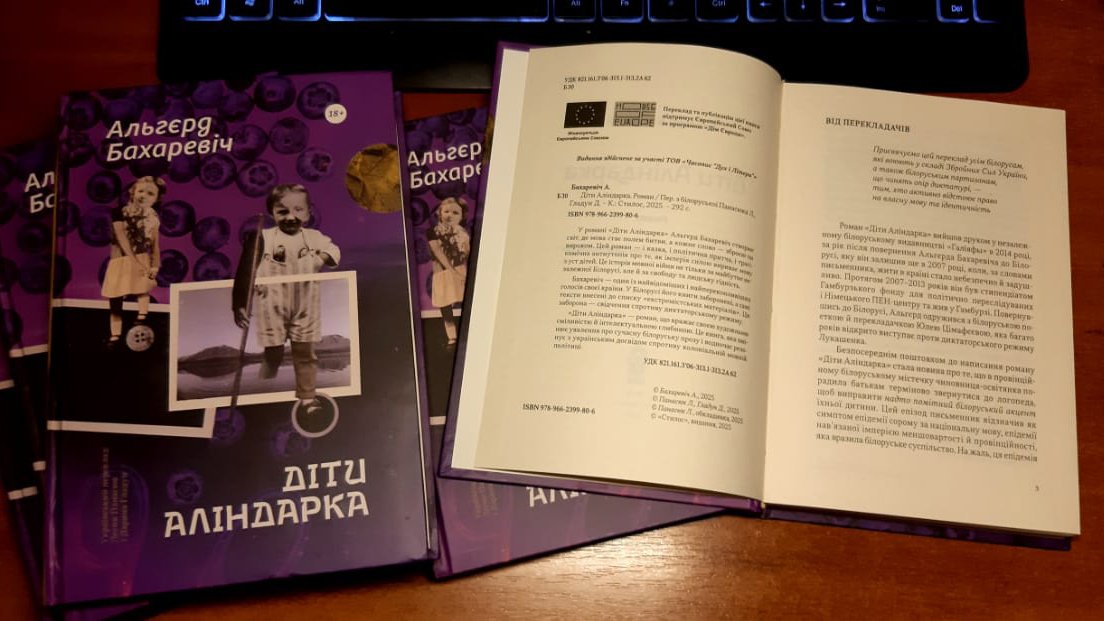
It should be noted that the translators of Plotka’s and Bacharevič’s books received support from the European Union programme House of Europe. In addition to translators from Belarusian, the programme also supported translations from the Crimean Tatar language. Thus, the joy at such support comes with tears in one’s eyes.
Translations from many languages in Ukraine receive support from national book institutes or ministries of culture. Unfortunately, Belarusian cultural institutions currently have no possibility of financing the publication of their authors in foreign languages.
In addition, the poetry collection Human Right by Yuri Izdryk (translated by Natallia Rusetskaya and Ales Plotka, published by hohroth minsk) entered the longlist of the Ukrainian Drahomán Prize for the best translation of a Ukrainian author into another language.
For his part, Andrei Khadanovich received the Carlos Sherman 2023 Award for his translation of Ukrainian poetry (poems from Serhiy Zhadan’s book Mesopotamia, published by Januskevic Books).
Alone in the Field: Independent Publishing from Nastassia Rahatko
A controversial book event at the end of the year was the release of Carry It With You (“Носи с собой”) by the Belarusian journalist Nastassia Rahatko, which took place in early November. (The author defines the genre herself as “ironic autofiction.”)
On a dedicated website created to promote the book, it is presented as samizdat (self-published), namely that “everything from the text to the cover design and website was made by hand.” The book, however, has an ISBN number and therefore was legally printed in a printing house, which means that it is not samizdat. After all, samizdat is a phenomenon from countries where censorship prevails and refers to books “published without permission.”
In free Europe, the samizdat method may sometimes be used for DIY projects whose authors associate themselves with counterculture and are not interested in the commercial distribution of their work. Rahatko’s strategy is the opposite, and the book is actively promoted, clearly with an intention to generate income (the small-volume edition costs 20 euros). It would therefore be more accurate to describe the book not as samizdat but as an independent publication. On social media the author explained that she consciously refused the services of publishing houses and ignored much of the advice offered by specialists, deciding instead to do everything her own way.
The book first appeared at the Pradmova Festival with no prior announcements. At the same time, that festival would have offered an ideal and free opportunity to present the new book precisely where its target audience was gathering. Meanwhile, book presentations in various cities did take place in December ( if one believes Rahatka’s posts on Facebook) because the author discovered that many readers want to have a signed copy of the book. Besides the striking promotional website there are also visually polished book trailers.
The mistrust displayed by an author–journalist toward professional publishers is not something new for Belarusians. Years ago, still in Belarus, Andrei Horvat self-published Radio Prudok (“Радзіва Прудок”). He started his own game and won. He continues to play successfully in the same field (this year’s House was also self-published). But Horvat began in a situation of an unstable book market constrained by the authorities, and the long-awaited book was sold at a more than democratic price.
Rahatka does the opposite – as if placing a premium signature on her own brand. Yet she is doing so within the European cultural scene, where book sales are a well-established business and publishers are the true legislators of the market. Polish and English editions are already in plans (also “handmade,”). Let us wish the author success, assuming that she knows what the author is doing.
At the same time, the bright and coherent debut of Nastassia Rahatka as a writer made us reflect on this Belarusian phenomenon of independent publishing. Relying on their own quite symbolic capital, authors create and promote their books themselves and take on distribution as well. Such a strategy is often chosen by people from the media sphere (Aliaksei Dzikavitski, Aliaksandr Charnukha). Yet books produced in this way are not always integrated into the national literary process. It is yet unclear whether this is unfortunate or perhaps fortunate.
Literary Life Inside the Country
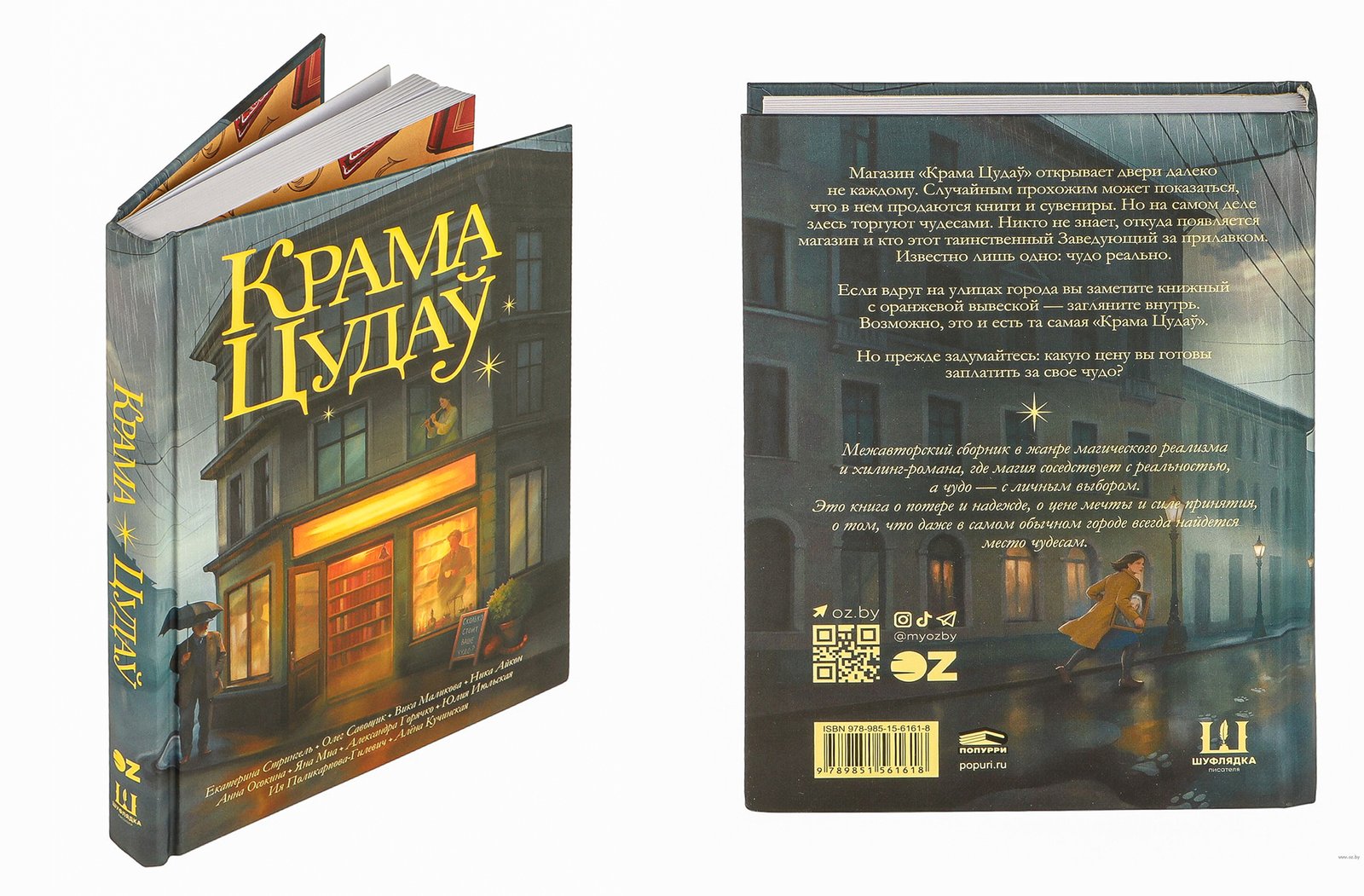
On November 28 the Belarusian online retailer OZ.BY announced the creation of its own publishing house and invited new authors to submit manuscripts. It was stated that the decision had been influenced by cooperation with the collective Writer’s Drawer, a group of fantasy authors known for the anthology (Un)Clean Minsk (“(Ня)чысты Мінск”).
The new publishing house is expected to “publish children’s books as well as translate and republish classical literature.” Most likely the same synergy also organized the one-day book festival Review, which took place on November 30 in the new cultural space Echo (on the premises of the Luch watch plant).
Bringing together primarily genre writers of the younger generation, the event, with its emphasis on entertainment and the sale of souvenirs, complemented the series of holiday season book fairs in Minsk. The next one-day Review festival is already planned for February.
The formation of a publishing house by a major player in the book retail market is a logical development. In fact, it could have been already predicted back in March, when, reviewing the Minsk Book Fair, we noted the organizers’ growing attention to local authors and writers of genre literature.
This development fits into the broader restructuring of the global book market, where bookstores themselves increasingly determine sales priorities in order to maximize profits. Belarusian booksellers have now also discovered that promoting their own authors is more profitable. In fact, this trend reached Belarus somewhat late. Back in 2020 there were signs that the crowdfunding platform Ulej or the store Symbal.by were going to establish their own publishing houses. Some IT companies also seemed capable of launching corporate book imprints. Political events, however, reshaped the cultural landscape. Now things appear to be returning to their natural course.
As for the declared objective of the new publishing house, that of republishing classics, it seems to confirm our earlier prediction about the growing demand for Belarusian language paperbacks. OZ.BY analyzed its sales data and discovered that demand for books in Belarusian is growing. In this context one cannot ignore the curious OZ.BY “cover-up” edition of The Curiosity Shop published by the same Writer’s Drawer collective, where beneath a Belarusian title and cover one finds stories written entirely in Russian.
As for the Review festival, it received mixed reactions from visitors. Two of them, posted on the social network Threads, are worth quoting here anonymously and with the original spelling preserved:
“The book festival in Minsk has ended and left mixed emotions. And it’s all simply because the organizers belong to a different generation. They made the festival for themselves. They made it the way they know how. Without looking back at the work of their predecessors. Let it be so. A generational gap. For me, as a reader with longer experience and different literary needs, there was far too much show-off in this festival.”
This opinion was countered by another:
“So what’s the problem? The event was positioned as a festival, which means that it is something with an entertainment focus. The festival worked exactly as it should: lectures, meetings with authors, and small interactive formats like bookcrossing or a blind-date-with-a-book. Judging from your comment, you wanted more of a book fair. But there are other events for that (like the Minsk International Book Fair). Those are more focused on selling books.”
Thus, the format of the new event was determined by the younger literary generation. It is entirely possible that they deliberately chose not to look back at the “legacy of their predecessors”: in some cases that can be dangerous, and in others it can be embarrassing.
The trade in “paper packaged as literature”/”cover-ups” (the aforementioned book, The Curiosity Shop, which is entirely in Russian, but has Belarusian cover and title) is also practiced by OZ.BY’s direct competitor, the bookstore Akademkniga.
It was the administration of this shop that organized a new translation of Mikhail Bulgakov’s novel The Master and Margarita (translator Pavel Kastiukevich, published by Kapital-Print) and held a literary presentation in the Pioneer Cinema on December 13.
All of the literary events mentioned above had an admission fee.
The monetization of the work of state literary museums is also continuing. This trend gathered its momentum in Minsk during the period under review. Museum programs became particularly busy during Advent and Christmas.
State Literary-Commemorative Museum of Yakub Kolas stands out for its especially rich program, which included lectures, presentations by state-approved authors, workshops related to traditional culture, children’s performances, and concerts by experimental bands. Ticket prices vary depending on the event. The most expensive and popular activity is the night quest (40 Belarusian rubles). It has to be organized frequently because of overwhelming demand. In autumn there was even a rather amusing situation: museum staff complained on their social media about ticket resellers.
The Literary Museum of Piatrus Brouka offers “dating excursions” for two persons for 80 Belarusian rubles. There is a waiting list for the service. On November 26 one could only book a slot for March 2027.
At the Maksim Bagdanovich Literary Museum, alongside quests, children’s performances and themed exhibitions, there is a noticeable emphasis on education. In 2025 visitors could attend lectures on Belarusian metaphysics by Ihar Babkou or take creative writing courses run by the museum’s director Mikhail Baranouski (the literary school TEXT).
Meanwhile, the State Museum of the History of Belarusian Literature, alongside quests and workshops, has begun organizing concerts by blogger and singer Ilya Shynkarenka. The museum has practically turned into a regular venue for this young performer. On December 13 it hosted the presentation of his solo album.
All libraries, museums and cultural centers in Belarus are formally required to organize cultural events. Yet it is perhaps only the institutions listed above that approach this task with exceptional dedication. At the same time, it must be noted that private venues face significant restrictions when attempting to organize literary or other cultural events and their programs must be approved by district administrations.
As a result, state institutions effectively have no competitors in satisfying the “cultural hunger” that is felt today in Belarus. The content of their programs clearly shows which themes are currently both in demand among mass audiences and safe for organizers: game-like formats, children’s events, and traditional or classical themes. There can be no discourse or engagement with pressing, cutting-edge issues of the present.
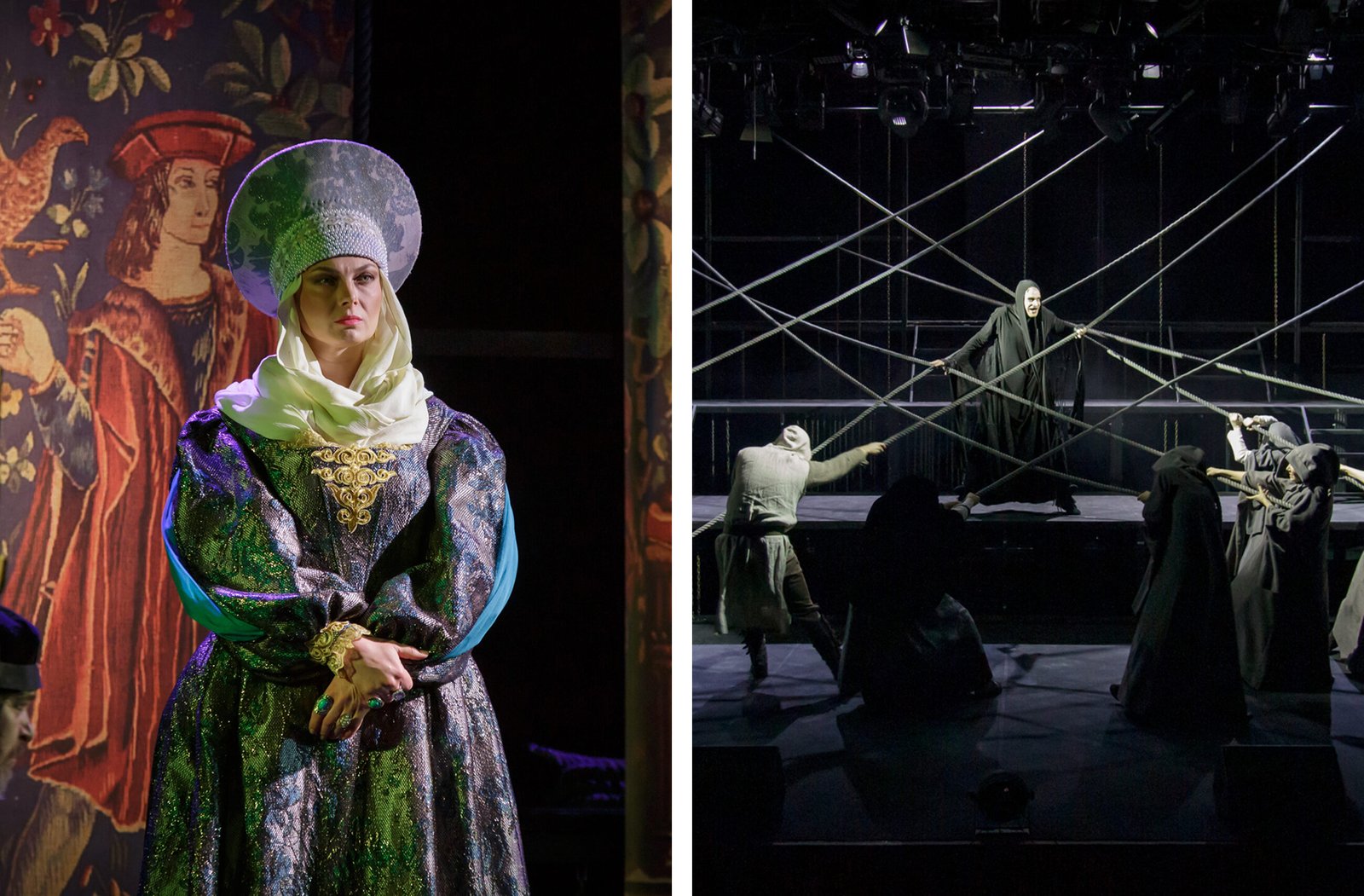
An illustration of this cultural hunger is the enormous demand for the premiere of the play based on Uladzimir Karatkievich’s novella The Chariot of Despair (“Ладдзя Роспачы”) at The Theatre of Belarusian Drama. By the end of December all tickets for the February performances had already been sold out.
Autofiction is being published in Belarus as well. One of such examples is the novel Red Bridge (“Чырвоны мост”) by Navum Halpiarovich, about the coming of age of a Jewish boy in Polatsk (published by Mastatskaya Litaratura). Yet the clear preference is given to fairy tales, magical narratives and utopian-fantasy settings. Readers want to read fairy tales and writers are allowed to create them, which can help to drift slightly away from piercing reality.
The boom in Christmas-themed publications in December, along with folklore-inspired decorations in shopping malls, is therefore not merely a commercial move. It is also an attempt to shield oneself from a grim reality behind a decorative curtain.
Summing up the Year
On November 23 in Warsaw, during the Pradmova Festival, the Association of Belarusian Publishers was founded. Finally, another structure whose necessity had been discussed for years came into being.
The association elected Valiantsina Andreyeva, the head of the Kraków-based publishing house Gutenberg Publisher, as its chair. The organization is preparing to register in Poland but invites Belarusian publishers from different countries to join. Eleven publishing houses participated in the foundation of the Association.
It has been emphasized that abroad, even more than inside Belarus, fragmented book initiatives need cooperation and coordinated action. The initiative group immediately began gathering feedback, launching a survey about readers’ needs.
Interestingly, Radio Free Europe/Radio Liberty (Radio Svaboda) also summed up the results of 2025 in the form of a survey, asking publishers to name their own top three books. (In previous years critics, booksellers and other independent experts had been asked to identify the best titles.) In 2024, the Belarusian publisher even became the collective image of the “Person of Freedom.” The further this process goes, the more publishers themselves are becoming cultural heroes for Belarusians.
The website of the International Union of Belarusian Writers announced a list of the 150 best books of 2025, compiled by Bellit.info. For comparison, a similar list by Ukrainian PEN includes 252 titles. In 2024 the Bellit.info portal published a list of 100 titles. Not all the worthy books of the year, in our opinion, made it into the 150, yet the titles listed still give a general sense of the direction in which Belarusian publishing moved in 2025 (and the list provides a useful guide for readers who did not follow new releases closely).
The portal Reform.news summed up the literary year with a conversation with Tsikhan Charnyakevich, secretary of the International Union of Belarusian Writers. One would gladly subscribe to many of his assessments — including his highlighting of important book series launched this year: Vetrachok (Breeze) (children’s books from the publishing house Roman Tsymberov Publishing) and A Window into Prose (reissues by Gutenberg Publisher of significant books originally published in the 1990s and 2000s).
The author of these lines has also compiled his own ranking of the literary events of 2025.
Acknowledgements
The author of these reports plans to leave the Analytical Group of the Belarusian Council for Culture this year and therefore says farewell to his readers.
At the end of 2025 he wishes to express gratitude to Belarusian media outlets that, despite unfavorable circumstances, did not stop covering cultural events and thus helped to assemble a coherent picture of Belarusian cultural life.
First of all, this thanks goes to the portals Budźma Belarusami! and Reform.news. Special gratitude goes to Reform for launching the project “Cultural Revision” in October, which is, in its own right, a response to the urgent need for art criticism that we have repeatedly noted in our reviews.
Thanks are also due to the authors and moderators of the portal New Belarusian Books for collecting reviews of contemporary literature and for providing a constant opportunity to “check the radar.”
We thank the online library Kamunikat for preserving and continuously expanding the archive of Belarusian books and periodicals. And we sympathize with you over the hacker attack you endured during Christmas.
And of course, we thank Mikita Melkaziorau – for having been.
Cinema: Both Sides of the Border
The main trends of this quarter can be formulated as follows. Belarusian filmmakers abroad continue their path to find their audience. Now we are speaking not only about projects intended for the diaspora, but also about films made within the respective local industries. The trauma of 2020 is a motif that will remain with us for a long time. While some film festivals abroad are flourishing, others seem to be in the state of decline
In Minsk, the new modern multiplex has opened, yet the space for quality cinema continues to shrink. The venue where intimate art-house screenings once took place has been closed. Listapad has clearly turned into a celebration of propaganda, and the Russian market is sending their film production teams to shoot on Belarusian soil.
What unites these two poles is the Belarusian Cinema Day, though it was clearly celebrated differently abroad and in Belarus.
Belarusian Cinema outside of Belarus — Poland, Estonia, the USA, Kyrgyzstan
An important event at the end of the year 2025 was the Northern Lights Film Festival, which took place from November 3 to 23. This year marked the festival’s tenth anniversary, and its gradual transformation is noteworthy. From a simple showcase of films from Nordic and Baltic countries, it has evolved into the largest platform today for presenting new works by independent Belarusian filmmakers.
The Nordic component remains important for Northern Lights, and for several years the festival has also included a program dedicated to Ukrainian films.
The festival once again took place in a hybrid format. Traditional screenings and meetings with filmmakers were held in Warsaw, Vilnius, and Tallinn. Viewers in Belarus, understandably, could see most of the program only online according to a special schedule on the festival’s website. At the same time, some films were inaccessible within Belarus. For example, Nikita Lavretski’s magnum opus Ulysses.
New Belarusian cinema was presented at the festival in the fullest possible scope, of course under the current circumstances. Audiences in three European capitals had another opportunity to see on the big screen the major films made by Belarusians in recent years – the feature films Mara Tamkovich’s Under the Grey Sky and Yuri Semashko’s film The Swan Song of Fedor Ozerov. A number of short films created by Belarusian auteurs living in exile also were screened during the festival.
The Belarusian program at this year’s Northern Lights turned out to be more diverse both thematically and generically. Of course, the theme of repression and emigration remained central. The topics were addressed in Vera Shysh’s animated film The Care Package (which received a special mention from the jury of the Belarusian competition), in the short films Kawalerka by Andrei Korzan, Tomorrow I won’t be Here by Alexandra Tchebotiko, The Letter by Tsimur and Pavel Nedzvedz, and, of course, Judgement of the Dead, a short horror film by Andrei Kashperski. This last short film became the winner of the Belarusian competition at Northern Lights 2025.
Several short animated works also stood out in the program. It is evident that simple auteur animation is more accessible for Belarusians in exile, as it does not require a large team or budget. It was also particularly valuable that films made by Belarusian diaspora filmmakers were shown not only from Poland and Lithuania but from other countries as well (from the Czech Republic to the United States).
The directorial debut of Volia Chajkouskaya, the founder of Northern Lights, took place within the Doc@PÖFF Baltic Competition programme at the Black Nights Film Festival in Tallinn in November. Her feature-length debut Not Made for Politics was produced over five years and once again addresses the painful theme of the events of 2020.
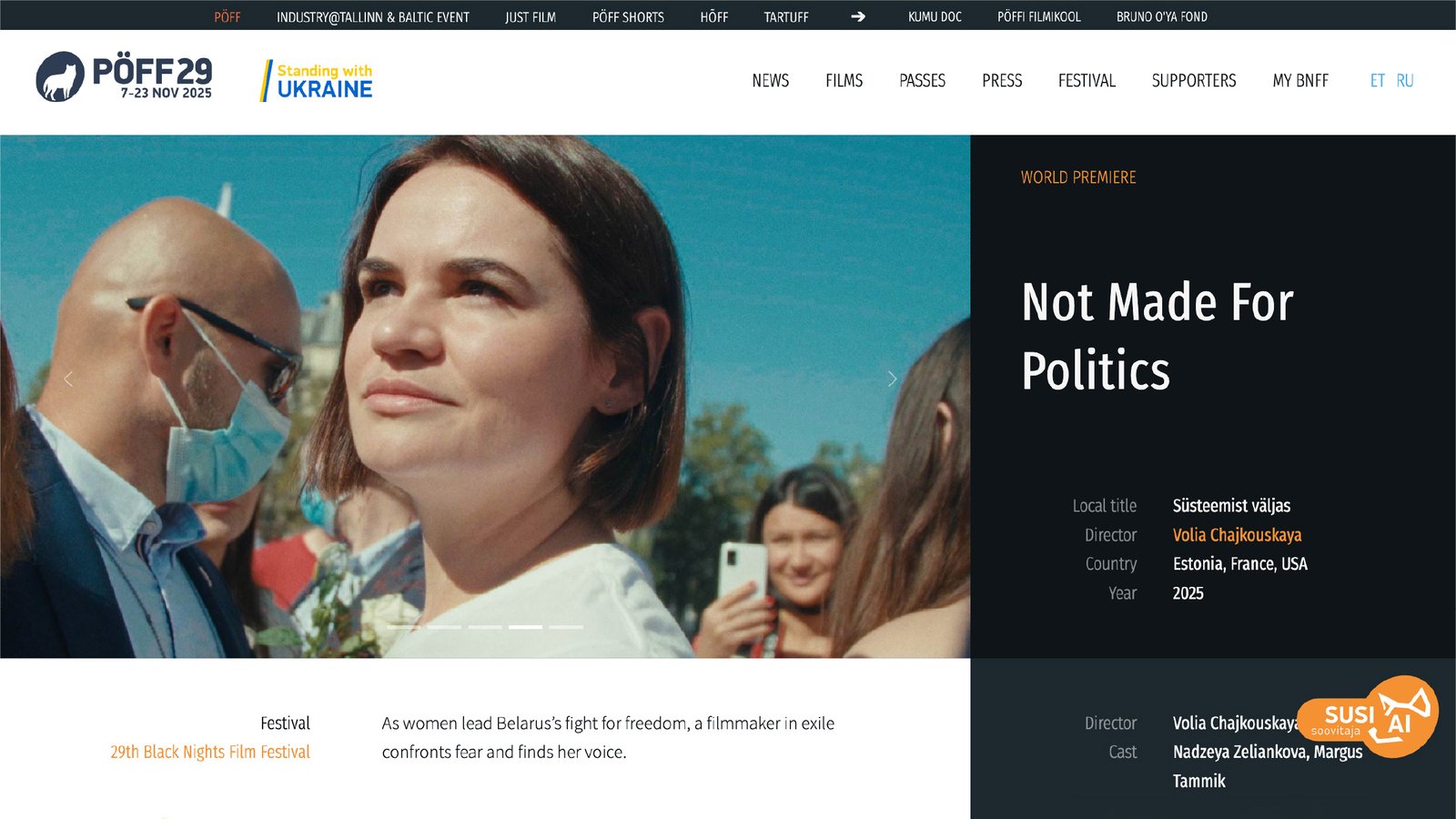
Despite the fact that a number of cinematic responses to repression and mass emigration have already appeared in the public sphere, even five years later this collective trauma remains the main subject of reflection for our filmmakers. It seems likely that the number of films about 2020 and its consequences will only grow, as this new collective trauma has already taken its place alongside the traumas of the Second World War and the Chernobyl catastrophe.
Under difficult conditions and with little funding and limited experience in international production national filmmakers are already creating films noticed not only by Belarusians and intended not only for the Belarusian audience.
The low-budget film Under the Grey Sky by Mara Tamkhovich continues to collect awards, telling the world about the Belarusian drama. Members of the international film critics’ jury FIPRESCI nominated it for the European Film Academy Prize in the category European Discovery. The film received the main prize, the Golden Elephant, at the Mediterranean Independent Film Festival in Catania, Sicily, and the main prize for a feature film at the prestigious independent film forum in Lublin, Poland. In December, the film became available for streaming in several countries on HBO Max, and at the end of the year it received the Krzysztof Krauze Award from the Polish Directors’ Guild.
The screenplay for Aliaksei Paluyan’s future film Heritage won the Hesse Award for Best Screenplay in December and is now preparing for production.
A new film by Darya Zhuk, titled Exactly What It Seems and based on a short story by Tatsiana Zamirovskaya, is also preparing for shooting in 2026. Both have long lived in New York. The project was selected for the industry program of the Festival of Central and Eastern European Cinema in Cottbus, Germany. Likewise, the project August by director Nela Agrenich was selected for the Industry programme of the Warsaw International Film Festival.
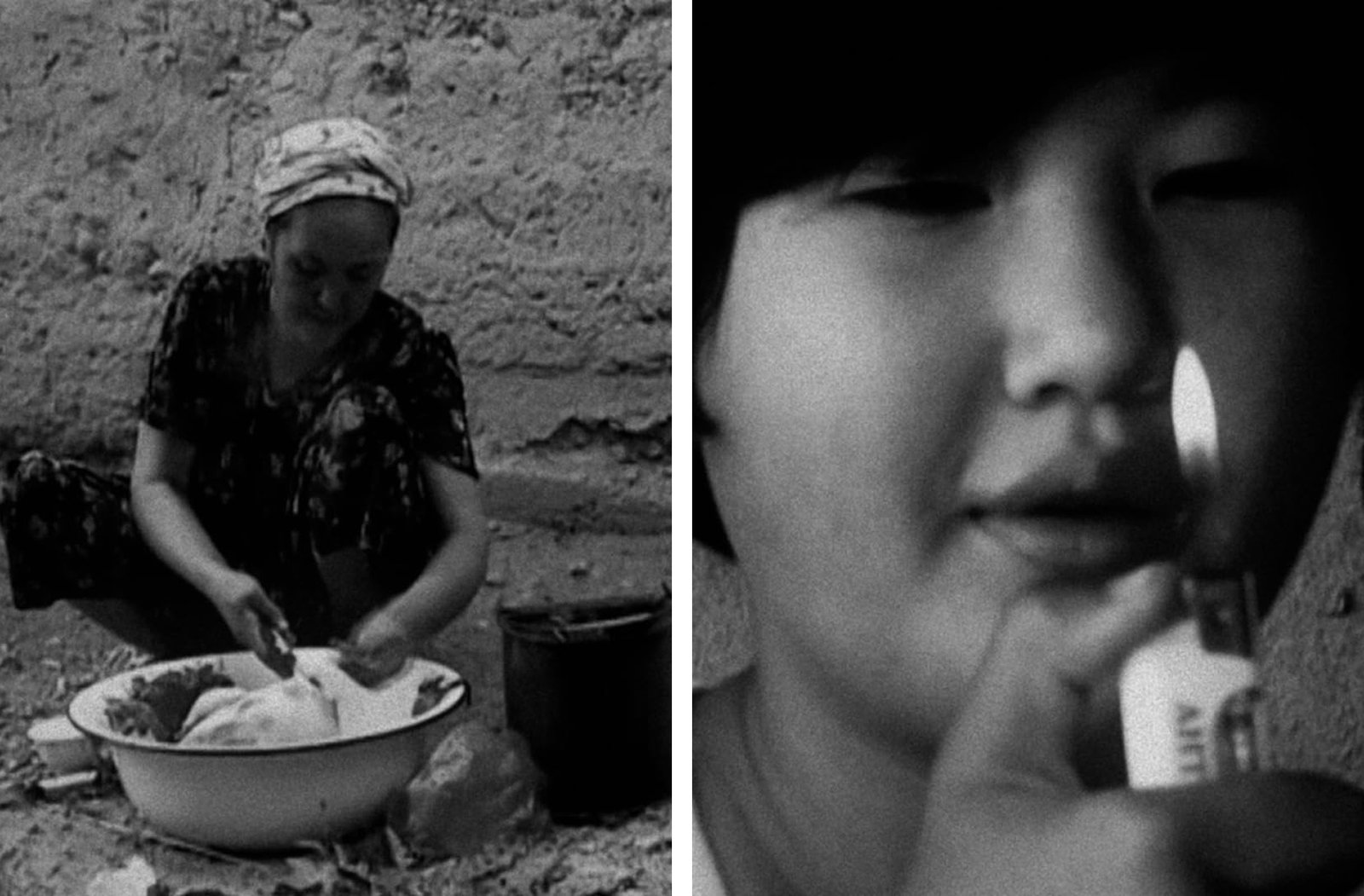
Another path for Belarusian filmmakers in the diaspora is to work with stories that come from the countries where they now live. For example, the debut feature film I Lit the Fire! by Valeria Lemeshevskaya, who currently lives in Bishkek, tells the story of a girl from the Batken region of Kyrgyzstan. The film participated in the competition of the prestigious Doclisboa Festival in Lisbon and received an honorary mention from the jury.
From October 24 to 26, the first Tamara Sołoniewicz Documentary Film Festival took place in Narewka in Podlachia. Sołoniewicz was one of the founders of the Polish documentary reportage tradition. The festival was devoted to films about the culture and unique characteristics of Podlachia region and the Białowieża region. The documentary Our Memory by Yuri Kalina, created by Belsat TV together with the Belarusian Cultural Center in Białystok, as well as the film Belarusians Are Going to Podlachia by Artsiom Lobach, both received special jury prizes there.
Meanwhile, it will become more difficult for citizens of Belarus to make films in Europe. On October 1, a new version of the state funding rules of the Lithuanian Film Centre (Lietuvos kino centras) came into force. According to these rules, state funding cannot be granted to projects involving citizens of Belarus, Russia, and other countries listed in the official register and that is regardless of whether they hold residence permits in Lithuania. It is worth recalling that a Lithuanian company served as the main producer of Yuri Semashko’s film The Swan Song of Fedor Ozerov..
Financial difficulties were cited by Janusz Gawryluk as the reason for the absence of his cult festival Bulbamovie (Potato Film Festival) from the 2025 festival schedule. Since 2011 the festival has taken place, although with some interruptions, in Warsaw, Białystok, other locations in Poland, and even Belarus. Initially it aimed to introduce Polish audiences to new Belarusian cinema, but it soon became one of the key platforms for independent filmmakers. However, during the symbolic “funeral” of Bulbamovie in Białystok on December 17, it was announced that the project might still return next year.
Meanwhile, the Belarusian Filmmakers Network launched an open call for an AI film laboratory. The organizers promise training sessions and master classes for selected participants, with the goal of producing films based on their own scripts using artificial intelligence.
Meanwhile, Cinema in Belarus
While Belarusians living abroad are trying to build their own cinema, those inside the country are forced to rely on pirated internet sources. The number of places screening art-house films in Minsk has decreased even further: the Monochrome space (the Cinemascope initiative) has closed, although film screenings had been its primary activity. It is unlikely that the new multiplex in the CITYMALL shopping centre will significantly improve the situation with the cinema scene in the capital.
Festival and art-house screenings on the big screen in Belarus have been reduced to a minimum. Much of the intellectual audience for whom they were intended has left the country.
The Minsk International Film Festival Listapad, which this time took place from October 31 to November 7, has for several years now lacked its former intellectual and internationally relevant level. It is worth recalling that since 2021 the festival has been managed by specially gathered festival heads under the National Film Studio Belarusfilm.
The programmes, which now consist of eight competitions, are filled according to an agitation-and-propaganda principle aligned with so-called “traditional spiritual and moral values.” Naturally, films are not accepted if they “promote war, extremist activity, violence and cruelty, social, national, religious or racial intolerance or hostility, pornography, or non-traditional sexual relations and/or sexual behavior.”
In reality, this censored regulation turns the festival into a bureaucratic, nomenklatura-style “celebration.” The cinema halls are filled with schoolchildren and students through the familiar method of compulsory attendance. The event lies under the shadow of the so-called “Russian world,” since even the official website of the “new” Listapad does not have a Belarusian-language version. Accordingly, the programme is structured under the banner of its most honored guests that of the filmmakers from Moscow.
The few examples of contemporary festival cinema included in the programme appear there solely to demonstrate a nominal “international level.” Non-Russian-language films are mostly invited from politically friendly countries according to a “fraternal” principle in order to broaden the geography, and as a result often possess doubtful artistic value. In this sense, the 2025th Listapad differed little from the four previous editions.
Belarus at the festival was represented by the new film The Turning Point by Dmitriy Soroka, a debutant in feature-length fiction cinema. On November 27 the film was released nationwide and was accompanied by slightly less promotional and propaganda noise than The Class Teacher, the previous premiere from Belarusfilm. Nevertheless, cinema halls during its screenings were filled in the usual way with state employees and students.
As for The Class Teacher, the propaganda efforts surrounding its promotion unexpectedly continued in the YouTube show O(b)suzhdaem (Let’s Discuss/Let’s Judge). The episode was initially removed by the platform’s administration following a complaint from Belarusfilm, but after explanations from the authors it was eventually restored.
Neither the first nor the second Belarusfilm “blockbuster” generated much public resonance. Among the state-funded Belarusian films, only the screen adaptation of Uladzimir Karatkievich’s novel The Black Castle left any noticeable trace in discussions this year. It was precisely in the autumn that the film finally appeared in good quality on pirate websites, where the majority of Belarusians now watch contemporary cinema.
Despite carrying the banner of the National Studio, however, the film was made under the direction of a Russian filmmaker and with the Russian film market in mind.
The latter continues to expand actively into Belarus. From December 12 to 14 the Moscow Cinema theatre in Minsk hosted the Festival of Russian Cinema Belarus 2025. The event was organised by the Moscow agency ROSKINO with the support of the Russian Ministry of Culture, and admission to the screenings was free.
The presence of Russian cinema in the country is felt not only through Russian premieres in Belarusian theatres but also through numerous joint projects and initiatives. Currently in production at Belarusfilm is the film Father Minai. A Partisan Legend, directed personally by producer (of well known Brest Fortress) and actor Igor Ugolnikov.
Collaborative projects with Russian regional studios are also being announced, including films “about the heroes of the Special Military Operation” and even a film about the Minsk years of Lee Harvey Oswald, the alleged assassin of US President John F. Kennedy. The latter project has unexpectedly attracted the interest of Aliaksandr Lukashenka.
Yet there remains one point where the current in-house film propagandists of Belarusfilm and independent nationally oriented filmmakers in the diaspora still converge. December 17 is considered the symbolic starting date of the history of national cinema on both sides of the border.
In Minsk the day was celebrated with a traditional concert in the style of the Panteleimon Ponomarenko era and was completed with obligatory speeches and certificates.
In Warsaw, meanwhile, two new projects by Andrei Kashperski were presented on December 17. The director hopes that both The Judgement of the Dead, the aforementioned winner of the Northern Lights Film Festival, and the new project Swingers will grow respectively into a feature film and a series (with hopes to reach Netflix.)
It is obvious to whom we wish success.
Theatre: Remodelling Toward a Russian DNA
The final months of 2025 brought with them yet another ban of the theatre production alongside the fresh signs of tilting toward Russia. At the same time, the Republican Theatre of Belarusian Drama (Theatre of Belarusian Drama) toured China, and individual Belarusian artists continued to gain successes abroad. Theatre is alive — but before our eyes it is becoming increasingly Russian in language, repertoire, and infrastructure.
The Production Ban at the Belarusian State Puppet Theatre
The most significant and deeply symbolic event of autumn 2025 was the ban of the play Sisters Grimm, a production that never made it to the stage of the Belarusian State Puppet Theatre. The process stopped at the “home stretch” stage. A committee from the Ministry of Culture, which conducts preliminary censorship of all productions, attended the closed staging of the play. Less than 24 hours before the scheduled premiere, the decision was made to prohibit further stagings. It was later reported that the committee from the Ministry of Culture deemed it ‘too dark’ and too gloomy to give it the necessary ‘green light.’
Ban of Sisters Grimm was not the isolated case, though such bans remain relatively rare in absolute numbers. Over the past five years, such productions as Final Essay (“Кантрольнае сачыненне”, Young Spectator’s Theatre (TYuZ), December 2020), Till («Ціль», National Academic Drama Theatre in the Name of Yakub Kolas, November 2021), and The Duchess from Chicago («Герцагіня з Чыкага», The Belarusian State Academic Musical Theatre, September 2022, though this production after revisions finally had its premier two months later) had been banned. The cancellation of Sisters Grimm thus became the fourth such ban in the series, and the third production that never reached the audience at all. In reality, however, the number is higher: censorship (not even to mention the existing self-censorship) often works in a so-called pre-emptive way, preventing projects from even entering rehearsal plans.
What makes the case particularly symbolic is that this time the committee targeted a production by Evgeny Karnyag, who is commonly regarded as the most successful and popular among Belarusian theatre directors working today. Over the past year, the Minsk Puppet Theatre has seen a steady rush at the box office. Criticism towards Karnyag’s productions has become almost a sign of a bad taste (while, it is worth remembering, that for critics that remain in Belarus, any kind of open critique has long been nearly impossible). The ban demonstrates that no one is immune from censorship and that previous informal “rules of the game” no longer apply. Whether and how this will affect the theatre’s future development remains unclear since we can observe that full creative freedom can no longer be assumed.
Leaning Toward Russia, Performing in China
Until this autumn, The Puppet Theatre Lyalka in Vitsyebsk had staged productions exclusively in Belarusian. However, in October 2025, the theatre premiered the production The Girl and the Bear («Дзяўчынка і мядзведзь») in Russian. This leaves us with only three theatres in Belarus performing exclusively in Belarusian language: the Theatre of Belarusian Drama, the Janka Kupala National Academic Theatre, the Yakub Kolas National Academic Drama Theatre. Ironically, Russian actors at the Janka Kupala National Academic Theatre have become guardians of the Belarusian language on the Belarusian stage. Yet even the head of the Theatre of Belarusian Drama, Svetlana Naumenko, announced last summer that Russian-language productions might appear in theatre’s repertoire in the near future, and the number of fully Belarusian-language theatres may soon shrink to two.
This is not merely a story about the ongoing Russification. In recent years, Russian companies have put their increasing funds in Belarusian culture in an attempt to tighten relationships between the Russian and Belarusian institutions. Under the banner of The Union of Theatre Workers of the Russian Federation operates the Centre for the Support of Russian Theatre Abroad. It regularly organizes theatre laboratories and workshops that take their place in Belarusian theatres during international festivals and as stand-alone initiatives.
The mechanism works in such a way that the Centre directs several Russian directors to Belarus. Over the course of several days, they prepare sketches with local ensembles such as fragments or conceptual outlines of potential productions. After a final presentation, theatre management selects one sketch to develop into a full production. Russia covers the costs of the director’s work and stay (and, if needed, of their team). Preference is naturally given to Russian classics and contemporary Russian drama. When domestic funding is scarce and Russian partners are willing to pay, few theatres decline. Repertoire planning gradually adapts to this format.
Since going on tours to Russia is typically covered financially wise, few theatres refuse such invitations. A state newspaper “Культура” (The Culture) recently wrote of a production of Yadviga (“Ядвігa”) at the Mahilou Regional Theatre (based in Babruisk): “It is quite clear, that a long and happy life awaits the production ahead, and not only on Belarusian stage, but on Russian as well. So, there is no coincidence that the production was staged in a Russian language since we are hoping for future successful tours.” With no intention to bad-mouth the theatre, we are going to admit that their productions typically do not reach the decent standards. But it is obvious that, by translating Andrei Dudarau’s Belarusian-language play into Russian, the theatre aims to tour Russian cities.
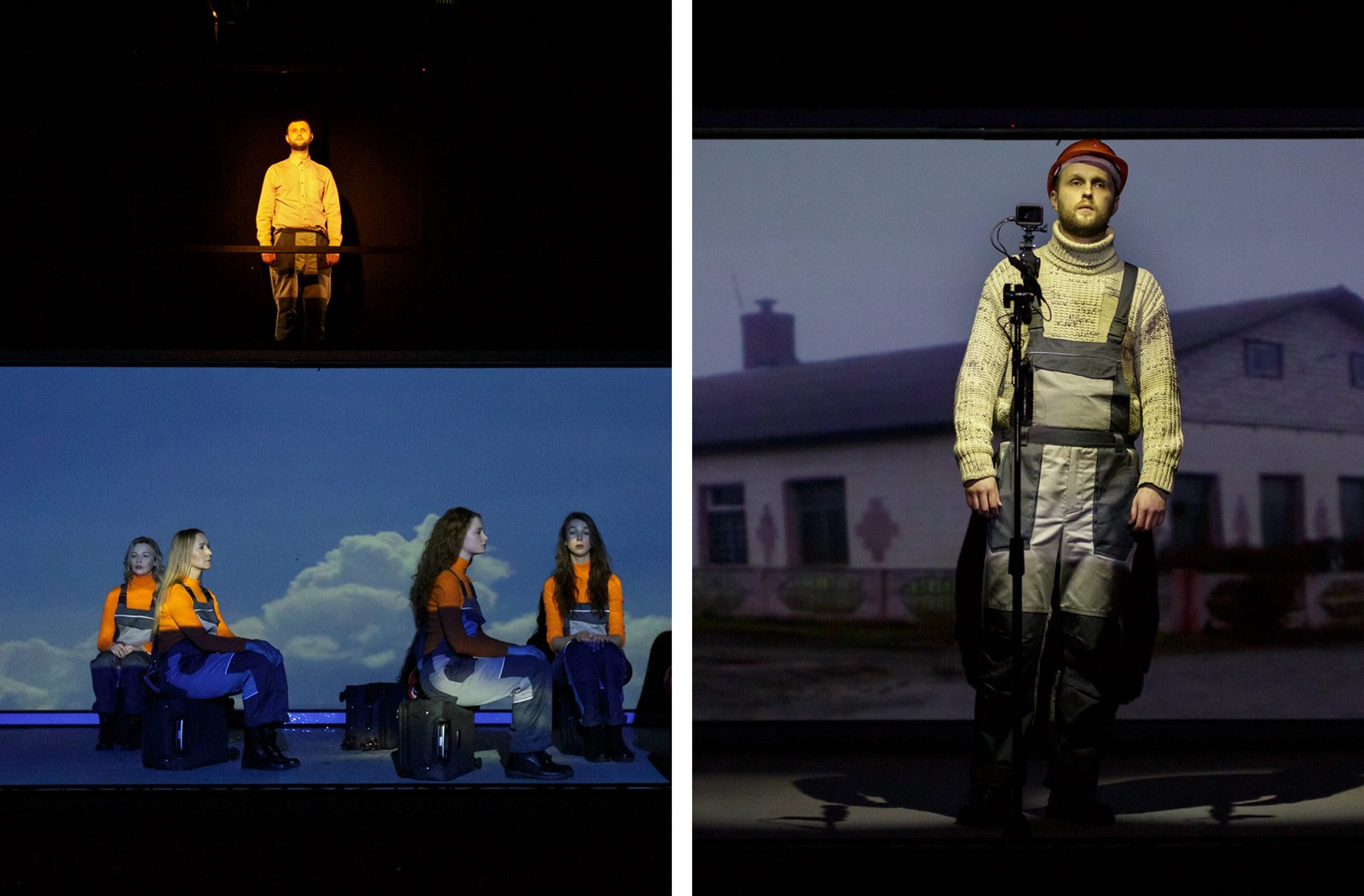
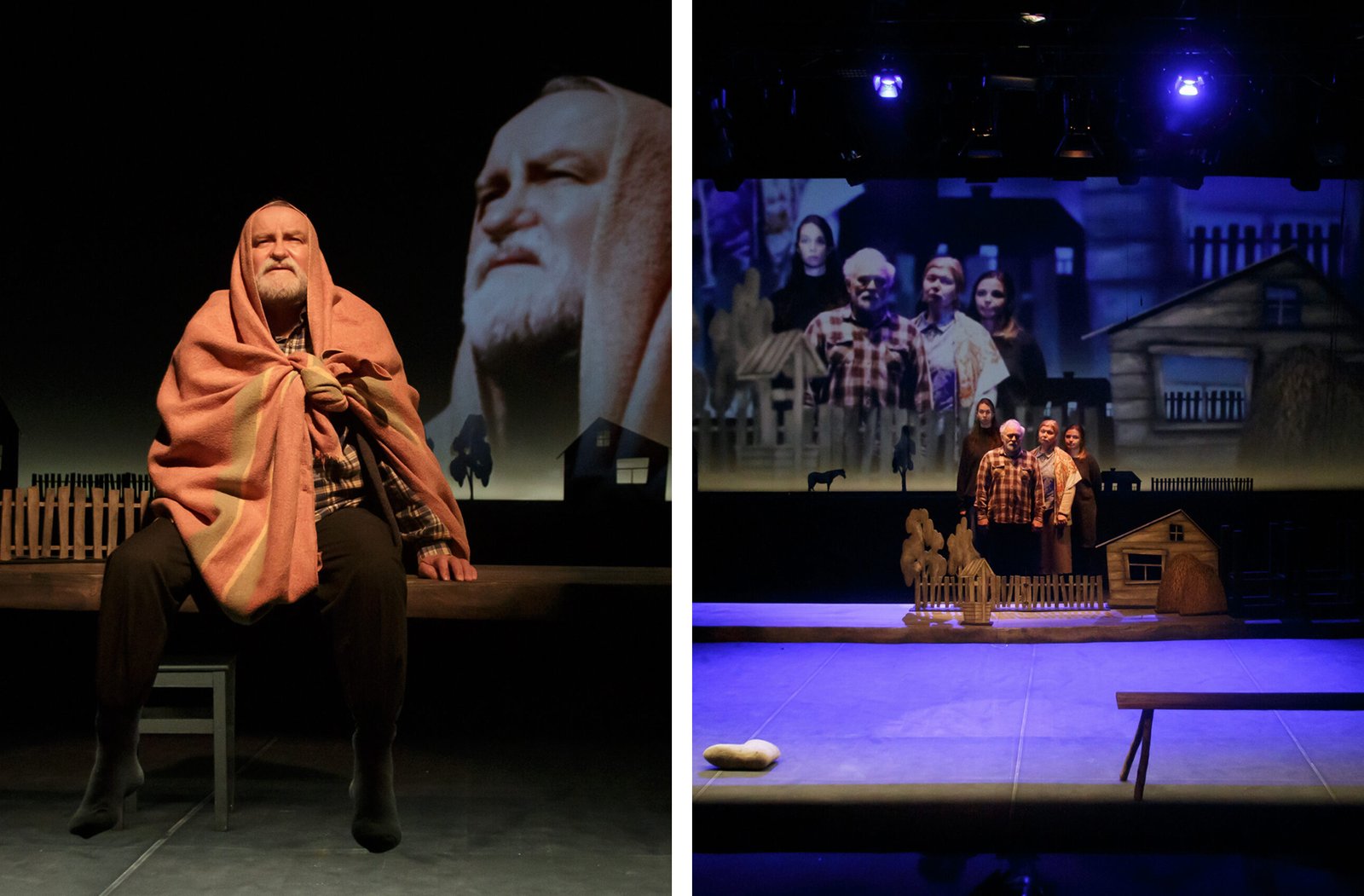
And these are not the only cases, when language is used as a tool in helping theatres to travel with their productions abroad. For the first time in its history, The Theatre of Belarusian Drama toured China, presenting the productions of My Homeland and Evening at a festival in Shanghai in Belarusian with English and Chinese subtitles and so demonstrating that Belarusian itself poses no obstacle when opportunities and organisational capacities are present. The trip also marked an important achievement for Anastasiya Vasilevich, head of the Centre of Belarusian Drama, who initiated and successfully organized the stagings of the productions in Shanghai.
Background Actors at the National Theatre Award
In 2025, the National Theatre Award once again summed up the year’s achievements. In its early years, winners were selected by a jury composed of theatre professionals. Over the past decade, however, decision-making authority has shifted toward state officials. The identities of jury and selection committee members are no longer publicly disclosed. Instead of professional theatre critics there are representatives of the Ministry of Culture, which at times tend to give awards to their own favorites. Nominee’s names are also at times not fully transparent and not present on the nominee lists.
In the 2020s, the role of the state officials within the National Theatre Award decision-making became increasingly apparent. Thus, the National Theatre Award became a compromise between artistically serious productions, and those productions and theatre troupes whose recognition is necessary for the state officials.
In 2025, the National Theatre Award had set a new record. 37 productions from 27 troupes were admitted to the final stages. For the first time, students from the Belarusian State Academy of Arts and the Belarusian State University of Culture and Arts participated. Almost all professional troupes were included, with only a few regional theatres absent (troupes from Slonim, Pinsk and Mazyr were absent, as well as drama theatres from Vitsyebsk and Hrodna).
With such a number of nominees, the award resembles a survey of the year’s output rather than a competition among professionals. This year also set a record in the number of special diplomas. In one section, beyond the main winner, additional productions were recognized “for spiritual and moral education of children and youth,” “for artistic achievements in children’s theatre,” and “for best ensemble performance.” Of seven nominated productions in that category, four received some form of recognition.
The award’s principal value now lies in enabling regional theatres to present their work in Minsk since for them there are only limited ways to find the funding for traditional. For Minsk audiences, it offers a rare chance to see and experience regional productions. Internationally, however, the award has little impact: Belarusian productions remain largely absent from festival circuits abroad.
Although, it is worth mentioning that the award program reflects broader trends. Nine out of thirty-seven productions addressed World War II themes (while the tenth one, the Brest Puppet Theatre production of the play The Cow, touched on the topic indirectly). And, even more striking, that 19 of 37 productions were based on works by Russian playwrights or composers. While some represent global classics (such as operas by Tchaikovsky or Prokofiev), many of the productions could have easily been excluded from the program and Belarusian or European authors could have filled the repertoire instead.
It is quite clear, the prominence of World War II narratives is tied to the state officials’ demands. The prevalence of Russian authors, however, may stem more from self-censorship and from the desire to avoid the committee’s censorship since the Russian plays much more harmlessly avoid it. Also, as was mentioned before, Russian plays receive better financial support. Thus, choosing Russian material often entails fewer approval risks and sometimes better financial support.
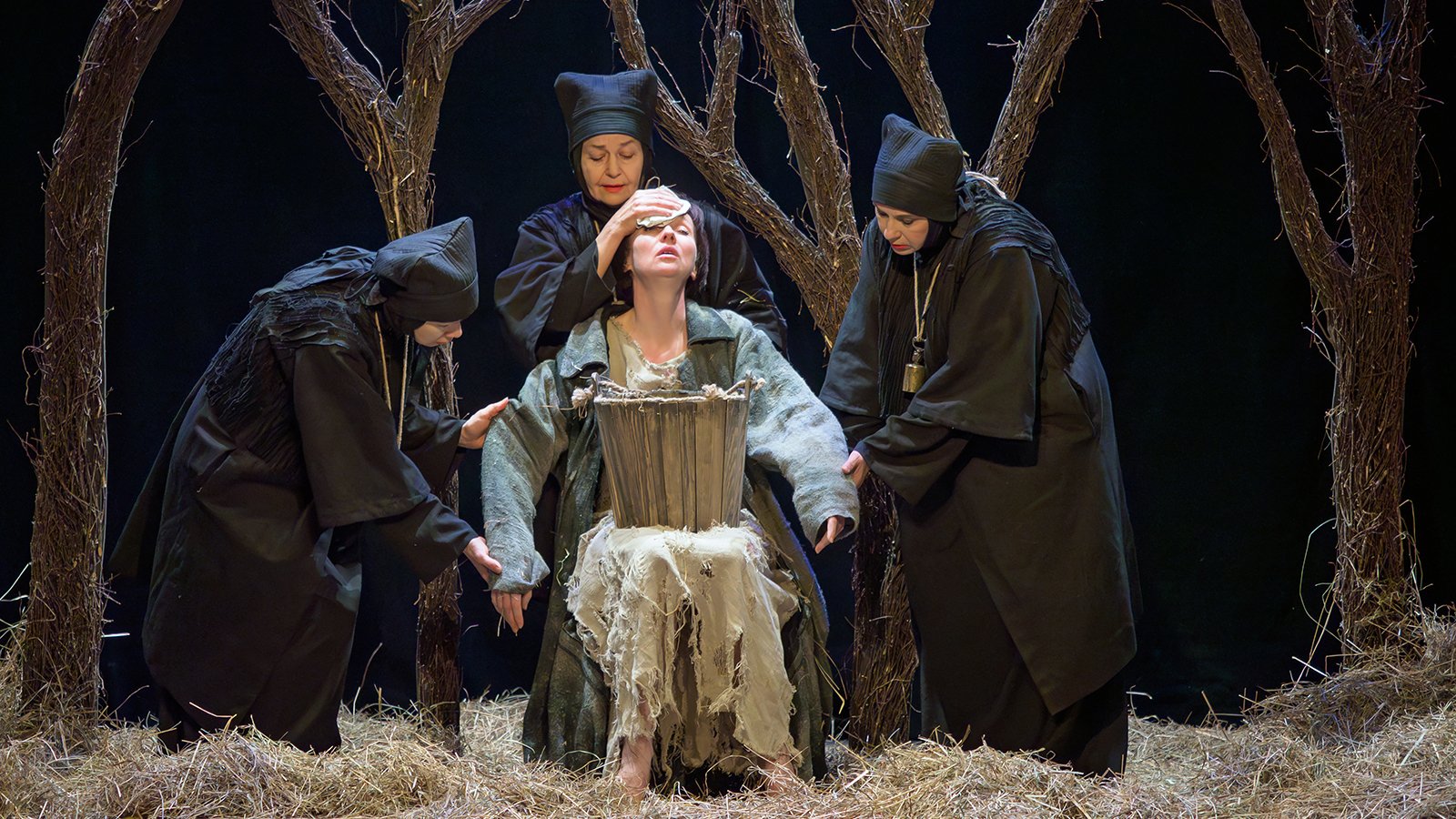
Among the winners, Evgeny Karnyag received Best Director award for the Puppet Theatre’s production of the play titled Haze (Mroiva, «Мроіва»), while the military-themed play titled «Бах-бах-бах» (The title imitates the shooting sounds) from Mahilou was named Best Production. Karnyag’s Smart Dog Sonya («Разумная сабачка Соня») also won the award for Best Production for Children and Youth.
Another noteworthy recognition went to 28-year-old David Razumov for his Gorky National Academic Drama Theatre’s production of the play Faust. A Deal with the Devil («Фаўст. Здзелка з д’яблам»). Production received the award for the Best Drama Production for a Large Stage. Such recognition may signal a gradual departure from the traditional habit of labeling directors “young”, when they are already well into their forties, which is still a persisting peculiarity of local cultural discourse.
Individual and Collective Achievements
The end of 2025 brought a new wave of successes for Belarusians.
Opera singer Oksana Volkova performed the leading role in Carmen at the Metropolitan Opera. She had already previously appeared on the same stage of one of the world’s most prestigious opera houses, but this time she took on the leading part.
Conductor Dmitry Matvienko made his debut at the Paris National Opera.
The production of The Cranes Are Flying by the Irkutsk Regional Musical Theater Named After N.M. Zagursky received four awards at Russia’s national theatre awards Musical Heart of Theatre. The production was directed by Belarusian director Anastasiya Grinenko, with choreography by her husband Dmitri Yakubovich.
From individual achievements, we move to collective ones. BLISKI WSCHÓD international theatre festival took place in Lublin, Poland and this time the forum was almost entirely dedicated to issues of theatre and to the Free Kupalauсy troupe. Two premieres were presented there: Wolves, based on Eva Viežnaviec’s novella What Are You Looking For, Wolf? (“Па што ідзеш, воўча?”), and a monodrama by Alexander Kazela. Both of the productions were directed by Pawel Passini.
The forum also featured performances of such productions as Geese–People–Swans, Zek-ameron, My Bread, The Comedy of Judith, Extremists, Dziady, and The Suitcase (“Гусі-людзі-лебедзі”, “Зэкамерон”, “Moj Hleb”, “Камедыя Юдзіфі”, “Экстрэмісты”, “Дзяды” і “Валізка”). This testifies to the scale of Kupalaucy’s work and demonstrates that both the troupe’s activity and, more broadly, Belarusian festival theatre life in Poland continue.
Symbolically, at Belarus’s request, Russia issued an arrest warrant for several members of the Free Kupalaucy troupe – Zoya Belokhvostik, Alexander Gartsuev, Valentina Gartsueva as well as for their former colleague Kristsina Drobysh.
At the turn of September and October, the Belarus Free Theatre presented the first staging of the production Urząd Przyjemności in Warsaw. Directed by Yuliya Shauchuk and Raman Shytsko, the production is the debut of the troupe’s experimental Warsaw-based branch.
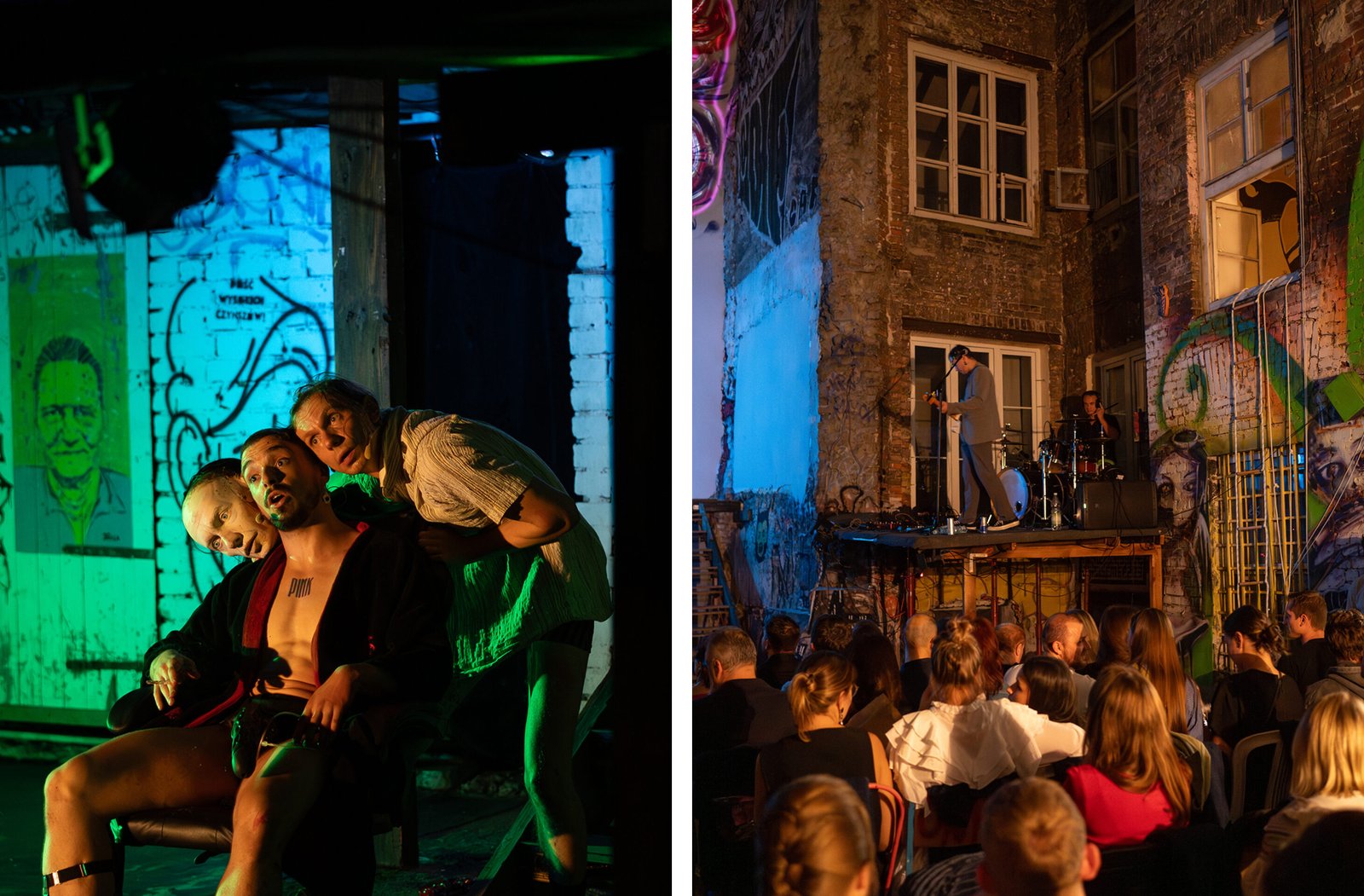
At the forum in Lublin took place the premiere of the Polish-language anthology of the new Belarusian drama Niekończący się sierpień (August without End). Brought together by Irina Lappo and Henryk Mazurkiewicz, the production is composed out of six plays about the events of 2020 and their aftermath.
Attempts to process contemporary reality are also being made in the Russian-language theatre sphere. Three works by Belarusian playwrights were shortlisted for the Lubimovka award: Maxim Dosko (Insula), Renata Talan (Limbo), and Khasia Korneva (The Red Squirrel). Lubimovka is an independent project for playwrights writing in Russian language. Their works address war, protests, and the consequences of these events. Belarusian playwrights are forced to seek foreign platforms in Poland and Russia since the Belarusian stage remains inaccessible to them. With the exception of Julija Cimafiejeva’s play Emigrants, published in the Polish anthology, these plays have yet to reach the stage, and such prospects remain uncertain.
In exile there is an evident lack of finances and inside Belarus, there is a lack of opportunity. The authorities have effectively blocked even the possibility of addressing contemporary issues. An apolitical thematic focus becomes an alternative, and state recognition helps such works to reach the stage. For example, Vlada Olkhovskaia won this year’s National Literary Prize in the Drama category, and her romantic-comedy thriller Titanium Witch was staged at the Yakub Kolas National Academic Drama Theatre. Since the play is commercially oriented, Vlada Olkhovskaia’s work was eventually translated from Russian into Belarusian.
Changes in Staff and Small Venture into Cinema
Several changes in staff took place. At the Gorky National Academic Drama Theatre, Natalia Gromyko succeeded the late Eduard Gerosimovich its head. The appointment may have been lobbied by Ruslan Chernetskiy, who is not only Minister of Culture but also an actor at the theatre and had long worked with Gromyko.
Ruslan Safonov was dismissed from the New Drama Theatre after only three years of occupying the position. The reasons remain unknown, and the position was still vacant at the time of writing of our report. At the Mahilou Regional Drama Theatre, Sergei Yaskevich became the chief head, replacing director Dmitriy Nuyanzin, who moved to the Minsk Regional Puppet Theatre Batleika located in Maladzyechna. Yaskevich had appeared out of nowhere five years ago in Hrodna and left little impression. His troupe was not even represented at the National Prize this year.
Sergei Yaskevich in his own right was replaced by little-known Russian director Alina Sorokina. The theatre’s head, Olga Bogdanovich, has also taken on directing duties. During preparations for The Demon and the Woman («Чорт і баба»), she also served as the production’s co-director, and her children’s fairy tale Kabuba Looks for Friends («Кабуба шукае сяброў») was staged there as well. This reflects a broader trend of individuals occupying multiple positions across institutions. At the Theatre of Belarusian Drama, its head Svetlana Naumenko works as a stage director as well; at the Belarusian State Youth Theatre, Vera Poliakova also performs as an actress. Similar overlaps occur in exile, where non-professionals are sometimes invited to act. For instance, playwright Diana Balyko appeared in the production of the play The Order of the White Mouse («Ордэн Белай Мышы»), while writer Hanna Zlatkouskaya performed in Yomakho Yomaso (“Ёмахо Ёмасо”) at the Tutejshy Theatre (the production is based on her own play).
In general, contemporary Belarusian productions are rarely available online, with the exception of several Kupalaucy performances on YouTube. Toward the end of the year, however, there were a few welcome exceptions. In Minsk, a television version of the production of the play The Idiot, based on Dostoevsky’s novel and directed by Ivana Zhigon at the Gorky Theatre, premiered (though it did not enter open access). In Warsaw, the poetic-musical film-performance JAN, based on the works of Jan Kochanowski and directed by Andrei Sauchanka at the Tutejshy Theatre, was screened and is now available online. Given the dispersal of Belarusians around the world, such initiatives help audiences experience the part of a shared cultural space.
Music: The Dissolution of the band Petlia Pristrastiya [Noose of Passion], Alexei Khlestov’s return, and a popular festival gets cancelled
The Belarusian music scene continues to feel like an emotional roller coaster. From October to December 2025, we took notice of some strong new releases, of the return of Alexei Khlestov, and of the solidification of rapper Pazniaks’s position as the major breakthrough of the year. At the same time, we watched the departure from the stage of the band Petlia Pristrastiya [Noose of Passion], felt disappointed in Maybe Baby over her collaboration with the Liberal Democratic Party of Russia for what is said to be a humanitarian aid, and were saddened by the authorities’ deeming Radio Plato an extremist formation.
The emergence of new stars and the return of the old ones
One of the breakthroughs of last year is 21-year-old rapper Pazniaks from Hrodna, who with his brisk rise to fame quickly became a true Belarusian star. Literally within a few months, the rapper went from being an unknown artist to one collaborating with major performers.
Pazniaks, who is the Grodna native, also released a joint track with the Zhabinka-born singer Maybe Baybe titled Zhabinka–Hrodna. The track Zhabinka–Hrodna, aims to emphasize artists’ roots. The music video for the track was not filmed in the aforementioned cities but was shot in Minsk instead.
Maybe Baby also drew a somewhat controversial attention through her collaboration with the Liberal Democratic Party of Russia in sending humanitarian aid “to the SVO zone” (Russian side of the war in Ukraine). The Party’s social media posted a photo of the singer together with the party’s leader, Leonid Slutsky, in front of a vehicle loaded with humanitarian supplies. The artist did not announce this move on her own social media accounts. Earlier, there had been rumors that Maybe Baby had been placed on blacklist and that her tour was under the threat of cancellation.
Representatives of the old Belarusian music school start to come back. A video featuring Alexei Khlestov, who is now forced to work as a taxi driver after he was blacklisted in 2020, went viral on social media. Belarusians around the world started making their own videos in support of Alexei. Meanwhile, people living in Belarus call taxis and sing together with the artist.
This gave Alexei a new life as an artist. He is now active on Instagram: Alexei streams and records videos. Also, recently he sang together with Inna Afanasieva, who is yet another Belarusian artist who has been blacklisted.
There were also some of the artists who decided to use and capitalize on the light of this attention. One of them is the lead singer of the band Bez Bileta, Vitaly Artist, who posted a video where he is clearing the field, which is going to be used as a retreat spot this summer. He also went to Crimea and recorded the track Old Ones (Oldy, “Олды”) together with the band Tyani-Tolkai (Pull-Push).
Outside of Belarus, Belarusian artists continue to reach for new heights. Molchat Doma submitted themselves for Grammy consideration in the Best Alternative Performance category. And Domsun appeared in a Polish mobile operator’s commercial for the release of a new iPhone.
The band СОЮЗ (Union – SOYUZ) released their Belarusian-language album titled KROK (Step) on the British label Mr Bongo and is set to embark on a European tour this year to support the album. The band alongside other Belarusian artists was also mentioned in the British online magazine The Quietus in an article dedicated to the music scene of Central and Eastern Europe.
Once again, the singer Max Korzh proved and demonstrated his ability to sell out a whole stadium within a short period. Earlier in December Max announced his 2026 spring concert in Bucharest and the tickets went sold-out within only nine days. It is worth noting that his Kazakhstan concert, which was set for 23 May 2026, had been canceled.
The Minsk-based band Intelligency went to Texas to take part in a space tourism program at SpaceX’s Starbase facility. The artists as participants of SpaceX’s program went through interviews, received recommendations on improving performance metrics. The band also combined the trip to Texas with a small tour.
Meanwhile, song of the band Barysauski Trakt became the soundtrack for the film Turning Point (“Переломный Момент”), produced by Belarusfilm.
Bands leave the music stage against the backdrop of repression
The Belarusian music scene suffered some major losses. The most overwhelming one is the departure of Petlia Pristrastiya’s vocalist, Ilya Charapko-Samakvalau. After completing a large-scale European tour, the band suspended its activity. For now, there are no indications that Petlia Pristrastiya plans to continue or is in search of a new frontman. Ilya himself has repeatedly stated that he is not leaving music and intends to focus on his own projects.
Former Eurovision song contest participants, the band Litesound, left Belarus and moved to Lithuania where they took part in a televised talent competition and went even further by impressing the contest’s jury. In March 2023, the Karakin brothers were sentenced to two and a half years of what is called “home chemistry” (a form of house arrest) for their participation in protests. It is worth mentioning that their parents were also punished. Both of their parents received the same “home chemistry” sentencing. Their mother was sentenced to two and a half years of house arrest, while their father to three years of the same sentence.
The frontman of the Mahilou-based band Serdce Duraka (The Heart of a Fool) Timofei Yarovikov, also left Belarus. In December 2025, he performed a free online concert for Ukrainians. It is also worth mentioning that Timofei conducts his workshops as well.
Belarus’s festival scene has also suffered its setbacks – and this time from an unexpected direction. The organizers of the festival Solncestoyanie (Solstice) announced that they had not been included in the official registry of organizers of cultural events. This fact means that the festival will not take place in 2026.
One of the festival’s organizers is Alexander Zaitsev, a businessman who previously owned the football club FC Dynamo Brest. In 2024, he registered a legal entity under the name Solncestoyanie and over the past two years, most of the festival’s headliners were Russian artists who publicly supported the aggression against Ukraine.
This announcement of the Solncestoyanie cancellation drew numerous disappointed comments, with some users even writing letters to the Ministry of Culture in an attempt to have the festival back for the summer.
While the cancellation of Solncestoyanie came as a surprise, the ongoing last-minute cancellations of local concerts, which sometimes get cancelled just days before the events take place, have become a routine in Belarus. This not only prevents artists from pursuing their careers but also worsens the financial situation of venues that host events.
Nevertheless, Belarusian musicians continue to perform both in Belarus and abroad and new projects continue to emerge within the Belarusian music scene.
Journalist Aliaksandr Charnukha started the new show Sepultura Alive. In itself the show is a series of online concerts featuring performances by Belarusian bands. Naviband, “Разбітае Сэрца Пацана” (RSP – Boy’s Broken Heart), and :B:N have already taken part in the show.
All of this unfolds against the backdrop of cultural figures being deemed extremist and outside the law. The project Radio Plato has been labeled an extremist formation, while several music videos by the band Dymna Lotva have been deemed to be extremist materials.
Veterans of the Belarusian music scene return and new voices secure their place
The fourth quarter of 2025 brought with it some strong new releases by Belarusian artists. The rap band UNNV (Killed But Not Buy You) came back with their new album, which happens to be their first in six years. The album titled Abibok (Slacker) is a bold and sharp reflection on national trauma, accumulated grievances, filled with many references and sharp remarks. The band is still the same old sharp band with its own Minsk underground sound that denies hype, viral content, and conventional promotion strategies.
Belarusians also received a new album from the band Port Mone titled Whisper. The musicians recorded their new album outside in Belarusian fields with the help of renewable energy sources. Dozens of microphones were set up to capture both instruments and sounds of nature. The result is a distinctly Belarusian music and a cultural souvenir, which can be particularly meaningful for those Belarusians who currently live abroad. It is worth noting that the album also had its physical release.
Listeners were also treated to a new album by Klub Lyubiteley Muzyki (Music Lovers’ Club, “Клуб любителей музыки”). Ulitsa Mira (Mir Street, “Улица Мира”) offers polished pop with a tilt toward mainstream rap. The group continues to build its career in Russia, as Belarus lacks venues suitable for their scale. At the same time, they emphasize their origins, by releasing Belarusian-language merch under the name Klub Amatarau Muzyki.
LSP released a new album titled Judgment Day (Sudny Den, “Судный день”). The artist opted not to experiment heavily, continuing his established line of intricate lyrics wrapped in accessible pop production.
The techno duo Police in Paris released a remix of the Soviet wartime song “Katyusha,” in collaboration with the Russian act BADGRUB, promoting it on social media as “slavic techno.” The track has gone viral on Instagram and continues to gain views.
In Russia’s music market, Andrei Katikov continues to strengthen his position. At the Yandex Music Awards, he received the Editors’ Choice prize. The platform also named its most-streamed Belarusian artists of the year: trio Uniqe, Nkeeei, and ARTEM SHILOVETS were recognized as Artists of the Year; Minsk-born Katsiaryna Chepik as Female Artist of the Year; and Andrei Katikov as Breakthrough Artist.
Belarusian musicians building careers in Russia increasingly emphasize their origins. Maybe Baby, Uniqe, Nkeeei, ARTEM SHILOVETS, Klub Lyubiteley Muzyki, and Nemiga all engage, in one way or another, with elements of Belarusian cultural code – sometimes in a somewhat cringeworthy way.
Conclusions
One of the key challenges in Belarus remains the inability to perform freely and openly. Touring permits are often issued just days before events – and can be revoked just as quickly. Under such conditions, it is nearly impossible to build a stable career inside the country. Concerts are a primary source of income for musicians. Without concerts artists are either forced to suspend their touring activities or buy a train ticket to Moscow.
Belarusian artists, just like many ordinary Belarusians, continue to face difficulties obtaining the Schengen visas and thus European tours become quite complicated to figure out. Belarusians sometimes wait for their documents for months. This situation makes tour planning extremely complicated.
No new venues are emerging in Belarus. Investing in live performance infrastructure remains a risky business. As a result, the country continues to rely on a handful of venues – some of which operate on the brink of survival.
Traditional Culture: Exhibitions, New Books, and Anniversaries of Belarusian Universities
For our report, we decided to focus on a selection of key events and publications within the field of traditional culture. Our report also focuses on the events that were already mentioned in our previous broader overview of the state of the traditional culture field in 2025. Among the most significant events for Belarus were yet another nomination to UNESCO’s lists of intangible cultural heritage, which renewed attention to heritage issues both inside the country and abroad, and anniversaries of Minsk-based educational institutions, where traditional culture, unfortunately, still occupies a rather modest place in academic programs. The period also brought with it new books and other publications alongside new film and music releases.
Intangible Cultural Heritage
Perhaps one of the most significant news of the period was the inclusion of the Neglyubka textile tradition from the Vetka District (Homiel Region) into the UNESCO’s list of Intangible Cultural Heritage in Need of Urgent Safeguarding. This took place on December 9 in New Delhi during the 20th session of the UNESCO Intergovernmental Committee for the Safeguarding of the Intangible Cultural Heritage. According to the 2003 UNESCO Convention for the Safeguarding of the Intangible Cultural Heritage, there exists three of such lists: the List of Intangible Cultural Heritage in Need of Urgent Safeguarding, the Representative List, and the Register of Good Safeguarding Practices.
The Neglyubka textile tradition includes the creation of rushnyks (decorative and ritual cloth), clothing, and other items for home with the use of distinctive weaving and embroidery techniques. Neglyubka cloths are particularly well known.
Here we list Belarusian elements that had been also already inscribed on UNESCO’s lists:
- Rite of the Kalyady Tsars (Christmas Tsars) in the village of Siemiezhava in the Minsk region (2009);
- Celebration in honor of the Budslaŭ icon of Our Lady (Budslaŭ fest) in Budslaŭ village, in the Minsk region (2018);
- Spring rite of Juraŭski Karahod from the village of Pahost, Homiel region (2019);
- Tree beekeeping culture (jointly with Poland, 2020);
- Straw weaving in Belarus, art, craft and skills (nationwide, 2022);
- Vytsinanka, traditional art of paper cutting in Belarus (nationwide, 2024).
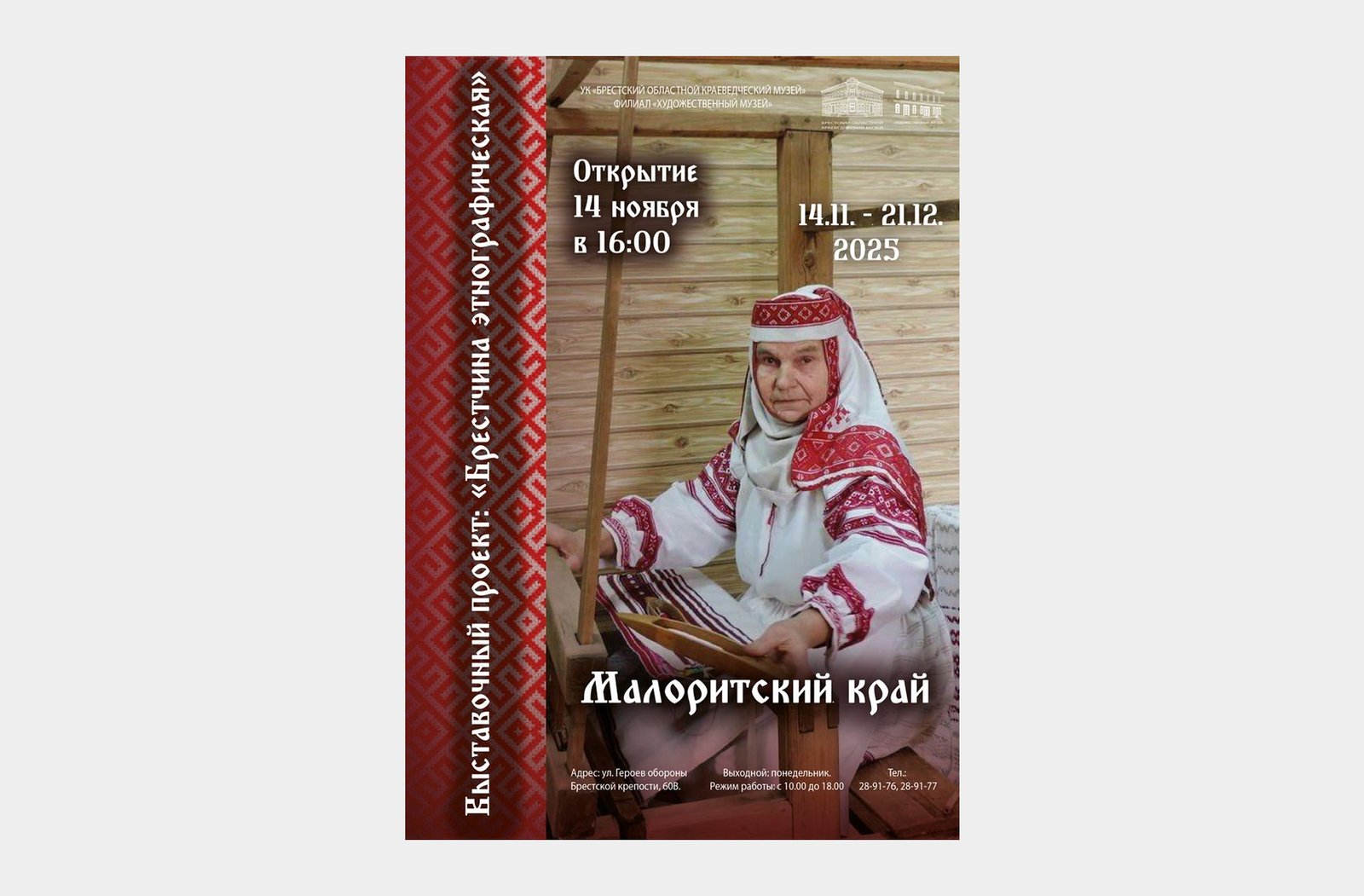
In the description of the exhibition dedicated to the Malaryta district, which is a part of the project Brest Region: An Ethnographic Perspective («Брэстчына этнаграфічная»), the buckwheat bread was highlighted as one of its key exhibits and it was also stated that its “production technology has been included in the State List of Historical and Cultural Values of Belarus as an intangible example of human creativity.” The exhibition also featured photographs, textiles, and various household objects.
Issues related to safeguarding intangible cultural heritage remain highly relevant for Belarusians in exile as well. The project Star Thread (Nitka Zorka, “Нітка Зорка”) produced by Kaciaryna Vadanosava for the television channel Belsat was awarded the Francišak Bahuševič Prize in December for the best historical work produced in 2024 “for the intellectual actualization of material heritage.” During the fourth quarter of 2025, one more episode of Nitka Zorka which directly addresses traditional culture premiered. The episode’s title is The Year Belarus Changed Forever: Belarusian Wedding Attire. Kaciaryna Vadanosava’s Perspective. The episode is focused on Kaciaryna’s and her partner’s wedding garments, which included the bride’s wreath and the weaving of belts with the usage of sprang technique.
Overall, issues concerning intangible cultural heritage continue to appear regularly in the Belarusian public sphere.
Educational Institutions celebrate anniversaries
On October 5, the Belarusian State University of Culture and Arts marked its 50th anniversary. Courses related to traditional culture are taught at the Faculty of Traditional Belarusian Culture and Contemporary Art, which consists of four departments: choreography, ritual and celebrations directing, theatrical arts, and folk decorative and applied arts. However, it is worth mentioning that in September 2021, the Department of Ethnology and Folklore was dissolved. Students who had already enrolled were allowed to complete their studies, but the department no longer exists. Within the choreography program, emphasis is placed primarily on staged folk dance, while traditional dances receive comparatively limited attention. Overall, traditional culture appears underrepresented in the institution’s curriculum.
On November 12, the Belarusian State Academy of Arts celebrated its 85th anniversary. Traditional culture occupies an even more modest place here. Students are introduced to traditional textiles and taught weaving at the Department of Decorative and Applied Arts and Costume (Attire) which is the part of the Faculty of Design and Decorative Arts.
Other Events
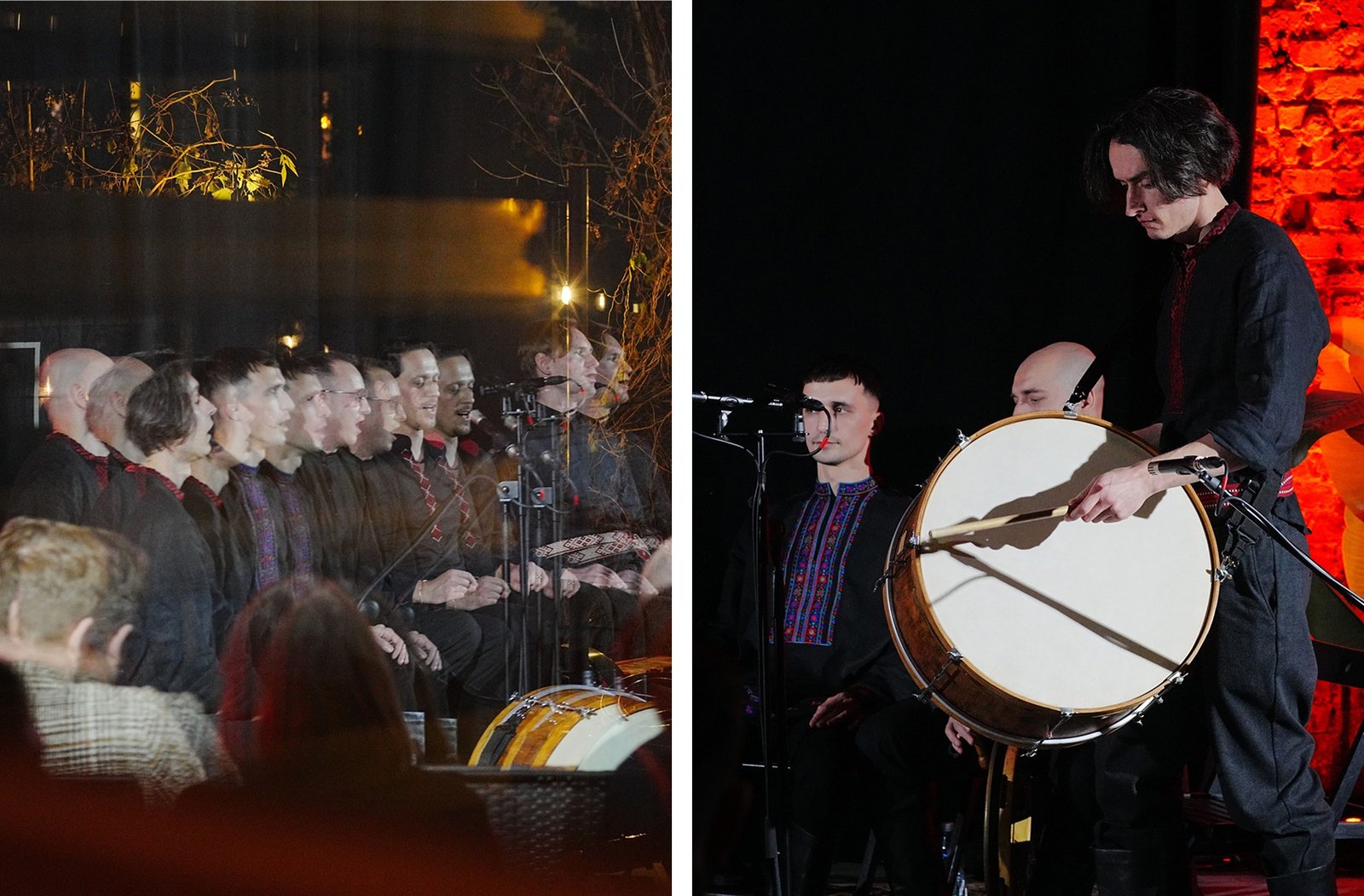
At the end of November, the Warsaw-based band Kasary released its debut full-length album titled Kasary. The album features recruitment style songs as well as lyrical ones and marks the band’s first studio album, following a period of concert performances and music video releases. The album is available on major streaming platforms and was presented at a large concert in Warsaw. On December 14, Kasary also performed during the concert Men Sing Lullabies (“Мужчыны спяваюць калыханкі”). At the concert, members of the band shared their own stories about how they put their children to sleep and performed several lullabies alongside songs from their main repertoire.
On November 24, the Belarusian hub (art-space) New Land (“Новая Зямля”) in Białystok hosted a lecture by ethnologist Stsiapan Zakharkevich which was titled Belarusians of Podlachia and the Region in Ethnographic Discourses of the 19th–21st Centuries. By following the link you can watch the recording of the lecture and learn how, for over two centuries, political and historical conditions existing in the Russian Empire, the BSSR, and the Republic of Belarus were influencing views, academic descriptions and interpretations of Podlachia and of its Belarusian residents and why during certain historical periods there was a rise (or decline) in the interest in Belarusians living in Podlachia. You can also learn valuable information on how all of this was (and is) reflected in academic publications and ethnographic papers.
On December 24, the documentary Belarusians Go to Podlachia (“Беларускі едуць на Падляшша”) directed by Artsiom Lobach premiered on the Belsat Doc. YouTube-channel. The film follows a group of Belarusian women living in Warsaw as they meet Belarusians in Podlachia who maintain a strong connection to Orthodox Christianity. The women were surprised to learn that Kupala Night is rarely celebrated in Podlachia. After returning to Warsaw, on June 22 they joined the Belarusian community in celebrating the traditional pagan holiday Kupala Night on the banks of the Vistula River. The holiday is traditionally celebrated during the summer solstice.
In October, the film received a special jury prize at the first NarewkaDoc. The film festival was dedicated to Tamara Sołoniewicz, and was recognized for its “mature craftsmanship and intriguing narrative about the tension between the women’s view of Podlachia and the “embodied experience”.” The festival took place in the village Narewka in Podlachia region. In December, the film was screened in Warsaw as part of the program Wyszeptane – tradycja, duchowość, alongside other films dedicated to Podlachia.
At the end of December, the Belarusian State Museum of Folk Architecture and Rural Life opened the exhibition From Evil Spell to Happy Return (“Ад злога чаравання да шчаслівага вяртання”) dedicated to protective magic in Belarusian traditional culture. The official opening took place on January 6, 2026. According to the museum’s website, the exhibition includes eight complexes which reflect key concerns that accompanied Belarusians throughout history such as building a home, maintaining a household, childbirth and childrearing, among others. Each complex puts together different museum artifacts, natural materials, and photographs to create a kind of “still life” – a material and artistic representation of the apotropaic magic within the traditional Belarusian culture.
New Publications
Volha Labachevskaja’s, monograph Abrok. Abidzennik: Female Ritual Practices
The monograph by Volha Labacheuskaya is the result of many years of field work conducted across Belarus. The monograph analyses how rural communities responded to life crises such as epidemics, mass outbreaks of animal diseases, wars, as well as existential crises in the life of an individual. The publication serves as a comprehensive study of the topic and demonstrates that many of the described practices remain present, although transformed, within contemporary Belarusian culture.
Anthology Ghosts and Apparitions of Traditional Culture
The eighth volume in the Mysterious Belarus series. This volume is the eighth issue in the series Mysterious Belarus. The collection extends its scope beyond Belarus and features materials related to Estonia, the Czech Republic, and Russia. The work includes around 100 unique, previously unpublished texts about ghosts and supernatural encounters.. Particular attention is given to the image of the “White Lady” (the female apparition dressed in white) as a recurring figure in folklore and cultural narratives. The volume brings together articles some of which are written in Belarusian and others in Russian language.
Reissue of Anton Hrynevich’s Children’s Songbook
The publishing house EtnaTradytsyja has reissued The Children’s Songbook compiled by Anton Hrynevich. According to the publisher, this was the first songbook for children composed out of Belarusian folk songs collected by Grynevich between 1905 and 1924 in various regions of Belarus. The songbook includes 33 carefully selected songs, refrains, lullabies, and play songs. The book includes not only children’s folklore but also introduces young readers to ritual and non-ritual lyric songs, as well as dance pieces. The book also comes with the audio version to help readers to get familiar with and learn both lyrics and the melodies.
The Pre-Order is open for the Children’s Book Zabaulianki (“Забаўлянкі”/Entertaining Book)
Publisher EtnaTradytsyja has also announced the pre-order for their children’s book Zabaulianki, which is scheduled for publication in January 2026. The publisher describes it as an interactive, colourful educational and entertainment book designed for up to four-year-old children. The content of the book is based around Belarusian folkloric rhymes and is intended to support speech development, motor skills, and attention, as well as to be of help in establishing an emotional bond between parents and children, while also transmitting elements of Belarusian tradition along the way.
Art: PRA _BEL. Beyond Foreignness
This text is an attempt to connect different fields within Belarusian art as well as to fill in gaps. This world often appears closed, fragmented, and atomized. Yet the emphasis here is not on borders or on the absence of unity, but on what arises regardless of them: a single, though heterogeneous, flow of discussions, echoes and mutual complements. Searching for tendencies in such a field is not classification or ranking. It is an attempt to see interconnectedness instead of fragments. Belarusian art then appears not as a closed system but as a continuous flow, internally linked even in its fragmentation.
Churches – for Art?
It might well be that such an attitude stems from the influence of the darkness of our dark times, somewhat of a Christmas sentiment. Let us begin the review of this quarter’s events with a territory that the art scene occupies rather rarely. Here we talk about the church as a place for contemporary art, and the religious reverberations encountered within the search for cultural codes.
One of the most interesting and large-scale works appeared right before the Advent season within the well-known venue for contemporary art, St. Peter’s Church in Cologne (Kunst-Station Sankt Peter, Cologne). For decades, this space has balanced on the edge of the transformation of a church into a museum and has remained open to the issues concerning the renewal of the forms of religious experience and the boundaries of artistic freedom. Netz (“Сетка” /”Net”) is Anna Sokolova’s fourth major project of the year in the Lineament series and was created specifically for St. Peter’s Church in Cologne. Anna Sokalova continues to explore the interplay between minimalist plasticity, video art and architectural space. Netz is a monumental light video sculpture about twenty meters long, stretching diagonally from floor to ceiling. Such a “challenge directed towards heaven” is not devoid of allusions: we enter the net, or perhaps even the bars, interpreting the structure as a symbol of light, light beam, radiation, or even a launched rocket.
Another example of the interplay between church and contemporary art can be seen inside Belarus, where a peculiar case of fresco censorship is taking place. After the departure from the country of Catholic priest Vyachaslau Barok, icons began to disappear from the walls of The Church of St. Anthony of Padua, Vitebsk region. One might assume that the church would care about preserving the contemporary meanings of the Gospel, well elaborated by Vladimir Kandrusevich. Yet where critical themes of the present (like war) break through and get addressed, the church proves unable to resist censorship and (in)voluntary impoverishment.
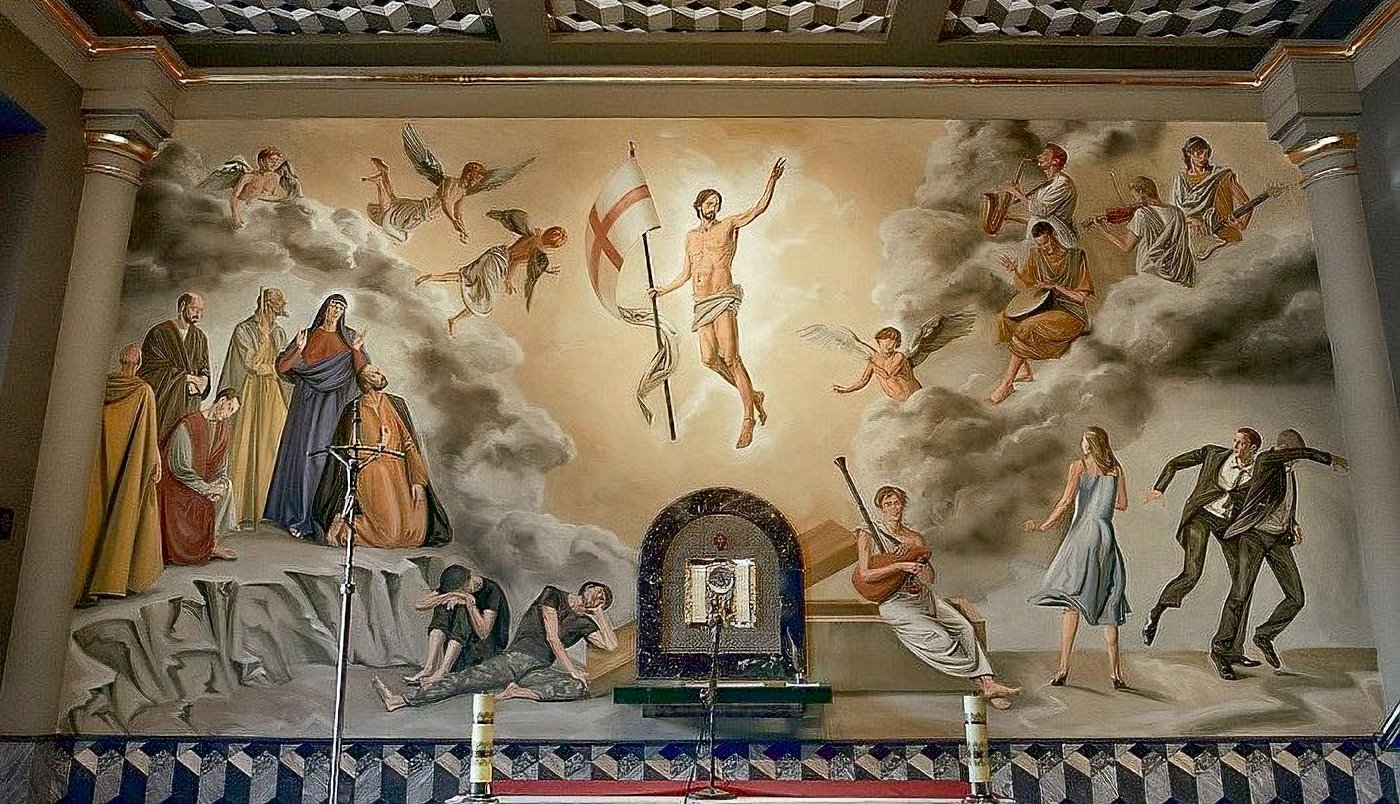
Disappeared soldiers return to the “temple of arts,” where religion uses a political ladder and ascends it in a military camouflage – even with the help of artists such as Svetlana Zhigimont. This presence, alongside an Orthodox underpinning that in fact carries a shade of the ideology of the “Russian world”, disrupts the idea of the museum as a space of cultural authority and quality
Let us “carry the candlelight” to the next church and this time to an evangelical one in Berlin, where the poetic intervention by Andrei Liankevich, Stones That Breathe – Wind That Sings – A Living Archive From Belarusian Palessie, already reveals through its title the curatorial touch of Anna Karpenka. The project constructs not only an artistic dialogue between photo projections and Baroque architecture in harmony with the music of Johann Sebastian Bach, but perhaps already something not quite ecumenical — rather the imprint of a truly Belarusian, bestial face of paganism that continues to break through Christian traditions even after a thousand years.
The black silhouette of a deceased Christian God in the embrace of Buddha finds shelter on the shelves of a Warsaw boutique. Should we regard this gesture of provocative irony in Adamau’s cultural and religious synthesis as a challenge to sacred things? Or perhaps the combination of religious symbols functions as a philosophy of absurdity, as a working model of the conditionality of cultural codes and of marketing’s game with blasphemy? Or is this still the same territory of free art, where “…thought will no longer have power over everything…” and “God has not been overthrown”?
Folk Disco-Trance and Inspiration found in Nature
Nevertheless, neopaganism inspires and permeates an entire layer of contemporary Belarusian culture, becoming almost a national feature. Today’s artists have naturally absorbed it as a polyphony – a democratic foundation of popular culture, where mysticism and spiritual experience intertwine with post-hallucinatory practices and folk disco-trance. This aesthetic trend resonates not only with the tactics of “escaping to the forest” and traditions of the “partisan movement,” but also with global green activism saturated with performative statements.
From Berlin to Beijing, Belarusian ethnography and folklore, creatively reworked, continue to attract both foreign and domestic forums. One example is the participation of Andrei Liankevich with his project Traditional Interior at Photo Beijing 2025. In this project, the inventory of Belarusian crafts gets transformed into a hymn to colour and the distinctive décor of an integrated environment that resembles an actual installation.
Even more enchanting is Whisper («Шэпт»/Shept), through which Sergey Leskets penetrates the tradition of the Belarusian village, full of rituals and mysticism.
Lesia Pcholka’s Roadside Objects at the IPMA festival (previously presented in Paris). Inspired by the book Belarusian Folk Crosses by ethnographer Mikhail Ramanyuk, it delights with its remarkable beauty and precise installation solution. Immerses us in the paradoxical atmosphere of spatial and temporal compression.
Even activists of the feminist movement cannot quite escape the draw themselves away from the “pleasure of a straw life,” of familiar songs and the warmth of fabric. In this way, a conceptual statement becomes tightly interwoven with folk tradition, transforming it into an interactive play within the museum space. This is precisely what happens in the case of Marina Naprushkina’s installation “Soil without Memory, Body without Rest” at the National Gallery Zachęta in Warsaw, presented within the exhibition “What are our collective Dreams?” co-curated by Antonina Stebur.
In a futurist aspiration to “bury the old world” through a return to the tradition of painted carpets, we are once again led to a crossroads of avant-garde practices – between the futuristic visionary imagination of Jazep Drazdovič and the primitivism of Alena Kish. These features are characteristic both of Naprushkina’s project Birds with the People from the 6th Kyiv Biennale and of the works by Maksim Osipau, which can be purchased in the Vyraj.pl shop.
The quoting of folk poetry and song by sculptor Ala Savashevich at the exhibition In the Moonlight stood her, listening to the Wind at the Centre of Polish Sculpture brings us back to the softly woven strength and hard work of contemporary women’s politics.
The aesthetics of collage, like a razor slices the picture of today and, out of fragments of history, constructs new creative forms while making use of the permitted power of language. When we can no longer manage to remain within the space of society, we are left to wander through forests and Polesia and to build Zburazhland (The Zburazh Constellation Exhibition «Zburazhland»). Then the village itself becomes a new space for artistic expression. Through it we move closer to nature, where human nature and the body still find territory for freedom – even under today’s conditions of totalitarianism. So be careful with Make Dazhynki Great Again.
Along green pART-isan trails, Belarusian art moves toward the ecological highway of a shared future. Nature remains within the logic of scientific understanding. For years George Yagunov has systematically developed bio-installations that address a wide spectrum of themes (from the prehistoric archaisms of stone sculpture to technological biotopes). At the exhibition The Age of Nature, questions about the future are raised sharply: where will space be found simultaneously for biodiversity, urban development, and green energy? Where will architecture and urbanism become a home at once for humans, animals, and plants?
Yura Shust consistently performs his “shaman rituals” on the boundary between performative ritual and technological progress, combining natural elements with artificial-intelligence systems in his installations, videos, and objects. Under the influence of AI, his motifs resemble at times a neural network, at times a fungal mycelium, which conservation seems to restrain either from spreading or from decay.
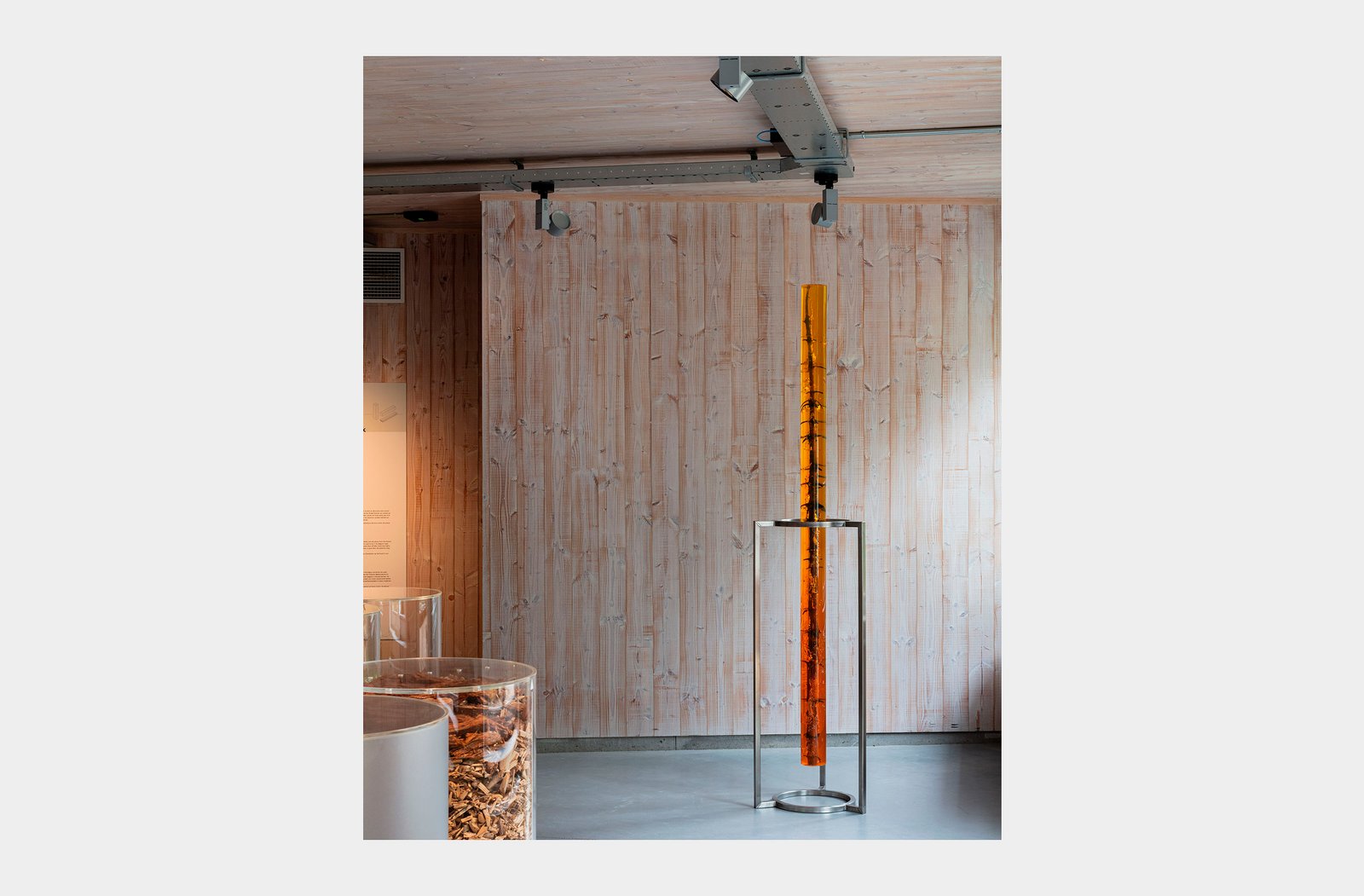
The forest is our fate. Curator Olga Mzhelskaya organized the charity exhibition Rewilding: the Breath of Creeping Shadows, in support of the Biebrza National Park in Podlasie. Together with numerous participants in the international initiative, Belarusian artists (even abroad) continue to support the movement for the restoration of wild nature and ecological balance.
Close in atmosphere and theme, a project titled Influence Effect, curated by Bazinato, took place in Tbilisi. There, creative “nomads and biocentric agents” from Belarus and Georgia used art to explore relationships between the human and the non-human: natural and urban landscapes, technologies and biocenosis, digital and indigenous systems. The project reconsidered artistic practices and conducted an experiment in creating a new biocultural whole grounded in respect for all forms of life.
Finally, news from Minsk. A study by the duo of curators Dina Danilovich and Aleksandr Bulash examines the search for an “ideal place,” a “personal utopia,” a symbolic “space of escape,” and reconciliation with an aggressive environment. The authors reflect on liminal zones and the zones between the personal and the collective, the anthropocentric and the cosmic, questioning the dominance of humans over nature.
Many Belarusian artists explore nature together with scientists, striving toward an “anthropogenic poetry”, where the human appears not only as part of nature but also as an art object. Video art can serve as a dynamic bridge in which movement and the presence of the human figure still function as visual images, which often transform into artefacts of intervention, performance, or action.
This became particularly evident during the first Festival of Belarusian Contemporary Video Art SAMASIEJ held at Bialystok University of Technology, within the exhibition I’m a Wounded Stork (“I Am Pfeilstorch” (German: “stork pierced by an arrow”) It seems that curator Uladzimir Hramovich sought to pierce the borderline of geographical and political space with the “arrow” of a new perspective, while also organizing a dialogue at the crossroads of contemporary artistic tendencies by demonstrating the capacity of Belarusian culture for self-regeneration even under conditions of prolonged crisis and war.
In her photo-, sculptural-, and installation-based performances, Arina Essipowitsch similarly moves across medial and thematic boundaries, striving for a merging with the landscape.
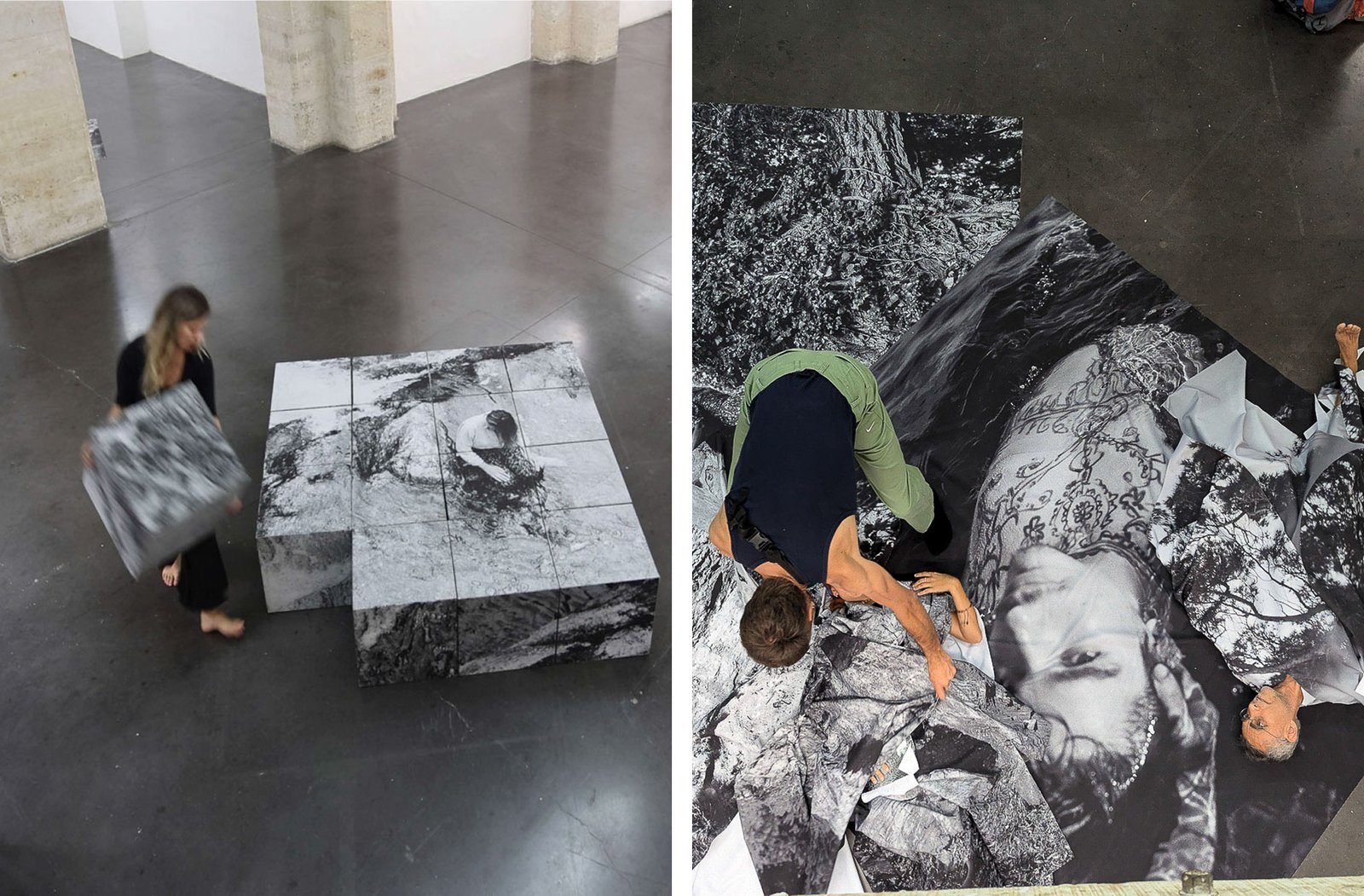
The dynamics of shape-shifting transformations, characterized by the tension between the organic and the geometric, the stable and the mobile, also concerns Horizon of Perfect Innocence, an interactive performance by Denis Romanovski. In the collision with the resistance of the material, the destructive grinding of the geometric path resounds. The social projection of “ideal innocence” not only destroys its own foundational structure but also leaves behind a trace of collective uncertainty.
At the Civa media art festival, an exhibition, a panel discussion, and a performance intertwine, creating a multisensory journey through uncertainty. The projects of Evelina Domnitch and Dmitri Gelfand are always built upon precise and complex scientific principles and methods, yet the acoustic levitation Force Field leaves a sensation of lightness, comparable to the dream of a suprematist flight.
A refusal to submit to the conventions of genre divisions can also be seen in the activities of Marika Anton Rabota. Magical Unicellular Music No. 13 is intended for plants, since “people have already forgotten how to listen to music, while in Berlin there is already enough music for animals.” The urge to cross boundaries is also evident in a recent balcony dance–music performance in Warsaw, since Anastasia Rydlevskaya long ago decided to free herself from adherence to a single artistic direction.
One inaccurate movement, and… the performance turns into a demonstration. Mikhail Gulin has returned to the street; this time his space is the Historical Park of the former The Moabit Lehrter Strasse Prison in Berlin. The sign of the Tyrannosaurus rex skull appears as a symbol of biological aging and the ultimate power of nature, that is the force from which every dictator ultimately flees.
By climbing over the fence of illusion and destroying the wall of naturalism, Alex Kuznetsov wanders through the same metropolis, transforming architecture into fragmentary photographic abstraction. The city waits, while the wall demands stickers from art tourists. One never knows where the “diver” of Mihas Mishuk will surface, or what quick-and-tasty thing Andrei Busel will soon be “buying at a high price.” Another surprise comes from Doctor Oy, who this year climbed up to Alpine meadows to cast his 80-meter smile down from the mountain to the “Earth.”
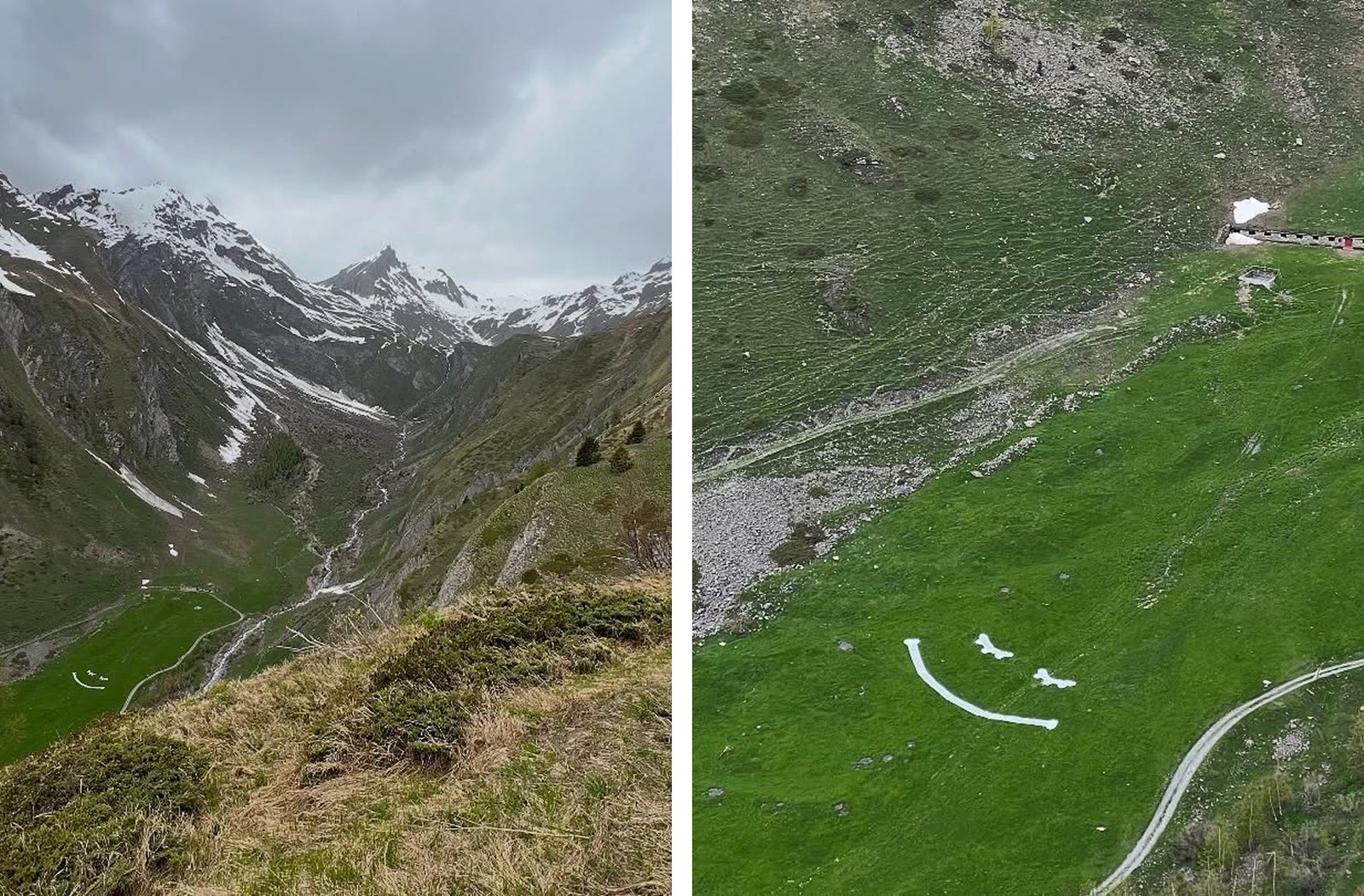
A risky movement: Semyon Motolyanets and his A Minute for Underpants. The artist is not afraid of slipping on a “soap” (his previous project).
As the grandmother of my friend used to say: “Learn to dance, and life will teach you the rest.” And life dials the number ”375 0908 2334” of Igor Shugaleev: “The body you are calling is currently unavailable.” He replies: “My name is Frau Troffea,” as if “clapping and striking.”
Movement and the body which found its place at the theatre of the “romantic realism” of ballet in the Valery Katsuba Museum, halted by the shot of a camera.
Another sharp snap of the workshop colleague’s finger: the album by Masha Sviatahor. Everybody Dance! entered the top ten of the book chart of the British Journal of Photography, and so together with Tamaka Publishing.
Books – the Bricks of the Architecture of National Consciousness
Ruins of Belarus is already the fifth publication of VEHA and one of those paradoxical books that, through historical facts of destruction, reconstruct our future.
Another wonderful colored plinfa (“Roman Brick”) comes from Ihar Yukhnevich, together with Maria Moroz and Olga from Opole, who “knows everything about how to bury properly,” reviving traditions. The book received the Mihail Anempadystau Prize for the best book cover.
Raising the Curtain. Operatic Modernism in the Soviet Republics by Oxana Gourinovitc explores architectural “opera modernism and Soviet nations” on the stage of nation-building and theatrical space. The book, published by the German publisher Spector Books, was recognized as one of the most beautiful books in Germany in 2025.
Within the walls of FSh1 took place the Belarusian Photography Platform in Warsaw, a presentation by Maryia Karneyenka. She looks beneath the foundations of our anthropocentric civilization, and her Rattus Sapiens reminds us of the animal condition of the contemporary underground.
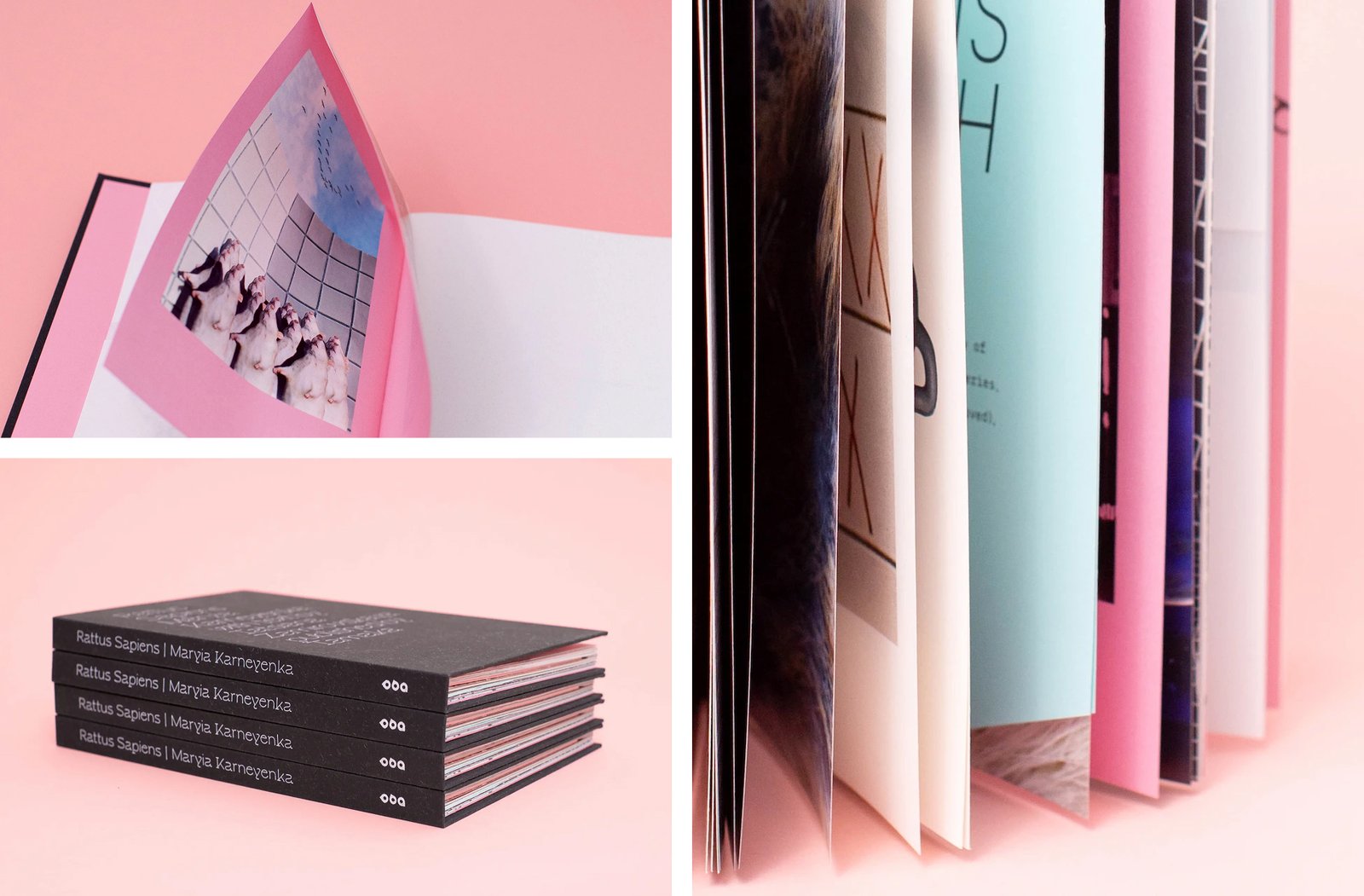
The metamorphoses of our time turn everything upside down. A poet takes up scissors and transforms into an artist. At Julija Cimafiejeva’s exhibition I Cut up History with Myself: Collage as Escape (ich zerschneide die Geschichte), one senses the need to translate the word into image, that seems more adequate to the harsh picture of today’s absurdity of destruction and fragmentation.
This also works in the opposite direction: the artist is pushed to turn to the word as a conceptual gesture. The Sacred Book is an excellent example of such “invisible connections,” unfortunately overlooked by the public. The project, realised by Konstantin Selikhanov together with the curator Olga Rybchynskaya at the Kairos Center for Contemporary Art, employs with complete precision the principle of the site-specific installation as a strategy.
Lesia Pcholka knows well that “The Future of Belarus: looking back in order to move forward,” even if this requires a Descent into the Marsh performed in an intercontinental split.
There, at the bottom of the bog, only short words can be exhaled:
- Natalia Dorosh has died
- Valentin Zankovich has died
- Aksana Shaliapina has been sentenced
- Sergei Rimashevski has been banned (in the Minsk gallery “Art-Belarus” his exhibition Cardiogram was cancelled)
they left the country…
…but they did not stop, they did not hold back. Resistance and stoicism remain defining features of Belarusian art. Here we should note projects by Rufina Bazlova, Sasha Velichko, Art Captures (Andrei Busel and Vera Shysh), Declaration of Independence (Ala Savashevich and Sergey Shabohin), and Narrative #16, Baby Angels. Beneath the Eyelids (Kseniya Grishkevich, Ala Savashevich, and Nadya Sayapina).
Solidarity Against War and the Militarization of Everyday Life
The destruction of national culture and the killing of a human being are two sides of the same war today. That is why it is so important that Belarusians support Ukraine. Even more important is that Ukraine does not erase Belarusian culture from its context and cooperation, especially in such major projects as the Kyiv Biennial.
Above we already mentioned the participation of Marina Naprushkina and her exhibitions at the National Gallery Zachęta in Warsaw. Ala Savashevich was also invited with her well-known project 1917–2017 to the second part of Homelands and Hinterlands at the M HKA Museum in Antwerp. At the same venue, eeefff presented the session of his School of Algorithmic Solidarity titled “Networks and Infrastructure”, within the framework of the project There is Nothing Solid about Solidarity, curated by Vera Zalutskaya.
The exhibition Dom Możliwy in Poznań is also of great importance for the solidarity of Ukrainian and Belarusian artists. This solidarity is cemented not only by creative collaboration but also by friendship. This was once again confirmed when the Belarusian and Ukrainian curatorial project Sense of Security was nominated for the Shevchenko National Prize.
In October, Aleksander Vasukovich received the Alexia Award at the Vilnius Photo Circle Festival for his photo series Along the Closed Roads of Ukraine, which covers eleven years of Russia’s occupation and aggression against Ukraine.
However harsh our reality may appear, we know that this war has a very female face in contemporary Belarusian art. It is largely women who prevail in the artistic field and who leave hope that not everything is so hopeless for our contemporary art.
Let us only mention here a few more no-less interesting projects: The City of Women in Warsaw (curated by Vera Zalutskaya and Michalina Sablik), The Woman Question: 1550–2025 (Dasha Brian & Art Project Revolution), the participation of the duet of photographers Julia Leidik and Evgene Kanaplev in OFF Bratislava, Silence Is the Gathering of Voices („Cisza jest głosów zbieraniem” ) (Ksenia Gryckiewicz) in Elbląg, the participation of Daria Buben in an exhibition project in New Delhi, and 0 / Katsuba ( by Tasha Katsuba and curated by Sergei Shabohin) in Białystok.
The quarter under review showed how many artists take on the role of curators. At times this seemed like an old-fashioned approach, yet the projects leave no doubt about their plasticity and conceptual quality. One can rejoice in and be proud of the truly integrative work of Belarusian curators with international institutions and within the global context.
In addition to the important awards we mentioned when we were summarizing the results of the year, attention should also be paid to other significant achievements of Belarusian artists.
The art group Dekateka (Julija Karzunova and Olga Bulavskaia), under the curatorship of Irina Kondratenko, received the Award of Excellence at the Biennale Larnaca 2025 for the project Through Nomadic Eyes: Chromatic Traces of Cyprus. The 16-metre handwoven coloured textile, created using the techniques of Belarusian folk weaving and adapted to the landscape and local architecture, aims to connect past and present, discipline and freedom, turning the process into meditation.
For its deep conceptuality and unconventional approach, the self-portrait film 0.Katsuba by Tasha Katsuba, created together with documentary filmmaker Maxim Shved, received a Special Jury Mention at the 5th International Fashion Film Festival ( Łódź Young Fashion 202). “Through clothing and movement, the artist attempts to convey her personal experience of migration, war, and rebirth.”
Uladzimir Hramovich was shortlisted for the Neue Kölner Kunst Preis 2026.
Antonina Stebur has been selected as curator of the main exhibition of one of the most influential digital and media art festivals in the world, transmediale 2027, which will take place in Berlin. Her curatorial work in recent years can serve as an exemplary model of international cooperation and collaboration with leading art institutions. In her exhibition concept she “reflects on the festival’s 40-year history through the methodology of ruins as infrastructure. Instead of celebrating achievements, she focuses primarily on collapses and analyses the militarization of everyday systems.”
Cover on the main page: photo from the project Flowing Stones by Arina Essipowitsch. Source: http://arinaessipowitsch.com/
The reviews are prepared with the support of the ArtPower Belarus programme and the European Union.